Last Night in College Basketball: UNC Upset Duke For a Tobacco Road W


Men's college basketball, women's college basketball – there's no shortage of college ball, every night.
Don't worry, we're here to help you figure out what you missed but shouldn't have. Here are all the best moments from the weekend in college basketball.
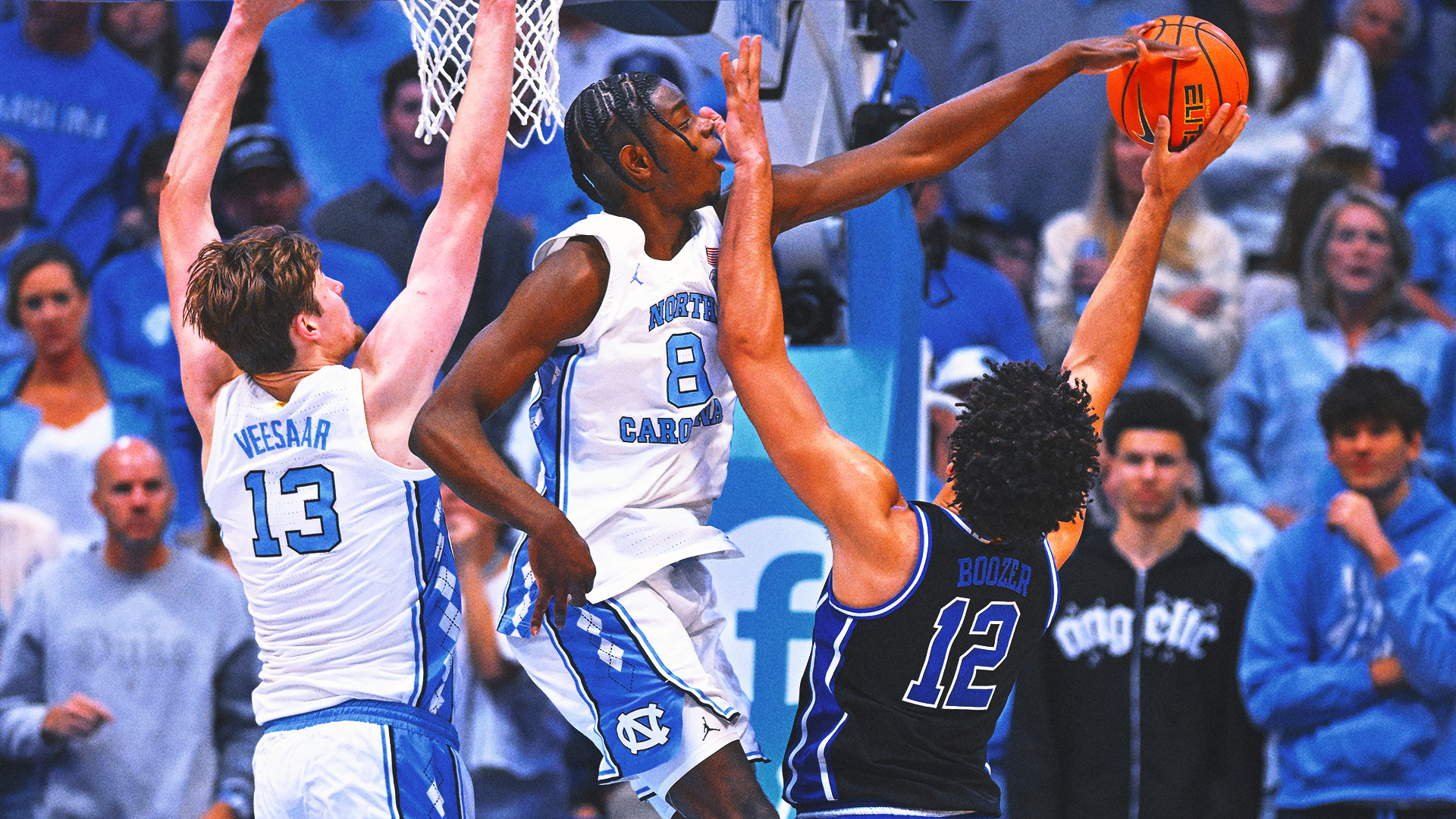
UNC shocks Duke
North Carolina isn’t bad this season by any means, but there are things that the Tar Heels don’t do well or even at all. For instance, play defense. That has led to some terrible losses for UNC, like on the west coast trip that saw it drop games to both California and Stanford thanks to a defensive strategy that mostly invited the two to do whatever unopposed. That’s what made the No. 17 Tar Heels defeating No. 4 Duke a shocker in this particular instance: the Blue Devils have been the better team — easily disposing of those same Cal and Stanford teams on their own road trip out west, for instance — but here, they fell short.
There were plenty of complaints about a lack of fouls called against UNC, especially with the Tar Heels going to the line more than twice as often, but it’s also all relative. Duke shot just 6 free throws, but UNC shot 14 — it’s not like one side had 30 attempts from the stripe and the other came nowhere close. Also, UNC’s lack of fouling has something to do with that aforementioned lack of defense. Not fouling wasn’t a masterclass of D here, so much as a result of a loose — and sometimes lax — defensive strategy. Tar Heels’ opponents have shot the 18th-fewest free throws per game in all of Division I this season, at 15.3, while Duke’s lack of free throws allowed on the season has much more to do with its defense being able to pester opponents without penalty, through the skill that has brought them to 3rd-overall in KenPom’s Defensive Rating. The Blue Devils let UNC get to the line 14 times; their season average is 13.6 per game, the third-fewest in D-I.
Now, this is not to say that the officials perfectly called everything — there are likely Duke fans reading this with very specific objections in mind, and hey, those are even justified. But neither of these teams fouls regularly, especially not on shot opportunities, and so this year’s Tobacco Road matchup had to be won in other ways. And with few fouls and free throws to go around, UNC shooting 11-for-14 from the line in a 71-68 win where it was outplayed in the paint and no one was able to take advantage of turnovers really sticks out, just as much as senior guard Seth Trimble nailing a game-winning 3-pointer with 0.4 seconds left on the clock — his lone trey attempt of the night.
Duke is going to be fine here — it’s still 3rd in the NCAA Evaluation Tool (NET), and is still likely one of the one-seeds in March Madness. Yes, the Blue Devils have lost twice — both to teams that they let get back into it and couldn’t stop before the buzzer — but they also have more Quad 1 wins than anyone else near the top, and North Carolina has its problems but it isn’t a pushover, either. A better win for UNC than it is a bad loss for Duke, basically, even if it feels terrible to drop one to your rival in one of basketball’s best annual showcases. If there is a next time this season between these two, it might not go the same way for North Carolina, considering what it took here.
UCLA outlasts Michigan
UCLA faced its toughest test of the season since having to take on Texas back during Feast Week. The Bruins have been a different team since that defeat at the hands of the Longhorns, less prone to extended lapses like the first-half one that cost them a chance for a W, and the result has been a dominant team that can, at the least, argue that it should actually be the No. 1 team in the poll over undefeated UConn, owing to an unmatched 13 Quad 1 victories this season.
While the Big Ten is tough — UCLA has had to go through ranked Ohio State, Maryland and Iowa, as well as unranked Minnesota right before that team turned a corner and became a terror as well — the Bruins had not yet faced the conference’s second-best team, Michigan. The Wolverines are ranked No. 8 in the poll and came into Sunday’s matchup 6th in NET and in Net Rating, while UCLA was the No. 2 team in all three measures. Whether Michigan is good enough to crack the top-tier of D-I women’s basketball is a question the Wolverines rarely get the opportunity to answer, but as they were now a single 3-pointer away from sending both of UConn and UCLA to overtime, it’s one worth considering.
What stopped Michigan here was one undeniable thing and another that’s maybe a little more philosophical. The undeniable thing was senior center Lauren Betts, who terrorized Michigan with her 6-foot-7 frame that no one on the Wolverines’ roster could match up with. Betts scored 16 points with 16 rebounds, and dished out 5 assists with a steal and 3 blocks, as well. And while it doesn’t show up in the stat sheet, UCLA sending her out to the arc to make sure that Michigan couldn’t get a clear 3-pointer to tie things up on its last possession was the kind of issue that the Wolverines couldn’t overcome. Sophomore guard Sila Swords got tied up in a mess of mid-screen bodies and length, and couldn’t get a clear shot — so instead, she took one that was never going to be on-target, and UCLA was able to hold on for the W despite a scare.
The Wolverines are going to have to figure out how to contain Lauren Betts, but that’s the more philosophical issue. UCLA is terrifying because it has a slate of likely future WNBA players in their senior year — Betts, Gabriela Jaquez, Kiki Rice and Gianna Kneepkens. Michigan is loaded with talented sophomores — most of the team is talented sophomores — but you can sometimes see how much of a learning and gaining experience phase that group is still in, like in its reaction to Betts playing out on the perimeter to make Swords’ life difficult at the end — no one seemed to know what to do, and the result was predictable and forced.
Michigan, when everything clicks, is as dangerous as anyone, which is why UConn and UCLA both came close to losing to it. Michigan as an ever-present threat, though, won’t happen until it can solve for relative inexperience that sometimes presents itself as sloppy basketball, and until it can figure out how to handle the versatile length that elite teams like UConn and UCLA can run out there. It’s very likely the Wolverines will get another crack at the former, at least, next month.
Michigan State beats Illinois in OT
What an up and down week for Michigan State. The Spartans lost to Michigan in their rivalry game to close out January, then followed that up with another defeat against unranked Minnesota, 76-73. With No. 5 Illinois on the schedule on Saturday, a third-consecutive loss was a very real possibility for Michigan State. Instead, the Spartans would win 85-82 in an overtime thriller.
Illinois was ahead 39-35 after the first half, but could never pull fully ahead: the largest lead the Fighting Illini managed all game was 9 points. Michigan State caught up, 47-47, with 14:11 to go in the second half, thanks to a pair of free throws by freshman forward Cam Ward, and from there it was basically a constant back-and-forth between the two.
Sophomore guard Kur Teng put Michigan State up 71-69 with just 8 seconds left in regulation with a 26-foot 3, but sophomore guard Jeremy Fears Jr. fouled Jake Davis with a single second left in the game. The junior forward would hit both of his free throws, sending the game to OT.
There, Fears more than made up for the foul, scoring 11 of Michigan State’s 14 points in the period. Fears had a game-high 26, but he also dropped 15 times to lead D-I ball over the weekend. Senior forward Jaxon Kohler had a double-double with 11 points and 16 rebounds, and Michigan State had some otherwise solid contributions, but it was Illinois’ lack of an answer for Fears that gave the Spartans the dub.
Illinois is now in second in the Big Ten, at 11-2 and behind Michigan. Michigan State, at 10-3, has a better hold on fourth and the last of the double-bye spots instead of falling behind Purdue, which would have happened with an L. The Spartans aren’t out of the woods yet, but what a W to reverse what could have been a season-wrecking stretch.
A monster game for Cawthorn
The biggest rebounding game of the year so far belongs to North Texas’ Megan Nestor, who also leads all of Division I in rebounds per game: she scored 34 points while grabbing 31 rebounds back in December. Matching that is going to be tough — there have been just three 30-point, 30-rebound games in Division I women’s basketball history, a period stretching back to 1981. Tennessee Tech freshman forward LaReesha Cawthorn got oh so close against Eastern Illinois on Saturday, though, by scoring 27 points while pulling down 27 rebounds.
She was the game’s leading scorer, and the weekend’s leading rebounder, for both men’s and women’s basketball. On top of that, Cawthorn also had 4 blocks, 2 steals and an assist. And it’s not like all those boards were thanks to the game going to overtime: just one of Cawthorn’s boards was in OT, with the other 26 in regulation. The 27 represent the fourth-most in a game in Tennessee Tech history, and the most by anyone in the program since the 1975-1976 season.
[Get to Know a Mid-Major: Ohio Valley Conference]
A big win for Tennessee Tech, as just the top eight teams in Ohio Valley make the conference tourney in March: the Golden Eagles are in 7th at 6-8, now three whole games up on the teams chasing them, a group that includes Eastern Illinois.
BYU falls short again
AJ Dybantsa had another huge game, as the freshman forward scored a game-high 28 points with 5 rebounds, 4 assists and a block. And yet, No. 16 BYU once again lost despite this, with No. 8 Houston beating it on the road, 77-66. Sophomore guard Robert Wright III added 17 points, but BYU could not muster much otherwise — the bench scored 5 points in 45 minutes, and the Cougars’ other three starters combined for 16, with the team as a whole shooting just 40% despite Dybantsa and Wright going 15-for-23.
Credit to Houston’s defense for causing trouble for BYU, but it also had a far more balanced attack: four of the Cougars starters scored between 10 and 19 points, and while senior guard Milos Uzan scored 8, he also had 3 rebounds, 5 assists and a steal. Houston leaned more a little less heavily on its starters and also got more out of its bench, too, with 10 points and 10 rebounds, and that made the difference.
BYU is now just 5-5 in Big 12 play, all the way back in 8th, while Houston sits 9-1, a game behind undefeated Arizona, which also picked up a dub on Saturday in an 84-47 takedown of Oklahoma State.
Coastal Carolina won in triple OT
It took three overtimes to get a resolution in one of the weekend’s second-round MAC-SBC Challenge games. Coastal Carolina defeated UMass, 94-91, after an extra 15 minutes of playing time that resulted in an additional 57 points between the two teams. UMass went up 32-21 after the first half, and at one point had a 14-point lead, but Coastal Carolina came storming back in the second with 43 points. With 7:38 to go in the second half, the Chanticlears were still down by 9, but tied it up 59-59 with 3 left, and nearly won outright before the Minutemen got a 3-pointer out of junior guard K’Jei Parker with 13 seconds left to tie things up again.
Coastal Carolina junior guard AJ Dancler hit a buzzer-beater 3 as time expired in the first overtime, but UMass answered with its own buzzer beater in the second overtime, out of the hands of senior guard Marcus Banks Jr., forcing a third period — if Coastal Carolina hadn’t missed one of its two free throws that preceded that shot, the game would have been over despite Banks. While the third overtime didn’t end with a buzzer beater, it was still a late 3 with little time left: senior guard Joshua Beadle sank a 3 with 2 seconds left…
…and then Banks missed a 47-foot heave as time expired, leaving the Chanticlears the winners. What a game.
A 40-point performance
The weekend’s leading scorer was Stanford freshman guard Ebuka Okorie, who dropped 40 points on Georgia Tech in a dominant 95-72 win for the Cardinal. Okorie shot 12-for-21 overall and 3-for-6 from 3, and the freshman also sank all 13 of his free-throw attempts while adding 5 rebounds, 4 assists, 4 steals and a block. Just a monster performance, and one the Yellow Jackets could not overcome.
No one else on Stanford had a big game, either, but with Okorie going off and Stanford able to win the rebounding battle and convert Georgia Tech’s 13 turnovers into 20 points, everything still worked out for the Cardinal.
Okorie is the fifth-ever freshman in ACC history to have a 40-point game, and it was his fifth game of the season of at least 30 points. He’s averaging 22.4 points per game, and the only reason he isn’t leading the conference is thanks to Duke’s Cameron Boozer, who is at 23.3. A pretty good season by both freshmen!
TCU upset by Colorado
No. 14 TCU is still struggling to put something together. After slipping from No. 8 to No. 14 in the poll in about a month’s time, TCU is now likely to fall again after losing to Colorado in Big 12 action. Despite a 31-point performance from fifth-year guard Olivia Miles that was complemented with 20 points out of senior forward Marta Suarez and 17 from junior guard Donovyn Hunter, TCU couldn’t do enough to stop the Buffaloes from being in position for a game-winning shot. It wasn’t a 3, but a 3-point play that did in TCU: senior forward Jade Masogayo hit a short bank shot to tie the game at 79-79 with 2 seconds left, and was fouled by senior center Kennedy Basham on the play to make it an and-1 opportunity. Even worse, Basham had been subbed into the game on that very play.
Masagayo sank the free throw, giving Colorado an 80-79 lead, and while TCU had one last shot — Miles let loose a 23-foot attempt as time expired — it didn’t find the basket. Buffaloes win, and TCU’s season just got a bit tougher because of it: the Horned Frogs are now 9-3 in conference play and tied for third with Texas Tech instead of moving into a tie for first with Baylor. Just the top four teams in the Big 12 get a double-bye to the quarterfinals of the conference tournament, and while TCU hasn’t fallen out of that ranking yet, it’s a lot closer than it would have been if Miles’ final shot had gone in, or if Basham had avoided the foul.
NYU sets D-III win streak
Let’s take a quick break from Division I ball to wrap the weekend’s happenings. In Division III women’s basketball, NYU is in the midst of a historic season: after winning the title in 2024 and 2025, the Violets are now aiming for a third. And will do so after breaking the record for the longest winning streak in women’s D-III basketball history. NYU won its 82nd-straight game against Carnegie Mellon, snapping a tie with Washington University of St. Louis and its 1998-2001 mark of 81 games.
NYU entered play, unsurprisingly, as the top team in the D-III coaches poll, with 18 of 25 first-place votes. The Violets are the team to beat once again, but there is a larger reason to point this accomplishment out here other than just that it’s a D-III record. A streak of 82 wins in a row is also longer than anything in Division II women’s basketball — Ashland recorded 73-straight victories between 2016 and 2018 — and longer than all but two women’s streaks in Division I: the 2008-2011 UConn Huskies, which won 90 games in a row, and the 2014-2017 edition of UConn, which broke its own record with 111-straight dubs.
NYU has five regular-season games left on the schedule — including one against rival Washington University in St. Louis, the previous record holder — and then the University Athletic Association conference tournament, plus the D-III Women’s Basketball Tournament. The Violets have opportunities to catch up to UConn’s second-place mark this season, but they will have to win a third-straight title without losing a game, and then some, to catch up to the 111-win record.




Kansas Lands Former Purdue Star Trey Kaufman-Renn On Eve of 2026-2027 Season

2027 NFL Draft QB Power Rankings: Has Trinidad Chambliss Usurped Arch Manning?

What Was Going On In Sports, Pop Culture Last Time Brewers Reached World Series?

College Basketball Rankings: Florida, Duke Highlight Men's Preseason Top 25

NCAA Sues Ohio Governor Over Order Allowing Schools To Ignore Eligibility Rule

SEC Accuses LSU Of ‘A Complete Lack Of Institutional Control’ In New Court Filing

5 Candidates Oregon Basketball Could Turn To After Dana Altman's Retirement

Top 25 college athletes with highest NIL valuations

UConn Huskies, Silas Demary Jr. Top Big East Preseason Polls





 Your Privacy Choices | Closed Captioning


