
4 Takeaways From No. 2 Michigan's Commanding Victory Against No. 24 USC


The streak is over. For the first time since Dec. 9, when Michigan pummeled Villanova by 28, the machine-like Wolverines failed to score 100 points in a game. They’d exploded for 101 against Maryland, 102 against La Salle and 112 against McNeese earlier this week — entrenching themselves as the most analytically sound team in the country — but fell two baskets shy of triple digits when facing No. 24 USC in Ann Arbor on Friday night.
Oh, the horror.
Michigan still eviscerated the Trojans, 96-66, for a wire-to-wire victory that extended its perfect record to 13-0 overall and 3-0 in the Big Ten. The Wolverines held USC scoreless for more than six minutes to begin the game and by that point, with the Trojans having already turned the ball over six times, the outcome felt somewhat inevitable. Such is the domination displayed by head coach Dusty May’s team so far this season.
[2026 Men's NCAA Tournament Projections: Vanderbilt Joins Mike DeCourcy’s No. 1 Seeds]
Here are my takeaways:
1. Michigan’s defense smothered USC from the start

(Photo by Aaron J. Thornton/Getty Images)
The first few possessions were all that anyone needed to understand why the Wolverines lead the country in defensive efficiency under May, who took FAU to the Final Four in 2023. Michigan entered the evening having only given up more than 72 points in a game once since Nov. 11 — a dominant 10-game run. The Wolverines rank first in both effective field goal percentage defense (40.7%) and two-point percentage defense (38.2%), according to KenPom, after finishing outside the top 235 in both categories the year before May arrived.
On Friday evening, May’s havoc-wreaking group forced three consecutive turnovers to begin the game, as a starting lineup featuring three players listed at 6-foot-9 and taller confounded the undersized Trojans. Towering center Aday Mara, a 7-foot-3, 255-pound transfer from UCLA, snagged three steals by the under-16 media timeout alone, clogging the passing lanes time and time again. His occupation of the paint played a significant role in USC missing its first seven shots. His endless wingspan while defending a baseline out-of-bounds play prompted the Trojans to burn an early timeout.
Nearly seven minutes elapsed before USC finally scored, with power forward Ezra Ausar muscling through contact for a traditional three-point play at the 13:19 mark. His was the first of only three field goals for the Trojans in the opening 10 minutes as Michigan stretched its lead to double digits.
2. Injury scare for Michigan star Yaxel Lendeborg

(Photo by Gregory Shamus/Getty Images)
To aid his rebuild of a program that crumbled under former coach Juwan Howard — who was fired after finishing 8-24 overall and 3-17 in the Big Ten during the 2023-24 campaign — May splashed big money in the transfer portal to land four of the top-60 overall players: Mara, former North Carolina point guard Elliot Cadeau, former Illinois power forward Morez Johnson Jr. and former UAB point-forward Yaxel Lendeborg. As a whole, the quartet ranked second in the 247Sports Team Transfer Portal Rankings behind the seven-player haul assembled by St. John’s.
No player was more coveted than Lendeborg, the No. 1 overall transfer in the country. He averaged 17.7 points, 11.4 rebounds and 4.2 assists in 37 games for the Blazers last season, ranking 12th nationally in offensive rating among players who used at least 24% of their team’s possessions. That May convinced Lendeborg to follow through on his commitment to the Wolverines despite widespread NBA interest — Lendeborg likely would have been a late first-round pick in last year’s draft — speaks in part to how compelling Michigan’s financial package proved to be. In total, the Wolverines’ roster reportedly cost more than $10 million to assemble.
Lendeborg’s influence through the first two months of the season has been nothing short of revelatory. He leads the Wolverines in scoring at 15.7 points per game and ranks second on the team in both rebounding (7.2 per game) and assists (3.6 per game) — all while playing multiple positions as a 6-foot-9, 240-pound forward with the ball skills of a guard. He is the single-most efficient player in the country, according to analytics website EvanMiya.com, with a Bayesian Performance Rating of 13.55 that would have led the country in every season but one for a database that dates back to 2009. Former Purdue center Zach Edey (14.28 in 2023-24) is the only player with a better mark.
Lendeborg played 15 minutes in the opening half against USC before exiting with what Michigan described as a bruised calf. He limped off the court late and toward the locker room late in the opening stanza, flanked by a member of the Wolverines’ medical staff. Though Lendeborg returned for the start of the second half, he continued to move gingerly and stretch his leg during stoppages. Lendeborg, who scored eight points, only played four additional minutes before sitting down for good.
3. Risky decision by USC coach Eric Musselman quickly backfires
(Photo by Gregory Shamus/Getty Images)
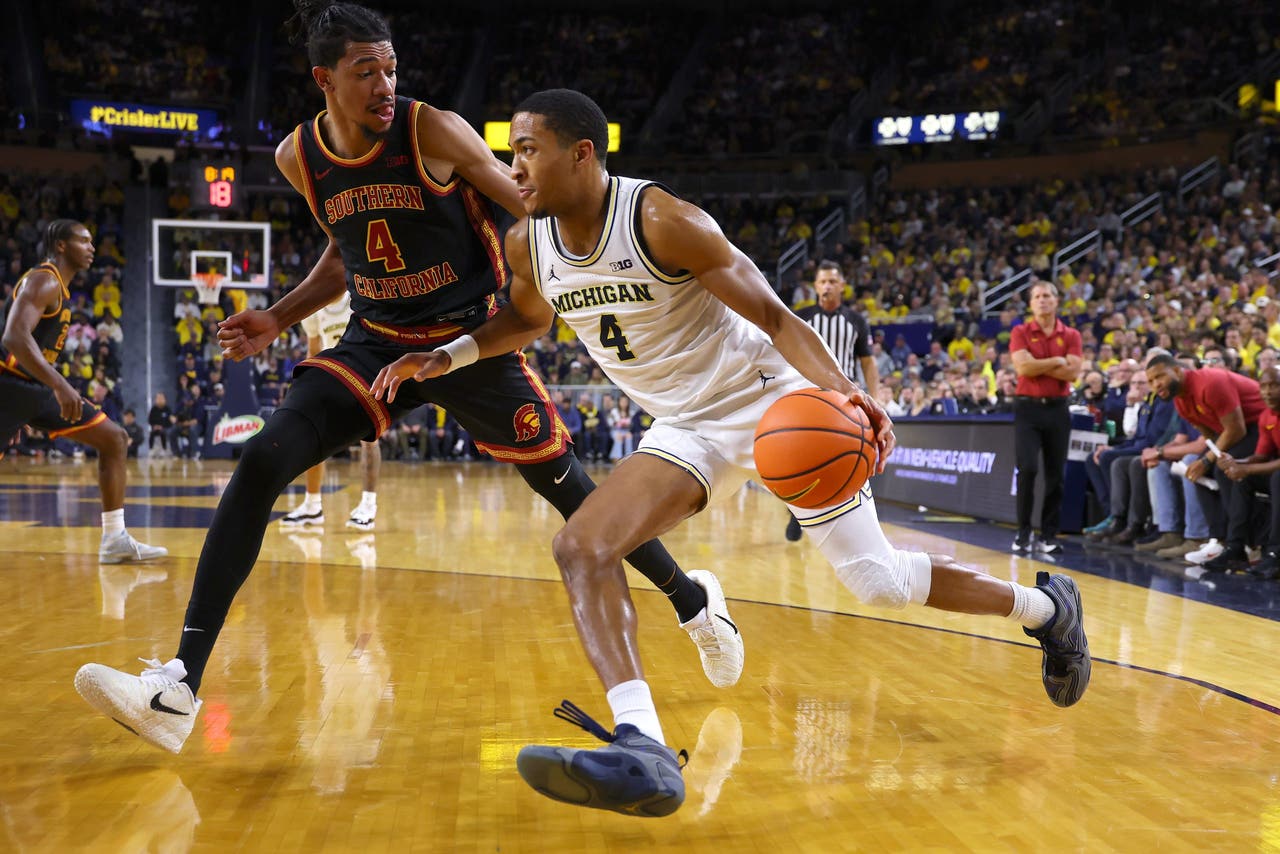
Few Big Ten teams, if any, have leaned more heavily on a single player through the opening stretch of the season than the Trojans with transfer guard Chad Baker-Mazara, formerly of Auburn, San Diego State and Duquesne. He leads the team in scoring (21 points per game), 3-point field goals (30) and free throws (83) while maintaining a usage rate of 29.2% in Big Ten games, highest in the conference.
Projected to share the starting backcourt with fellow transfer guard Rodney Rice, who averaged 13.8 points per game at Maryland last season, Baker-Mazara’s role expanded almost immediately. Rice suffered a shoulder injury during the Maui Invitational in late November and eventually underwent season-ending surgery shortly before Christmas. It has fallen on Baker-Mazara to absorb most of Rice’s workload.
Against Michigan, whose relentless defense induced 21 turnovers, that meant hoisting seven of the Trojans’ first 15 field goal attempts, including five tries from beyond the arc. He scored a team-high seven points during that stretch to keep USC from getting blown out before most of the fans had even arrived.
But the same aggressiveness that fueled Baker-Mazara’s offensive outburst also resulted in him committing three fouls by the 4:32 mark of the opening half, two of which were separated by just seven seconds of game time. Rather than keep Baker-Mazara on the bench until the second half, Musselman re-inserted his star for the Trojans’ final offensive possession, desperate for any kind of spark before the break. That decision proved catastrophic when Baker-Mazara turned the ball over and was whistled for a foul in transition — his fourth.
The fourth foul sapped from Baker-Mazara any semblance of defensive intensity in the second half, forcing him to play passively to protect from disqualification. It thrust the Trojans, who never led, into a precarious position because their best offensive player was little more than a matador on the other end of the floor. He refrained from challenging for rebounds and allowed Michigan guard Trey McKenney to glide past him for an easy transition bucket. But without him, it’s unclear which guard the Trojans could have trusted to score.
Baker-Mazara finished with 12 points.
4. No perimeter shooting, no problem for the Wolverines
(Photo by Jaime Crawford/Getty Images)
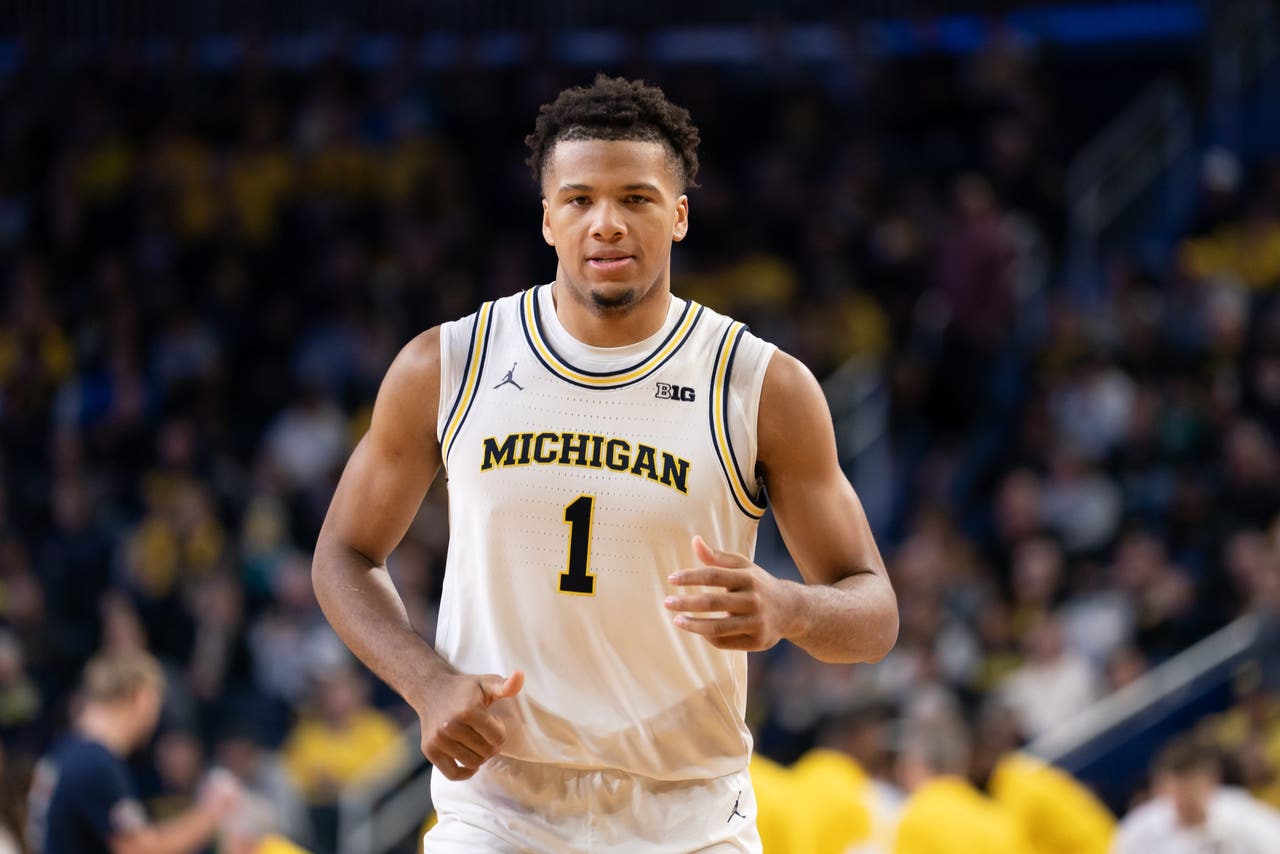
Michigan entered this game shooting 38.3% from 3-point range, a more-than-respectable rate that was good enough for 28th nationally and fourth in the Big Ten behind Purdue at 39.9%, UCLA at 39.8% and Iowa at 38.6%. It represents a noteworthy improvement from last season, when May’s team ranked 205th in the country and shot just 33.2% from beyond the arc.
The Wolverines’ newfound perimeter prowess included six players with at least 12 made 3-pointers ahead of their date with USC — all of whom were shooting at least 37.5% — and three players north of 20 made 3s in McKenney, Cadeau and Lendeborg. As a team, the Wolverines score nearly 33% of their total points from 3-point range, up more than two full percentage points over last season.
But those shots rarely fell against the Trojans on Friday night, with Michigan missing 17 of its first 19 attempts from beyond the arc. Lendeborg missed six of his first seven. Shooting guard Nimari Burnett failed to connect on his first four. McKenney missed all three of his attempts. Nobody on the Wolverines’ roster made more than one 3-pointer, with May’s team finishing 6-of-30 overall — an unsightly 20% clip.
And yet, it hardly mattered given how productive Michigan was in the paint. With Lendeborg limited by injury and Mara only playing 17 minutes, the Wolverines leaned on Johnson to terrorize the undersized Trojans with rim runs, post-ups and put-backs for which the visitors had no answer. The energetic and electric Johnson poured in a career-high 29 points on 10 of 12 shooting as Michigan finished with a plus-22 advantage for points in the paint and shot a staggering 71.4% from inside the arc. This was the second-consecutive 20-point outing for Johnson and his third in the last six games.
4 ½. What’s next?

(Photo by Gregory Shamus/Getty Images)
After another blowout victory for Michigan — its 10th in a row since notching a four-point win over TCU on Nov. 14 — the question of when someone will legitimately test the Wolverines becomes increasingly difficult to answer. An extremely friendly opening run in conference play means Michigan won’t face another ranked opponent until it hosts No. 13 Nebraska on Jan. 27. The Wolverines’ most difficult run will come in late February and early March, when they face No. 5 Purdue, No. 6 Duke, No. 20 Illinois, No. 25 Iowa and No. 9 Michigan State in a span of three weeks. They might not face much adversity between now and then.
For USC, meanwhile, a brutal three-game road haul continues next week with games against Michigan State (Monday) and Minnesota (Friday). This is the first of two trips to the Eastern Time Zone for the Trojans, who will also travel to Penn State and Ohio State in early February. They’ll be eager to reach the back half of a Big Ten schedule that keeps them on the West Coast for six straight games to end the regular season.
Michael Cohen covers college football and college basketball for FOX Sports. Follow him at @Michael_Cohen13.
Want great stories delivered right to your inbox? Create or log in to your FOX Sports account, follow leagues, teams and players to receive a personalized newsletter daily!

Top 25 college athletes with highest NIL valuations

Duke Debuting On-Court Ads In 2026 College Basketball Season

SEC Bans Athletes From Returning To College After Signing Pro Contracts

NFL Rules Players Returning To College Ineligible As Big 12 Follows Suit

Former Celtics, Jazz Player RJ Luis Jr. Cleared By Judge To Play For LSU

2026 NFL Uniforms: Bills Reveal 'Nickel City' Alternate Unis




-
Top 25 college athletes with highest NIL valuations
Duke Debuting On-Court Ads In 2026 College Basketball Season
SEC Bans Athletes From Returning To College After Signing Pro Contracts
-
NFL Rules Players Returning To College Ineligible As Big 12 Follows Suit
Former Celtics, Jazz Player RJ Luis Jr. Cleared By Judge To Play For LSU
2026 NFL Uniforms: Bills Reveal 'Nickel City' Alternate Unis





 Your Privacy Choices | Closed Captioning


