A game that won't count, but could pay off: Duke-Kansas brings high stakes to Allen Fieldhouse


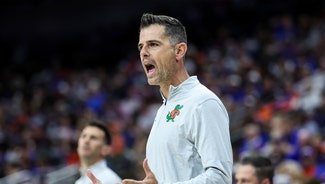
LAWRENCE, Kan. (AP) — Duke coach Jon Scheyer was still in his crib in the family home in Northbrook, Illinois, when the Blue Devils last stepped foot in Allen Fieldhouse. It was a late-February day in 1988, and they were preparing for a regular-season game against Kansas.
In a back-and-forth showdown between storied programs, Duke escaped the Phog with a 74-70 overtime victory.
The Jayhawks got the last laugh, though: They avenged the defeat six weeks later, down the road in Kansas City, Missouri, when they beat Duke in the Final Four. The team known as “Danny and the Miracles” went on to beat Oklahoma for the championship.
That explains how rare on-campus games are between two of college basketball’s true blue bloods. Preseason second-ranked Duke and No. 17 Kansas have met only 16 times, and that game 38 years ago remains the only game in Lawrence — until Sunday, when the Blue Devils edged the Jayhawks 90-84 in the latest in a wave of high-profile matchups important on the court and off it.
“This is a special thing, you know, the fact that our two programs haven’t played here,” Duke coach Jon Scheyer said. “Nothing about it felt like an exhibition game. You know, the environment, everything here was beyond special. So for us to go on the road, play, you know, a really good team — hungry team — I think we learned a lot.”
Iron sharpens iron with no nicks in the armor
The first benefit of these exhibitions is obvious: The opportunity to play a high-level game with no risk to your record.
Throughout the 1980s, ’90s and into the early 2000s, top schools played their exhibitions against elite amateur teams made up mostly of former college athletes. They had names like Marathon Oil and Athletes in Action, some sponsored by companies and others operating as a sports ministry or for another such purpose. Even the Harlem Globetrotters occasionally shelved their comedic antics for a night and sent out a highly competitive team to take on college basketball’s best.
In most cases, they offered some pretty stiff competition on the eve of the new season.
But when the NCAA passed a rule change in April 2004 saying Division I schools could no longer play non-college teams, they had to begin scheduling tune-ups against Division II and Division III schools that rarely provided the same challenge.
Eventually, Division I coaches wisened up and began playing “secret scrimmages” with no fans or media, though the results inevitably leaked. Then those games became public under the guise of charity exhibitions, and quite naturally, became the sort of exhibition game that just about every major college basketball team is playing this season.
“Our league is so good, you’re going to hit some road blocks, so you prepare for that,” explained TCU coach Jamie Dixon, whose team beat Wyoming in an exhibition game last week. “You know there’s going to be ups and downs. It’s not an easy road.”
Money matters in the current college landscape
The other benefit to high-profile exhibitions like Duke-Kansas is quite simple: money.
Isn’t that just about the only thing that matters in this era of college basketball, where players are freely transferring between schools in search of the most cash, and the NCAA Tournament has expanded to 76 teams in large part to drive more revenue?
The matchup between the Blue Devils and Jayhawks is sponsored by an insurance company — the State Farm Blue Blood Classic — and broadcast by ESPN, with Kansas due to visit Cameron Indoor Stadium next October for the first time since 1989.
Four hours before tipoff Sunday, prime courtside seats were listed for more than $6,300 on some ticket marketplaces.
“The good thing about the game is it’s not a conference game. It’s not on the season-ticket package,” Jayhawks coach Bill Self said, “so that money can be used toward things that are pretty important to programs right now.”
In other words, the name, image and likeness bank accounts required to lure top players to school these days.
In the end, pride is still on the line
Duke and Kansas rarely played when they met back in 1988, though that has changed in recent years. Both are part of the Champions Classic, rotating opponents along with Kentucky and Michigan State each season, and many more showdowns have come in the NCAA Tournament, including a national championship game in 1991 won by the Blue Devils.
Other high-profile exhibitions Sunday included Michigan vs. Houston and St. John’s vs. Texas.
While those games won’t count in official tallies, they nonetheless carry a lot of meaning for everyone involved. There’s pride on the line, especially for a team like Kansas that already had lost an exhibition game to No. 11 Louisville at Allen Fieldhouse.
In Sunday’s showdown, Patrick Ngongba had 28 points and 10 rebounds, and John Blackwell scored 23 points.
Tyran Stokes had 27 points, eight rebounds and seven assists for the Jayhawks. Fellow freshman Taylen Kinney had 14 points.
“For me, I thought we showed a lot of toughness,” Scheyer said. “You know, you’re still figuring out what you have, even in these exhibition games. ... So really proud of our group. Learned a lot, and we’re looking forward to starting the season and taking these lessons and carrying forward, carrying us forward.”
___
Sign up for Top 25 poll alerts here, visit the Top 25 here and see AP’s full men’s basketball coverage here



2027 NFL Draft QB Power Rankings: Has Trinidad Chambliss Usurped Arch Manning?

Kansas Lands Former Purdue Star Trey Kaufman-Renn On Eve of 2026-2027 Season

College Basketball Rankings: Florida, Duke Highlight Men's Preseason Top 25

What Was Going On In Sports, Pop Culture Last Time Brewers Reached World Series?

NCAA Sues Ohio Governor Over Order Allowing Schools To Ignore Eligibility Rule

Top 25 college athletes with highest NIL valuations

5 Candidates Oregon Basketball Could Turn To After Dana Altman's Retirement

SEC Accuses LSU Of ‘A Complete Lack Of Institutional Control’ In New Court Filing





 Your Privacy Choices | Closed Captioning


