The Blueprint: Inside the Shot-Selection Revolution in Men's College Basketball


This is Part 2 of a four-part story in The Blueprint franchise examining the major uptick in offensive production during the 2025-26 men's college basketball season. Read Part 1, Part 3 and Part 4.
Long before the season began, Illinois men's basketball head coach Brad Underwood and his staff devised a training tool they believed would help optimize offensive efficiency. Each and every kind of shot a player might take was funneled into a grading system derived from easily understood imagery: a podium at the Olympics.
Regardless of whether shots were made or missed, each attempt could then be deemed worthy of a gold, silver or bronze medal based on how closely it adhered to principles outlined by the coaches. For the rest of summer, Illinois players worked through pick-up games in which winners were decided by shot selection rather than a traditional score.
"Who got the most gold-medal shots? Who got the most total medals?" Underwood explained to me last month. "There were negatives for mid-range jump shots, contested shots, et cetera. There was a lot of creativity that went into that. And then just over the course of time, players start to understand.
"Early in the season, we made a lot of quick substitutions based on really poor shots. And we weren’t going to take those. We weren’t going to take the contested mid-range pull-up with 22 on the shot clock. Or we weren’t going to take a contested 3 with 16 or 18 on the shot clock. Those things have been emphasized literally since June."
Nine months later, Illinois’ offense is operating in rarified air. If the season ended today, the team's current mark of 131.7 points per 100 possessions would be the highest ever recorded in 30 years of KenPom data. Underwood has drawn widespread praise from coaches around the country for an embrace of modern analytics that is manifesting through enviable floor spacing, mathematically sound shot selection and a roster bursting with seven players who have already made at least 27 3-pointers this season.
Some of the statistics that Illinois’ approach best exemplifies are indicative of a larger philosophical shift in shot spectrum across the sport. That shift helps explain why nearly three times as many teams are averaging at least 120 points per 100 possessions during the 2025-26 campaign as in any season over the past 30 years.
(Data as of March 9, 2026)
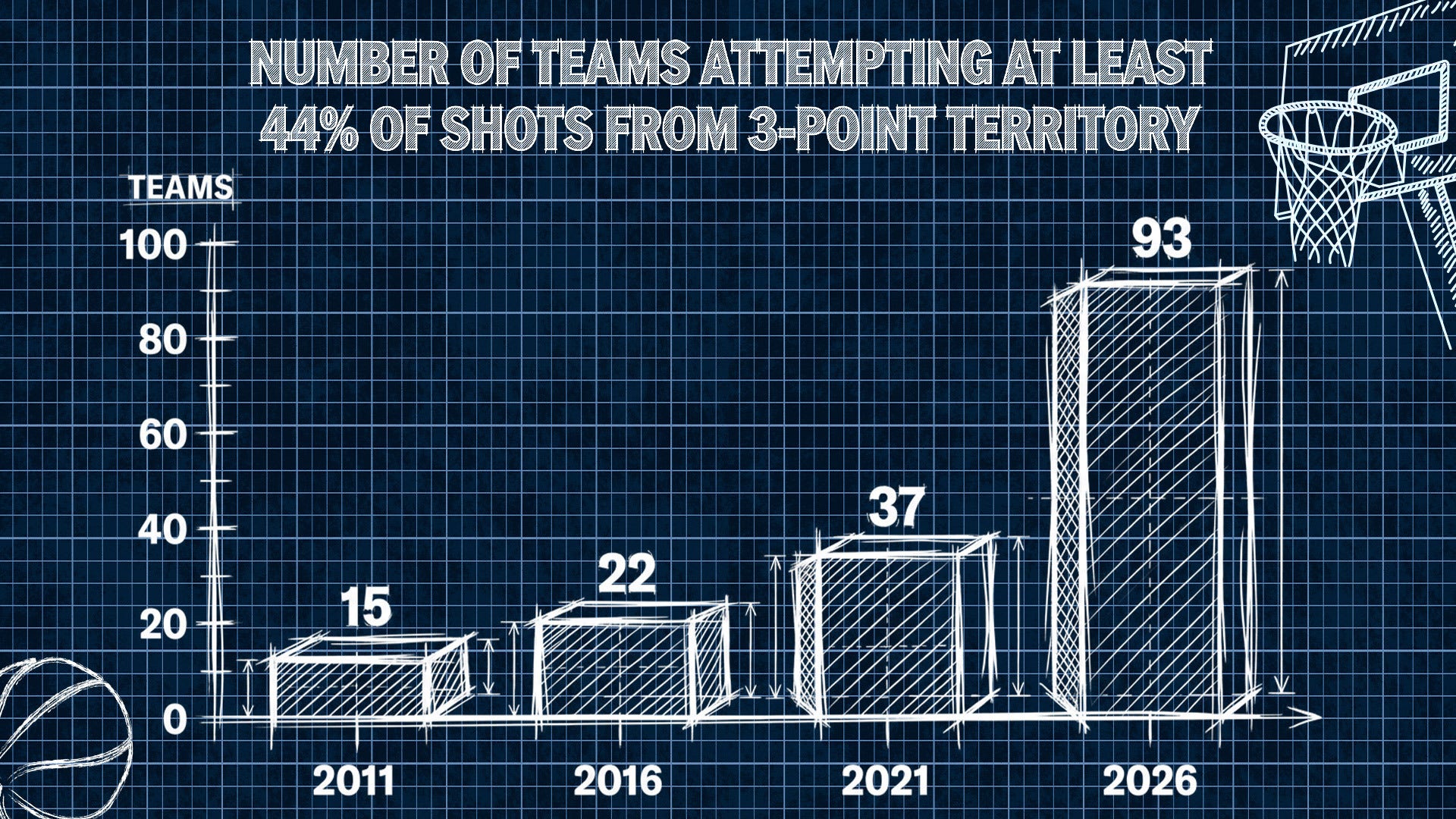
The Illini rank ninth nationally in 3-point field goal rate at 50.9%, a measurement reflecting the percentage of a team’s shots that originate beyond the arc. So far this season, 92 teams are attempting at least 44% of their field goals from 3-point territory. There were only 37 such teams five years ago, only 22 teams 10 years ago and only seven teams 15 years ago.
"If you look at the best offensive teams in college basketball," Houston head coach Kelvin Sampson told me last month, "Illinois is a good example. Illinois is a great offensive team [because] there’s nobody on the floor that can’t make a 3. That spacing that’s created from the 3-point shot also creates driving lanes. And then you’re driving to collapse the defense, and then you move [the ball] and you shoot a 3. That’s how the game has changed."
In Part 2 of our series, some of men's college basketball’s keenest minds explain how the rapid evolution of shot selection translates to such an uptick in offensive efficiency:
[THE BLUEPRINT: Offense-First Player Acquisition]
*** *** ***
Pat Kelsey, Louisville: We went to modern basketball analytics years ago, starting when I was at Winthrop. I met Nick Nurse, who is the head coach of the 76ers, who used to be with the Raptors, and before that was a successful G-League coach with the Houston Rockets organization that was one of the pioneers in modernizing basketball. They went to the extreme end of it with the James Harden era when it was just 3s and rim shots, and that’s it. He introduced me to that when I didn’t know anything about anything with modern basketball metrics.
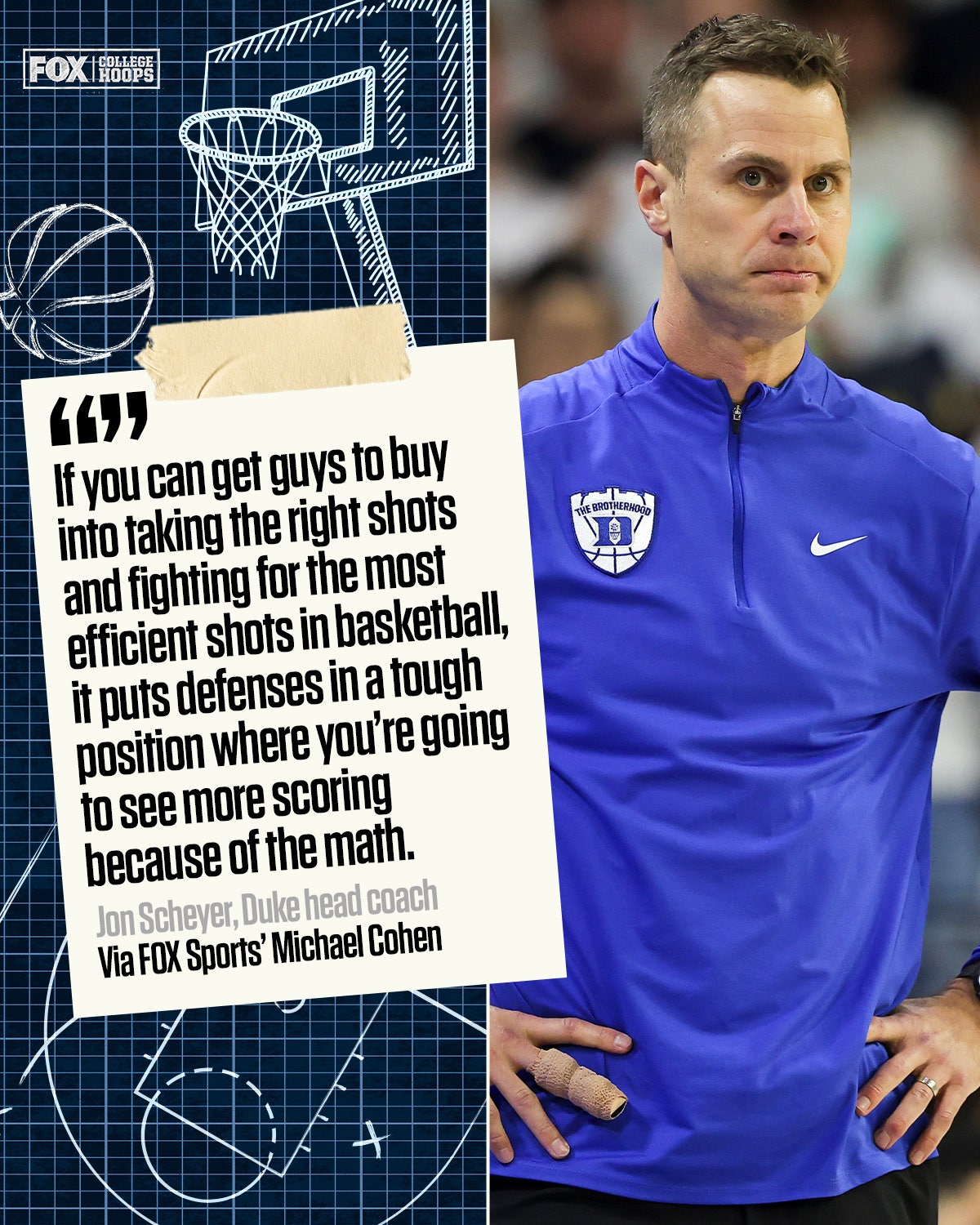
Jon Scheyer, Duke: It’s a math game, at the end of the day. Obviously, it’s something we take a lot of pride in ourselves, but shot selection has a lot to do with it. If you can get guys to buy into taking the right shots and fighting for the most efficient shots in basketball, it puts defenses in a tough position where you’re going to see more scoring because of the math.
Underwood: When everybody started playing drop coverage [on defense], everybody started getting really good at mid-range pull-ups. Chris Paul built a career on that. That was the shot. Now we’ve kind of evolved even more with the five-out spacing and the game has not become as much [about] how high you jump and how fast you run as it has become, OK, let’s find as much space as we can on the floor and do it with positional size.
Sampson: I did a seminar with the Spurs a few years ago, and as we were sitting there talking, I kept hearing [Gregg Popovich] say, "We have to make sure we’re chasing space." So I stole that term from him. With our offense, any time you get the ball in the paint and you kick it, you can’t stay [in one place]. You’ve gotta go chase space to open it up for another drive and create help so now you can pass it.
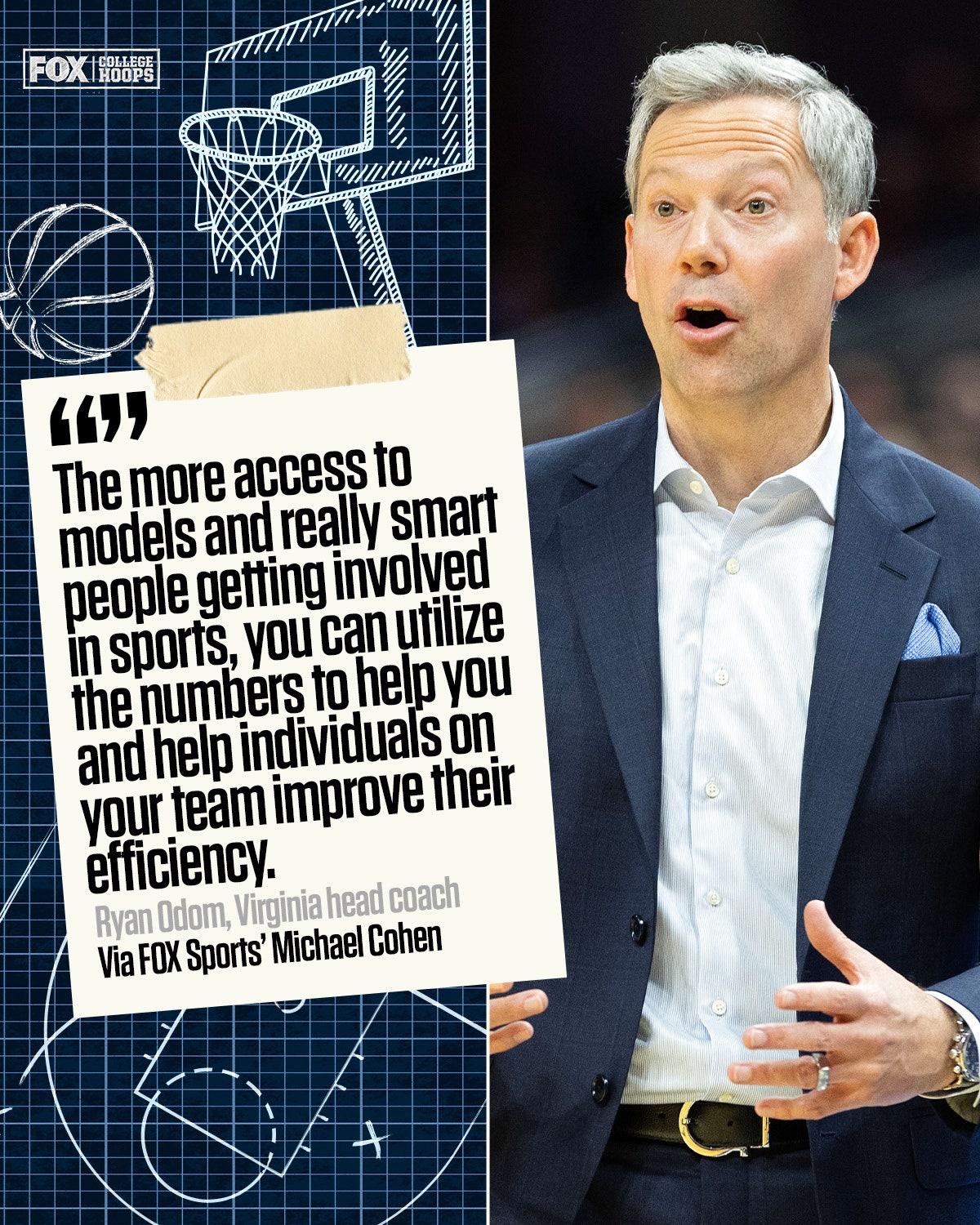
Ryan Odom, Virginia: The more access to models and really smart people getting involved in sports, you can utilize the numbers to help you and help individuals on your team improve their efficiency. A lot of it is based on what expected numbers would be. It’s to help the individual become the most efficient player they could be. But then also, most importantly, our team overall. And a lot of it is shot diet. What type of shots are you taking?
Scheyer: We teach a class, basically, in the summer. A shot selection class. And there’s two parts to it. We show shot selection, and we quiz our guys and talk to them. I think it’s a misconception with a lot of young players where they think 3s are worth more and those are the best shots. When in reality, a dunk is the best shot you can get. And then obviously free throws, and you work your way out. We just want to give them a basic understanding of that.
Then we try to just really reinforce every day in practice, so it’s very clear from the get-go the shots we’re fighting for. We talk about fighting for the rim and what that means and what that looks like. We talk about the 3s that we want to shoot, and we go through the numbers and explain it to our guys.
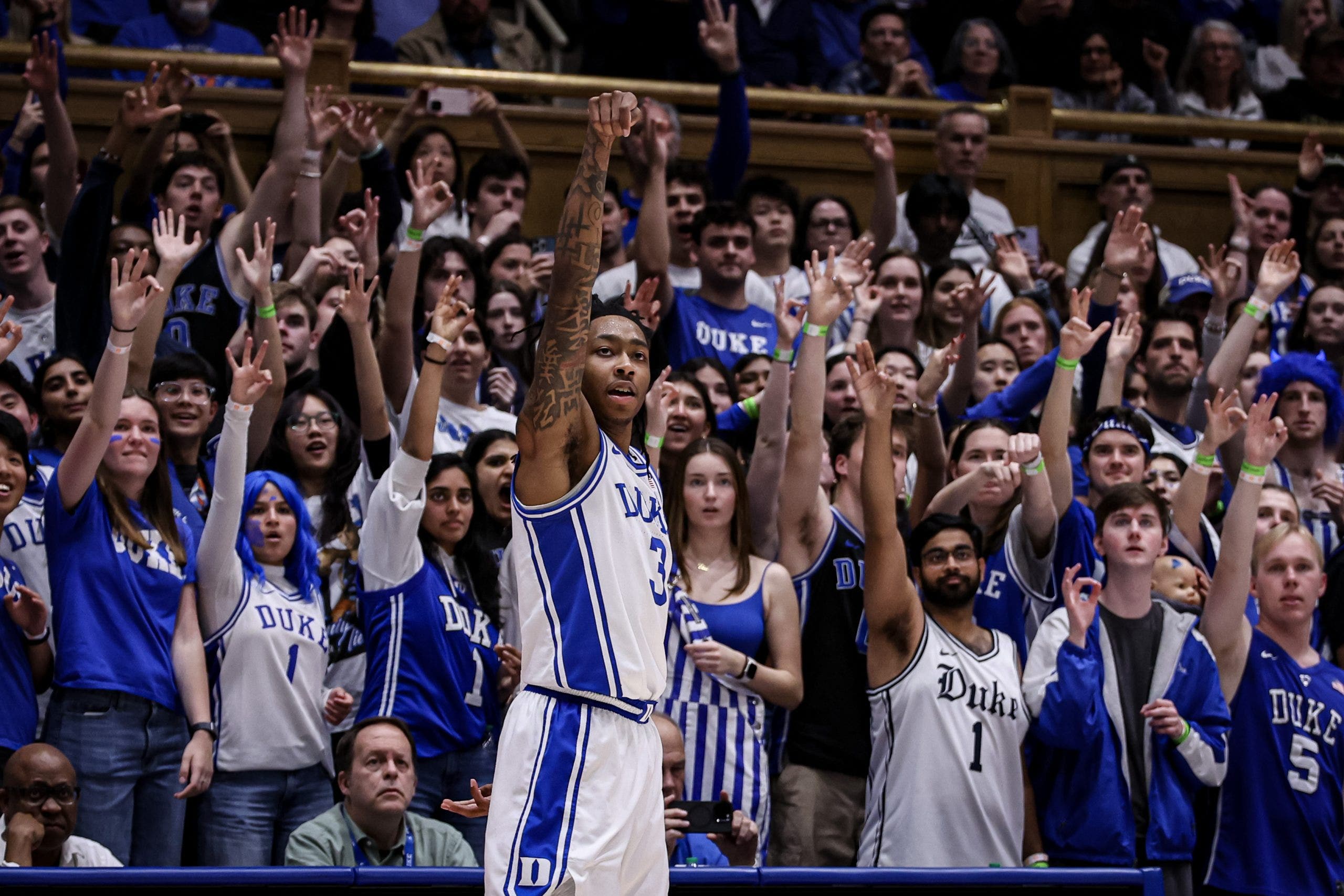
Isaiah Evans #3 of the Duke Blue Devils watches his shot go in against the Syracuse Orange. (Photo by David Jensen/Getty Images)
Sean Miller, Texas: If you go in order, free throws by a great free-throw shooter, dunks at the rim … and then one-two step open 3s taken by the right shooter. Those are the three high-value shots. The more we can take of those, the better. And you try to teach our team and the individual player what that means.
We also have one or two players on this year’s team that are really good in that area that we want to discourage shots from. And sometimes, when you have that player, you have to see that for what it is and allow him and make sure that everybody understands, for him, this is a better shot because of how efficient he is in that space. As a coach, you have to have that responsibility because you can’t put the square peg in a round hole.
Todd Golden, Florida: When we got here three and a half, four years ago, we wanted to build a program that would be consistently good, hoping to have a high floor and also try to root out any unnecessary volatility in our results. We made a conscious effort to play bigger and play a two-big system where we’re constantly trying to get really good rim 2s and catch-and-shoot 3s.
This year, we haven’t shot it great from the perimeter. So we’ve continued to find different ways to get those highly efficient 2-point field goal shots. Especially with this year’s team, I think the less 3s we take, the more consistent we’re going to be. I think other teams across the country are playing that way, like Arizona [and] Michigan are good examples of that, who have kind of traded out the 3-point volatility hoping to be more consistent with the higher floor.
Odom: We’re searching for "our shots," and there’s different parts of a possession. Early in the possession, in transition, is a great opportunity to get a clean look because the defense, a lot of times, isn’t set. Most coaches, those that play fast, are trying to do that [with] a willingness to shoot open 3s early in the clock. I think that the key is just the discernment that you have to teach your players. Which shots are the right shots for that particular individual and convincing them to stick with it and shoot those shots. And then, what’s the best shot for our team? It’s a constant exercise for us each day. We grade our guys. We call it the ‘Cav score.’ Everybody gets a Cav score after every practice.
Matt Painter, Purdue: One of the things I always bang on in recruiting is, ‘Here’s how I see you as a player if you’re one of our top three scorers.’ And then they always follow that back with a question, ‘Well, how do you see me if I’m not one of your top three scorers?’ Well, you’re gonna have to blend in with those top three scorers.
Ben McCollum, Iowa: I think shot selection for us is you want to get layups, you want to get the easiest shot in basketball. The best way to get layups is obviously to space the floor. The best way to space the floor is to shoot 3s. I think it works that way rather than shoot 3s to get layups, if that makes sense. Rather than working from the outside in, we work from the inside out.
Teaching shot selection [is about] understanding natural points per possession. All kickout 3s aren’t the same. All contested versus uncontested 3s aren’t the same. All extra-pass 3s aren’t the same. [All] transition 3s [aren’t the same]. Everything is a little bit different based off how good a shooter that guy is, how heavy the contest is, time and score — meaning where are we at in the game — and then, obviously, who can make what shots.
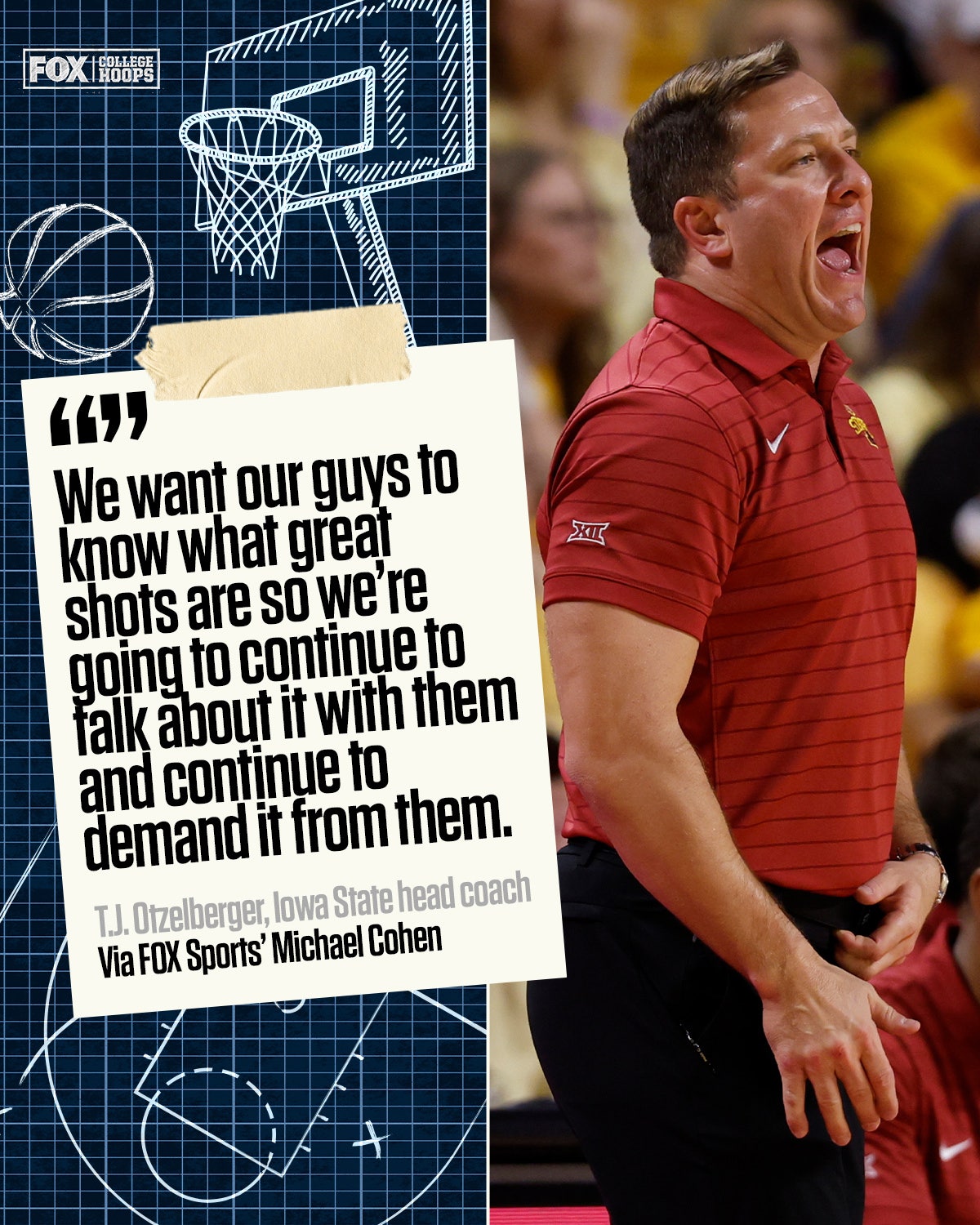
T.J. Otzelberger, Iowa State: I think more than anything, we talk about other teams, and we call a contested pull-up from mid-range a ‘surrender shot.’ We try to encourage as many surrender shots [from our opponents as possible]. Our guys yell ‘Surrender!’ in practice when somebody shoots one. I think they know to stay away from those.
We talk about paint-touch 3s, and those are the ones that we want. Consistent feedback and communication is important. We want our guys to know what great shots are, so we’re going to continue to talk about it with them and continue to demand it from them.
Sampson: Paint touches was not something that was talked about in the ‘80s or early ’90s. You just told your point guard to get to the basket. But the paint touch is what opens the game up. Everybody is trying to get in and then play inside out. Three yards and a cloud of dust was throwing the ball into the center and you lived off 2s. Now, the 2-point shot is only at the rim, and everything else is a 3.
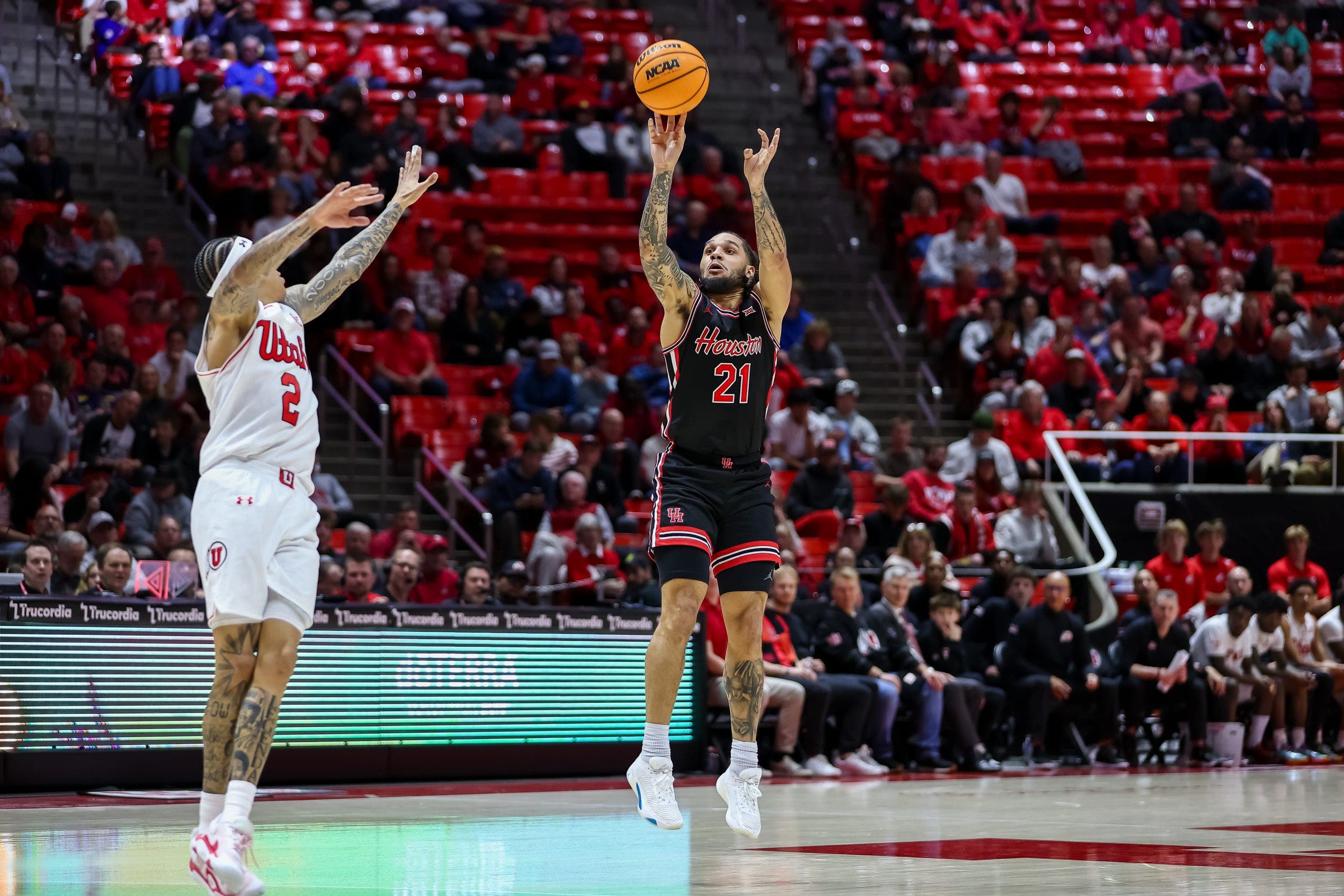
Emanuel Sharp #21 of the Houston Cougars shoots the ball during the second half of a game against Utah. (Photo by Bryan Byerly/ISI Photos/ISI Photos via Getty Images)
Miller: We’re playing teams in our league where you go, "Hey, they’re shooting 25 3s a game. That means that over 50% of their shots are 3s." Next game, "Actually, 54% of their shots [are 3s]." You’re going through these stretches where, holy s---, I’ve never seen more 3s taken.
McCollum: "We might turn down a contested layup for an elite kick-out 3. Or we might turn down a contested layup for an extra pass for an uncontested layup. So often, people just assume, "Since I’m near the rim and there’s not a ton of bodies around me, I deserve to shoot it." And in reality, you really don’t. You have to make it. Because ultimately, the more missed 2s you have, the easier it is for runouts because those rebounds aren’t very long. And now [the opponent’s shooting] percentage goes up. When their percentage goes up, and they score on you more, you’re not going to play in transition, you’re going to play against more set defenses. And then your 2-point field goal percentage goes down because you’re out of rotation. It all kind of adds together.
Kelsey: We’re always revisiting and presenting our shot spectrum to the guys. We just want to make sure that our volume is in line with what our philosophy is. And if we get out of line or out of whack, we’ll present that to the guys. … We’ve done stuff in practice where we place a higher point total [on certain quality shots]. Then, I don’t lose my mind if a guy with 16 seconds on the shot clock shoots a contested mid-range and it goes in. As they run by me, just under my breath, I just say, ‘that’s the lowest-percentage shot in the game,’ and move on.
Underwood: The last two years — and especially this year — has been much, much, much more about shot selection than maybe some of my other teams.
Come back on Wednesday for Part 3 in this series, which focuses on a shift in offensive rebounding philosophy that has wide-ranging implications for both shot selection and efficiency.
In The Blueprint, our in-depth, long-form series takes you inside some of the most amazing stories in sports.




Men's CBK AP Top 25: Florida, Duke, Illinois Receive 1st Place Preseason Votes

2027 NFL Draft QB Power Rankings: Has Trinidad Chambliss Usurped Arch Manning?

College Basketball Rankings: Florida, Duke Highlight Men's Preseason Top 25

Kansas Lands Former Purdue Star Trey Kaufman-Renn On Eve of 2026-2027 Season

NCAA Sues Ohio Governor Over Order Allowing Schools To Ignore Eligibility Rule

What Was Going On In Sports, Pop Culture Last Time Brewers Reached World Series?

SEC Accuses LSU Of ‘A Complete Lack Of Institutional Control’ In New Court Filing

Top 25 college athletes with highest NIL valuations

5 Candidates Oregon Basketball Could Turn To After Dana Altman's Retirement




 Your Privacy Choices | Closed Captioning


