4 Takeaways From Michigan's Defensive Win vs. Michigan State in Top-10 Matchup


To understand how much this one stung Michigan State head coach Tom Izzo, whose team swept the season series against in-state rival Michigan last season and had won seven in a row over the Wolverines at the Breslin Center dating to 2018, all anyone needed to see was the consternation twisted into his face in the waning moments, the game already out of reach. There stood Izzo, already the recipient of a technical foul, bellowing at the referee while flanked by assistant coach Saddi Washington, who was there to make sure the Hall of Famer didn’t push things too far.
So much about the preceding two-plus hours had irked Izzo. From his team’s horrifically slow start in the opening half to what Michigan State believed was an unfair whistle from the officials. From a furious second-half comeback that finally showcased what the Spartans look like at their best to the final five minutes in which Izzo’s crew surrendered a backbreaking 20-7 run after briefly taking the lead.
This was arguably the most anticipated regular-season matchup between the Spartans and Wolverines in decades, the highest-ranked battle this rivalry had ever seen, and for most of Friday evening, Izzo knew that Michigan was the better team. The Wolverines led for nearly 37 minutes in an eventual 83-71 win.
Here are my takeaways:
1. Matchup of old school vs. new school swings toward Michigan
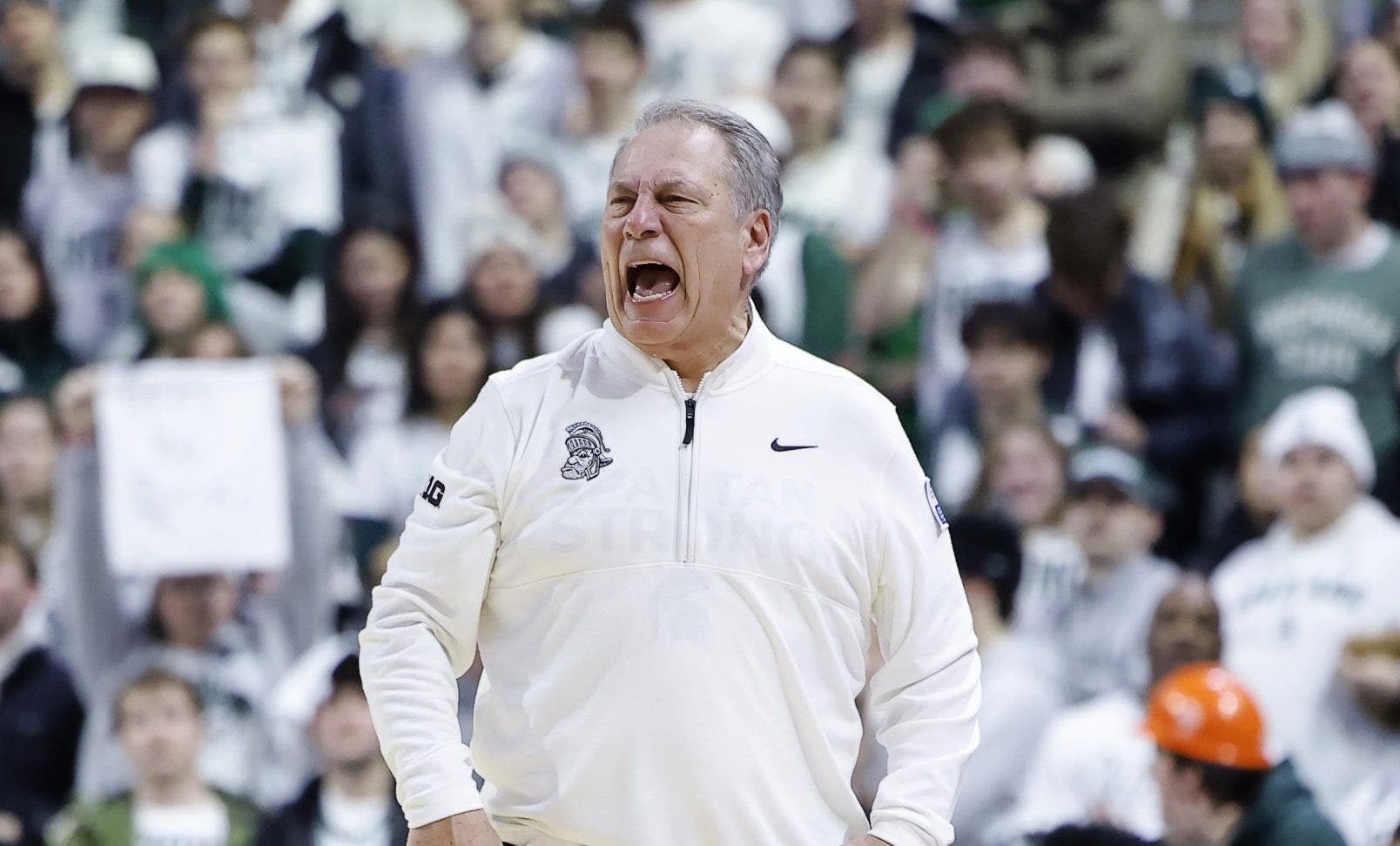
EAST LANSING, MICHIGAN: Michigan State head coach Tom Izzo during the second half against Michigan at Breslin Center on January 30, 2026. (Photo by Rey Del Rio/Getty Images)
As so many coaching icons have opted for retirement in recent years — from Mike Krzyzewski and Roy Williams to Jay Wright, Jim Boeheim and Jim Calhoun, among others — it’s left Izzo as one of the leading voices in college basketball, a long-toothed sage with more experience and more success than seemingly everyone he faces. When issues arise across the sport, like the recent hullabaloo surrounding player eligibility, Izzo’s is the voice that tends to cut through the noise like a knife.
Which is why, toward the end of Friday night’s game, it was so difficult not to envision some of the news conferences and other public forums Izzo has used to lament the transfer portal in recent years, to rail against the unfettered player movement that continues to revolutionize roster building across the sport. The Wolverines arrived at the Breslin Center with a roster infused by the second-best transfer portal haul in the country, according to 247Sports, trailing only St. John’s. More than 50 spots behind Michigan, at No. 56 overall in the transfer class rankings, sat the Spartans and their old-school coach.
Like it or not, the discrepancy in how these two rosters were constructed told the story of Friday’s game. All three of the Wolverines’ leading scorers were high-priced additions via the transfer portal, which speaks to head coach Dusty May’s modern stewardship of the program. Forward Yaxel Lendeborg from UAB scored 26 points and grabbed 12 rebounds, guard Elliot Cadeau from North Carolina scored 17 points and dished out six assists and forward Morez Johnson Jr. from Illinois chipped in 12 points and four rebounds. Even former UCLA center Aday Mara contributed eight points and four rebounds.
The Spartans, meanwhile, did not get a single point from anyone who began their collegiate career outside of East Lansing, relying almost exclusively on the program’s ability to develop young talent into mature stars. It’s a method that has served Izzo well for ages and worked again this year with point guard Jeremy Fears Jr. and power forward Jaxon Kohler. But competing for national championships is difficult when other programs are more willing to embrace the tools at everyone’s disposal.
2. Yaxel Lendeborg must be more assertive for Michigan to win it all
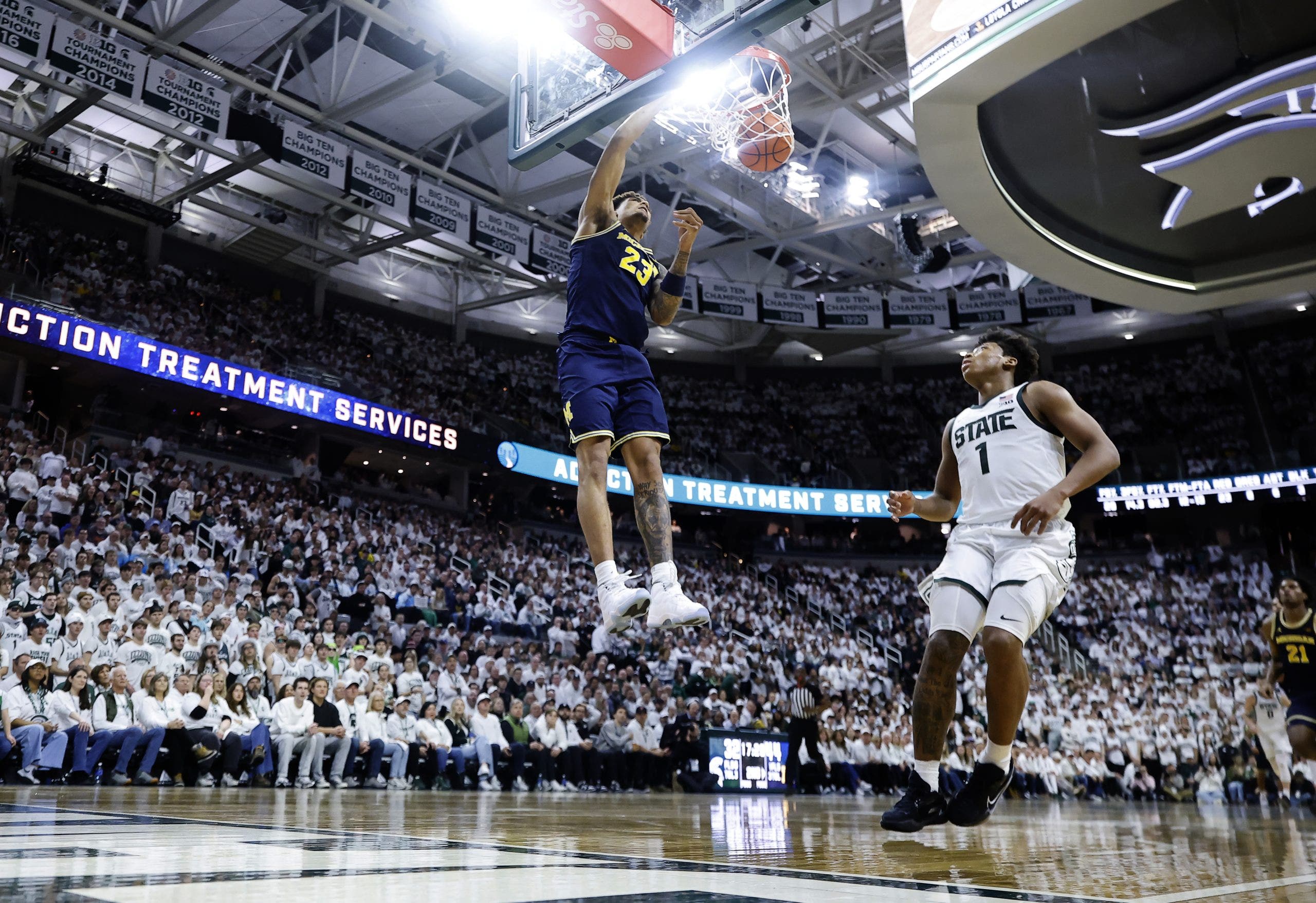
EAST LANSING, MICHIGAN: Yaxel Lendeborg dunks against Michigan State at Breslin Center on January 30, 2026. (Photo by Rey Del Rio/Getty Images)
There are so many things to like about Lendeborg, who came to Michigan as the No. 1 overall player in the transfer portal following two stellar seasons at UAB. His 6-foot-9, 240-pound frame screams prototypical NBA wing, and his measurements aren’t far off from the body type of one LeBron James. He can, even at that size, handle the ball like a guard and initiate offense when necessary. There’s nothing to question about what he offers defensively, either, routinely flashing enough versatility and quickness to guard players of all shapes and sizes.
Yet as obvious as Lendeborg’s talents clearly are — he was widely projected as a first-round pick in last year’s NBA Draft had he decided to turn pro instead of transferring to Michigan — there are rumblings about his assertiveness in critical moments. Lendeborg is so unselfish, so willing to defer to his teammates, that he’s only attempted more than 11 shots in a game twice since a non-conference win over La Salle on Dec. 21. From that day forward, his scoring average is just 11.9 points per game — respectable, certainly, but far from what most expected from a player of his caliber.
A significant chunk of the worry surrounding Lendeborg revolves around the 3-point line, where he shot 35.7% for UAB last season only to watch his percentage plummet to 30.3% so far this season. The micro view is even more concerning: Lendeborg entered Friday’s game having only made seven of his last 40 attempts (17.5%) from beyond the arc and then shot 1-for-4 against the Spartans, with his lone make coming early in the first half.
[Men's College Hoops Spotlight: Rebuilding, Villanova Eyes NCAA Tournament Berth]
Given the breadth of Lendeborg’s enviable skill set, it’s easy to envision him scoring with ease at pivotal junctures, heaping the initiative on his own shoulders. But aside from one driving layup with 2:33 remaining — a basket that extended Michigan’s lead to 71-65 — Lendeborg was largely quiet when the Wolverines were teetering. Nearly nine minutes of game time elapsed without a field goal for Lendeborg in the second half amid his team’s most pressure-packed stretch of the season. And while he helped secure the victory with six free throws when the score was out of reach, ultimately leading the team in scoring and rebounding, he needs to find more consistency as the postseason approaches.
3. Overreliance on Fears hints at Michigan State’s ceiling
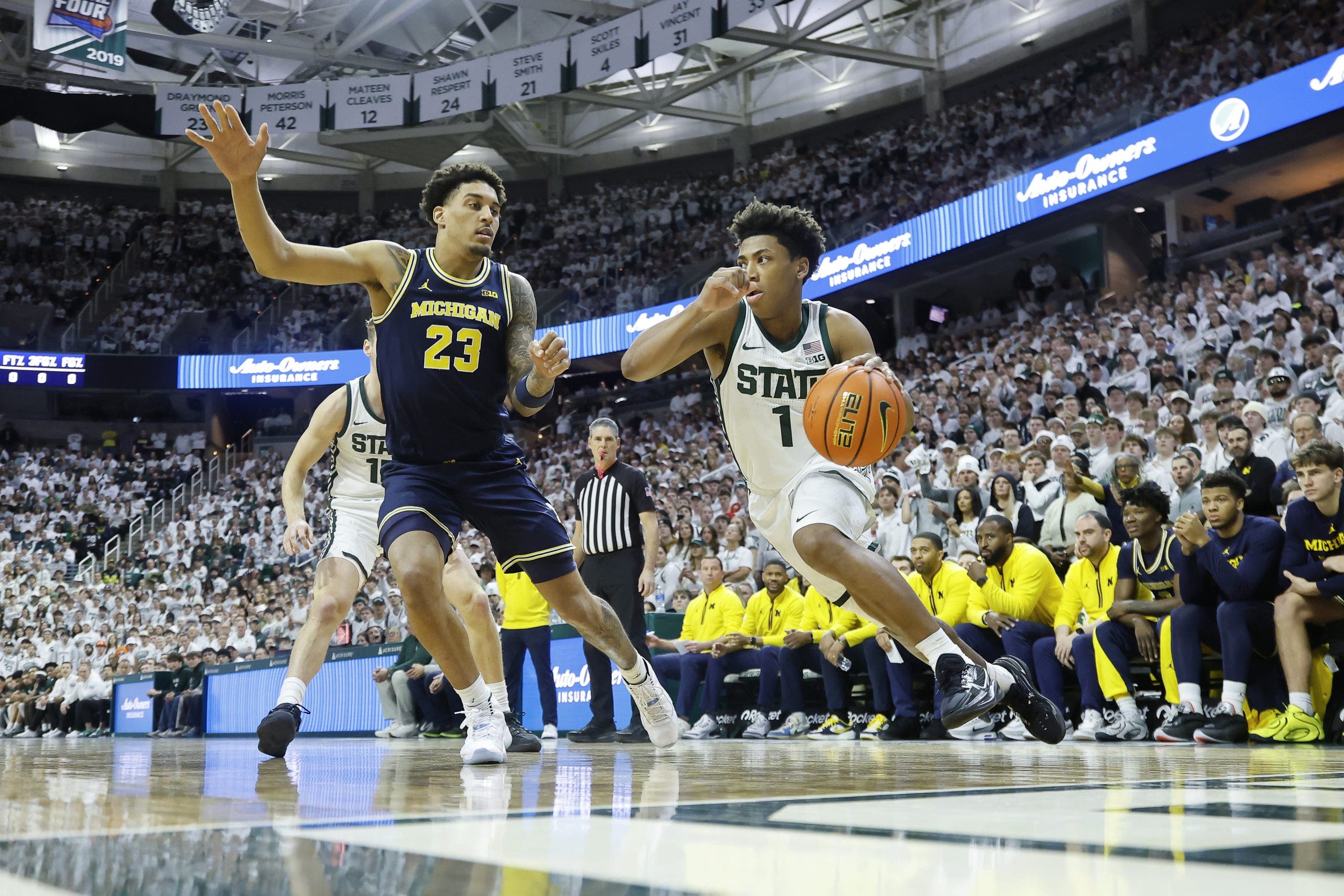
EAST LANSING, MICHIGAN: Michigan State's Jeremy Fears Jr. drives to the basket against Michigan's Yaxel Lendeborg on January 30, 2026. (Photo by Rey Del Rio/Getty Images)
Just as they have all season, Michigan State’s offensive possession began to fall into a familiar pattern during Friday’s game against the Wolverines. Second after second, dribble after dribble, action after action, the show belonged to Fears, whose stranglehold on the ball never seemed to relinquish. He probed and penetrated to create his own shots. He slalomed his way around screens from the Spartans’ front-court towers. He drew fouls at an impressive rate to manufacture trips to the free-throw line when everything else he and his teammates tried seemed to fail amid a first half marred by 27% shooting.
Close observers of the Spartans will know that nothing about this was particularly unusual; it’s the way Fears has been forced to play all season. A glaring lack of depth at both guard positions means that Fears, a redshirt sophomore, shoulders one of the heaviest workloads in the Big Ten. He leads the team in scoring at 14.1 points per game and ranks second nationally in assists with 8.9 per game, trailing only Purdue point guard Braden Smith in that category. He entered Friday’s game having assisted on 51.6% of Michigan State’s field goals this season — the highest rate in the country, according to KenPom — and ranks fifth in the Big Ten in PRPG! at 5.5, per T-Rank, which measures how many points an individual contributes to his team above what a replacement-level player would produce.
There have been plenty of nights when relying so heavily on Fears worked just fine. He poured in 29 points and dished out nine assists in a victory over Rutgers, scored 23 points and distributed 10 assists in a win over Indiana and chipped in 21 points and 11 assists in a surprisingly competitive victory over Cornell. Fears leads the KenPom race to win Big Ten Player of the Year — recently overtaking Smith in that category — for a reason.
But the manner in which Friday’s game unfolded saddled Fears as practically the only offensive option at Izzo’s disposal. It was Fears who scored 12 of the team’s 26 points in the opening half and Fears who was the only Spartan to make more than one field goal during that stretch. Had small forward Coen Carr not converted a short runner as the first-half buzzer expired, Fears would have been the lone Michigan State player with more than three points at the break. Izzo and his staff will know that such a recipe could prove problematic when trying to mount a lengthy postseason run.
4. Michigan threw the early punch in a battle of elite defenses
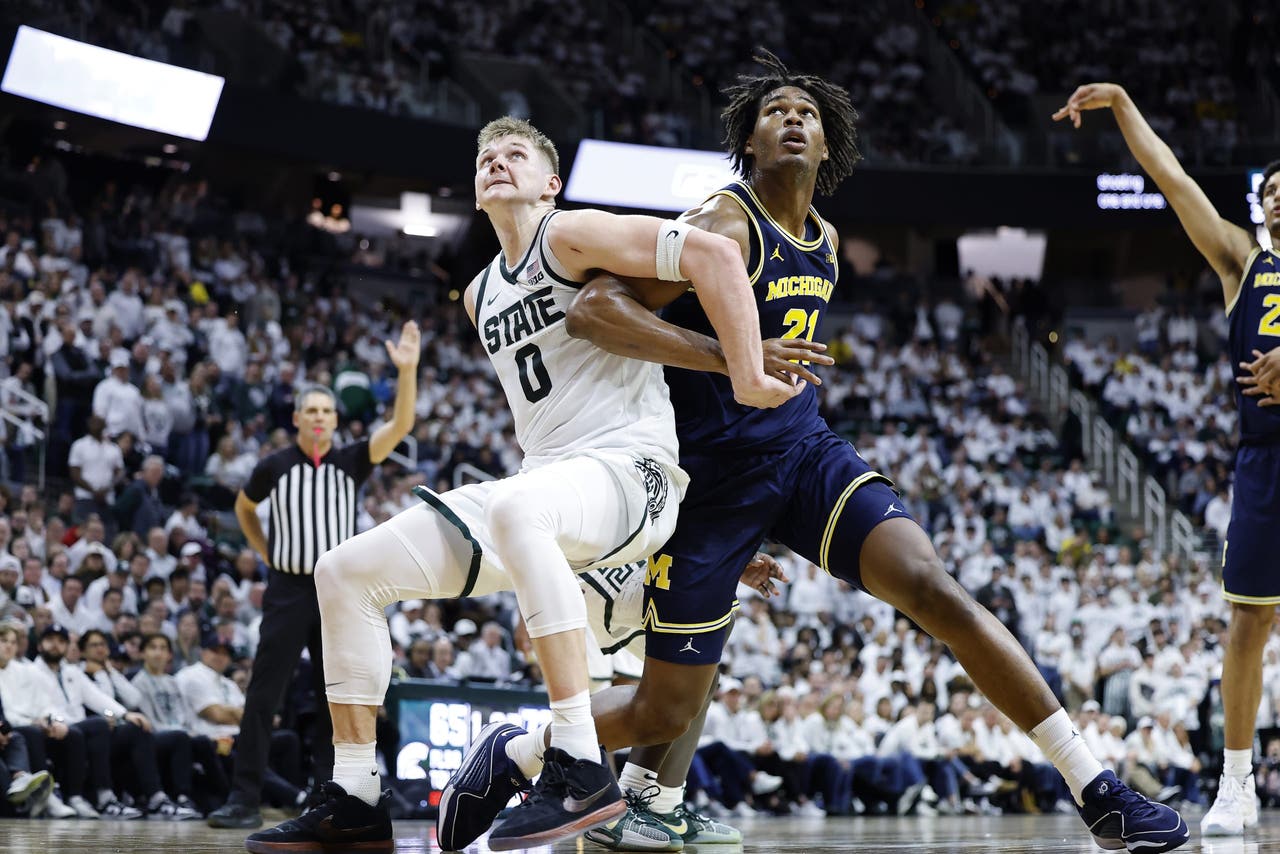
EAST LANSING, MICHIGAN: Michigan State's Jaxon Kohler boxes out Michigan's Morez Johnson Jr. on January 30, 2026. (Photo by Rey Del Rio/Getty Images)
Across so much of Michigan’s incredible 19-1 start to the season, which matches the best 20-game record in program history, equaling Final Four-bound squads from the 2012-13 and 2018-19 campaigns, the Wolverines claimed the nation’s best defense. An enormous front line featuring three players listed at 6-feet-9 or taller — including Mara, a 7-foot-3 behemoth — caused problems for seemingly every team Michigan faced. And beginning with a 67-63 road victory over TCU on Nov. 14, the Wolverines held 16 of their next 18 opponents to 72 points or fewer.
Slowly but surely, though, and in trademark Izzo fashion, the Spartans began leaning more and more heavily on their defense amid an equally impressive stretch in which they won 19 of their first 21 games. Aside from an eyebrow-raising 114-97 victory over Cornell — a game that proved to be a statistical outlier in more ways than one — Izzo’s team only surrendered more than 70 points in a game twice, with one of those instances coming in an overtime victory at Rutgers. By the time Michigan State tipped off against Michigan on Friday night, the Spartans had leapfrogged their in-state rivals to claim the stingiest defense in the country, according to KenPom.
But that’s not quite the impression most observers would have formed after absorbing a first half that included nearly 18 minutes with Michigan in the lead. Instead, it was the visiting Wolverines who imposed themselves defensively in the early going to build an advantage that swelled as large as 18 points. Tipped passes, jumped passing lanes and relentless physicality forced the Spartans to commit 11 turnovers in the opening half, a sloppy stretch that was further compounded by icy shooting, hitting three field goals in 16 attempts to begin the game and only seven in the first half overall. Izzo stewed and stormed along the Spartans’ bench as he watched an opponent out-tough and out-execute his team early — a rarity during his Hall-of-Fame tenure.
4 ½. What’s next?
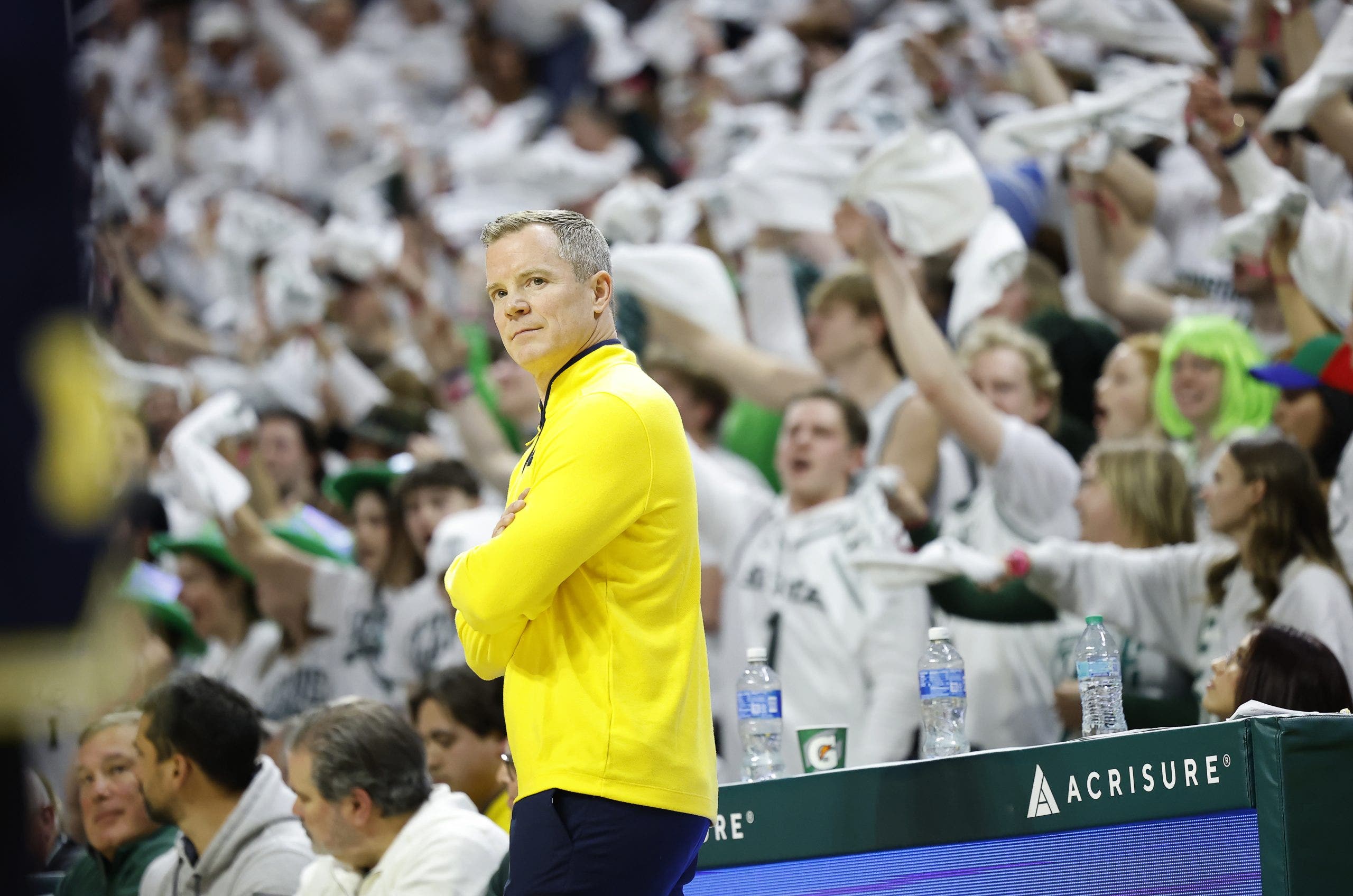
EAST LANSING, MICHIGAN: Michigan head coach Dusty May during the game against the Michigan State Spartans on January 30, 2026. (Photo by Rey Del Rio/Getty Images)
Both teams will have ample time to recover from the mental and physical challenge that was Friday’s game before returning to the court next week. The Spartans will travel to Minnesota (10-11 overall, 3-7 Big Ten) for a tricky test on Feb. 4, while the Wolverines return home to host struggling Penn State (9-12 overall, 0-10 Big Ten) on Feb. 5.
In some respects, both of those games serve as demarcation lines for two programs that were gifted extremely favorable starts to conference play. Michigan, which entered the showdown with Michigan State having played the 18th-toughest Big Ten slate, according to KenPom, is preparing to embark on a finishing stretch likely to include at least four more ranked opponents — including the mouthwatering non-conference tilt against No. 4 Duke on a neutral floor next month. And Michigan State, which has played the league’s 17th-toughest schedule, should face at least three more ranked teams in the coming weeks, with two of those games on the road.
Everything culminates in the rematch between these teams at Crisler Center on March 8, the final day of the regular season. It’s a game that might well have significant seeding implications for both the Big Ten tournament and the NCAA tournament.

King of New York: Markquis Nowell's epic show at MSG is one for the history books

2026 College Basketball Odds: Best Bet for Bama-Tenn; Duke to the Final Four?

2026-2027 College Basketball Offseason Buzz: Illinois' David Mirkovic Underwent Surgery

Colin's All-Time Can't Miss Prospects

Who are the 10 best Duke basketball players of all time?

Ranking the Top 20 Players in the Men's College Basketball Transfer Portal

Stanford Freshman and ACC Scoring Leader Ebuka Okorie Declares for NBA Draft

March Madness Meets the iPad era: How Coaches' Challenges are Changing the Game

Auburn keeps the No. 1 crown with complete win at No. 2 Alabama



-
King of New York: Markquis Nowell's epic show at MSG is one for the history books
2026 College Basketball Odds: Best Bet for Bama-Tenn; Duke to the Final Four?
2026-2027 College Basketball Offseason Buzz: Illinois' David Mirkovic Underwent Surgery
-
Colin's All-Time Can't Miss Prospects
Who are the 10 best Duke basketball players of all time?
Ranking the Top 20 Players in the Men's College Basketball Transfer Portal
-
Stanford Freshman and ACC Scoring Leader Ebuka Okorie Declares for NBA Draft
March Madness Meets the iPad era: How Coaches' Challenges are Changing the Game
Auburn keeps the No. 1 crown with complete win at No. 2 Alabama




 Your Privacy Choices | Closed Captioning


