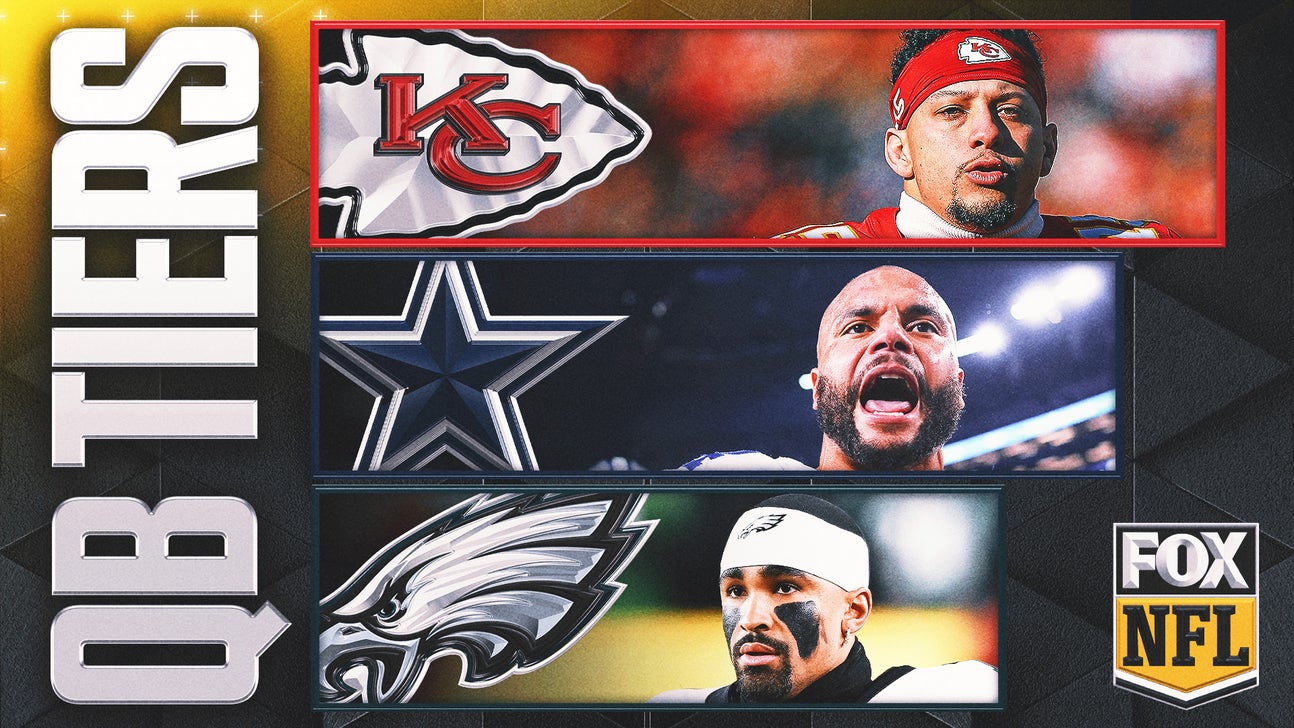
2026 NFL Quarterback Tiers: Which Starters Are Elite And Who Should Be A Backup?


A word of warning before you scroll down: You’re going to disagree with some of the opinions you’re about to read.
I know I’ve never come across an NFL quarterback ranking I’ve agreed with 100%, and the same is almost certainly true for you, whether you lean heavily on analytics, film, or team results. We all have different ideas of what makes one quarterback better than another. How you stack them is determined by what you value most in a quarterback.
I prefer to focus on a quarterback's skill set and how it helps their team’s offense function. The quarterbacks who can do everything for their team go to the top of the list, and they’re closely followed by those who can still carry an offense despite one or two small weaknesses in their game.
From there, you have your quarterbacks who can put up big numbers in the right environment and then those who are just trying to hang onto a starting job. And if your team’s quarterback doesn’t fall into one of those four categories, it’s time to start looking for a new one.
For this exercise, I’ve placed all 32 of the league’s starting quarterbacks (plus the eventual loser of the uninspiring battle going on in Atlanta) into one of seven tiers, ranging from "Elite" to "A Backup on Any Other Team."
One last thing before we get started: These selections are based on what these quarterbacks have done in the past; they are not a projection of what’s to come in 2026.
Click on a tier below to go directly to it.
Elite | Franchise Carrier | On The Doorstep | Supporting-Cast Dependent | Good Enough To Start | Erratic But Talented Sophomores | Backups On Any Other Team
Tier 1: Elite

The best of the very best. These quarterbacks are one-man starter packs for a top-10 offense. They have no limitations on what they can do on the field. They can burn a defense with their arms, legs, or even their minds. No matter what’s going on around them, their teams will be in contention for a title—provided they’re healthy, of course.
We can all agree Josh Allen belongs in this tier after putting up another MVP-caliber season in 2025, but Patrick Mahomes and Lamar Jackson are probably undervalued, with both missing the playoffs and posting pedestrian numbers by their lofty standards.

Patrick Mahomes has been active throughout training camp is trending toward starting Week 1 for the Chiefs. (Scott Winters/Icon Sportswire via Getty Images)
Let’s start with Mahomes, who’s still the league’s best quarterback, no matter what the league standings or analytical charts from last year say. The Chiefs had no receivers who could separate from man coverage, and Mahomes’ only reliable pass catcher, Travis Kelce, was running like a beer league first baseman. The offensive line was full of holes, the running backs produced just two runs that went for more than 20 yards last season, and Andy Reid’s offense was about four years past its expiration date.
Still, this was an above-average offense by any objective measure. Kansas City’s season from hell wasn’t proof that Mahomes has lost a step; it proved that a quarterback can only do so much to prop up a poorly built roster.
It’s more difficult to make an argument in favor of Jackson’s 2025 campaign. The two-time MVP did not play well at times and contributed to some of the issues in Baltimore’s passing game by holding onto the ball for far too long and taking avoidable sacks. But I’m willing to give Jackson a one-year pass for two reasons:
1. He was banged up throughout the season, which explains his reluctance to scramble.
2. That whole two-time MVP thing.

Lamar Jackson will look to bounce back after a disappointing 2025 season. (Perry Knotts/Getty Images)
Jackson’s track record of elevating mediocre supporting talent is long enough to warrant inclusion in this tier. If we get a repeat of last year in 2026, we can revisit this discussion.
Tier 2: Franchise Carriers

These quarterbacks are good enough to match the elite guys throw-for-throw, but there’s at least one weakness in their game that keeps them out of the top tier. While it’s not a guarantee that their teams will contend for a title, they will be in the playoff hunt as long as they’re on the field.
There’s only one quarterback in this group without a playoff win in his résumé. That’s Justin Herbert, of course.
Quarterbacks are ultimately judged by what they do in the postseason, but we’re talking about a sample size of three games here. Herbert has played 98 regular-season games and has been damn good in them. He also checks every box laid out in the description of this tier. Herbert just dragged a below-average receiving corps and a historically inept offensive line to an 11-win season.

Next for Justin Herbert: achieve playoff success. (Luke Hales/Getty Images)
As long as Herbert is out there, the Chargers have a chance to win. It’s only a matter of time before that translates to postseason success.
Dak Prescott is the other postseason faller in the group, but the perception that the Cowboys quarterback is bad in the playoffs largely stems from two bad games against superior 49ers teams.
Fun fact: Prescott and noted playoff riser Jalen Hurts both average 0.07 expected points added per dropback in the postseason, but Prescott’s success rate is nearly 8 percentage points higher, per Next Gen Stats. He also clears Joe Burrow, another supposed postseason riser, in both stats. If we just focus on Prescott’s game, which is built on a mastery of the Cowboys offense and top-end timing, precision, and pocket presence – you know, all the hallmarks of great quarterbacking – his inclusion in this tier is a no-brainer.

Tier 3: On The Doorstep

These quarterbacks have a few more kinks they need to work out before they can make the leap into the tier above it. Give them a good support system, though, and they’ll perform like a tier-two quarterback.
As you can probably surmise by now, I don’t put too much stock in small postseason sample sizes. That’s why C.J. Stroud (just barely) makes it into this tier.
Stroud was downright awful in Houston’s playoff run last season, but that shouldn’t overshadow the good work he did in the regular season, with a receiving corps decimated by injuries, an offensive line short on talent, and a first-year play-caller who enters 2026 on the hot seat. Stroud’s season was also disrupted by a concussion that took him out for a month.

C.J. Stroud delivered a strong performance in the back half of last season. (Kenneth Richmond/Getty Images)
Statistically speaking, Stroud was a top-10 quarterback after his return, and his tape was just as impressive as the numbers imply. He found more consistency with his accuracy, played more decisively, and showed more command of the offense before the snap. Houston’s offensive setup should improve in 2026, which should coincide with a bounce-back season for the 2023 Offensive Rookie of the Year.
Out of the four passers in this group, Jordan Love is the closest to making the jump into the next tier. Look at his efficiency numbers, and you’d think he already belongs in that group, but I’d like to see Love maintain that efficiency in a pass-first offense. Given the state of the Packers defense heading into the season, he’ll get his chance to do it in 2026.

And then there are the two generational prospects who haven’t quite lived up to the hype.
Caleb Williams has had his elite moments, but unreliable downfield accuracy and some overly ambitious decision-making are holding him back from the top tiers. The same goes for Lawrence, who fixed some of his accuracy issues last season but is still good for one or two bozo moments per game. Still, when these two are at their best, there are only a handful of quarterbacks who can match them.
Tier 4: Supporting-Cast Dependent

This group can produce like top-10 quarterbacks provided the conditions around them are just right. Some in this group require pristine pass protection. Others need an innovative play-caller or a stacked receiving corps. But when those needs aren’t met, they play more like bottom-10 quarterbacks. This is the middle class of NFL passers.
The fanbases for these quarterbacks are all thinking the same thing: Why is my guy lumped in with these scrubs?
I’d guess that Lions fans are most offended, and they could make a decent argument that Jared Goff belongs in a higher tier based on production alone. Even last season, when Detroit missed the playoffs, Goff remained productive without Ben Johnson calling plays. That ignores the fact that Detroit’s offense was mostly powered by Jahmyr Gibbs’ explosive runs and a receiving corps that could turn a short pass into a monster gain.
Goff’s inability to play under pressure is the main reason he’s stuck in this group. He was, once again, one of the worst quarterbacks in the league when pressured, and his lack of mobility, which won’t miraculously improve now that he’s in his 30s, is the root cause. Put Goff in, say, the Chiefs offense, and he’d crumble. If you need proof, just revisit his first season in Detroit when the Lions were still in rebuilding mode. Or just watch any game where he’s under siege.
Kyler Murray and Jayden Daniels are the two quarterbacks who could make the jump into the next tier this season. Both will have to stay healthy – a tall order given their respective injury histories.
Murray has higher upside in 2026, mostly because of a better supporting cast. He also has the stronger arm and has shown more as a pocket passer. Daniels has to regain his short-area accuracy to rediscover the form we saw in his rookie season. Given the state of Washington’s offensive line, even that may not be enough for Daniels to bounce back statistically.
This tier also includes three quarterbacks who have played in a Super Bowl, and two of them have won it. Sam Darnold is the defending Super Bowl champ, and he’s coming off a clean postseason run, but he also led the NFL in turnovers last season. Jalen Hurts has led mediocre passing games in three consecutive seasons despite a wealth of surrounding talent. And Brock Purdy has battled injuries and inconsistency since breaking out in 2022 with a superstar supporting cast and Kyle Shanahan calling the plays.
Tier 5: Good Enough To Start

On their best day, these guys can trick their fan bases into thinking they have a franchise quarterback … but a sobering reminder that they don’t is always right around the corner.
I want it on record that I believe Geno Smith and Tyler Shough could force their way into the tier above this one by the end of 2026.
Smith was dealt an impossible hand in Las Vegas last season. His offensive coordinator was calling plays that weren’t in the game plan, the unqualified offensive line coach was way over his head, and wide receiver Tre Tucker led the team in targets.
Even considering all that, Smith didn’t play well, but there are only a handful of quarterbacks who would have in that environment. I expect the veteran to bounce back behind a solid Jets offensive line and talented skill group.

Geno Smith gets another shot at starting in the NFL this season with the New York Jets. (Joe Sargent/Getty Images)
I was pleasantly surprised by Shough’s rookie season but still have plenty of concerns. Deep accuracy and a concerningly high pressure-to-sack ratio are at the top of that list. The second-year pro has the arm talent and mobility to improve in those areas, but he’s already entering his age-27 season, which gives him less room for improvement compared to the rest of his draft class.
Despite the large gap in age and accolades, Bryce Young and Aaron Rodgers are largely the same players at this point in their respective careers. Neither is comfortable throwing to the middle of the field, which can hamstring their offenses, but both make up for it with impressive touch on vertical, perimeter throws. Both look physically overwhelmed at times.
Tier 6: Erratic But Talented Sophomores

Well, this one’s self-explanatory. I’m not ready to give up on either of these guys, but the holes in their games prevent me from fully buying in.
If I had to choose one of these quarterbacks for the upcoming season, Jaxson Dart would be my pick. If I were picking for the next five years, I’d go with Cam Ward.
Thanks to his scrambling and run-game contributions, Dart is the more useful player. But he’s seemingly incapable of playing in structure and consistently misses even the most basic reads. When reviewing the tape of his rookie season, I lost count of the times he’d be staring directly at an open receiver underneath and not throw the football. It was mildly infuriating, but Dart showed an uncanny ability to salvage those missed opportunities with his legs. On the flip side, his refusal to slide led to countless trips to the blue medical tent. He’s more comfortable in there than the pocket, it seems.

Jaxson Dart is entering his first Week 1 as the Giants' starting quarterback. (Doug Murray/Icon Sportswire via Getty Images)
Ward’s pocket presence also needs improvement, but he’s shown more as a processor early in his career. The 2025 first-overall pick has no problems reading a defense and making anticipatory throws, but getting the ball to his intended target has been an issue for him. If he doesn’t shore up his accuracy in 2026, the Titans could be back in the quarterback market next offseason.
Tier 7: Backups On Any Other Team

The teams these quarterbacks play for are already looking forward to their next quarterback. In one case, he’s already on the roster.
Kirk Cousins is the inclusion here that might get some pushback, but just ask Falcons fans how excited they are by the prospect of Michael Penix Jr. starting in Week 1 and then remind yourself that Cousins couldn’t beat him out a year ago. While I’ve always liked Malik Willis’ upside, he doesn’t stand a chance in the Dolphins offense. Jacoby Brissett is a career backup, and the Browns naming Deshaun Watson their QB1 has the sport's most loyal fanbase ready to revolt.



Overreaction Monday: Chiefs Not A Super Bowl Contender? Steelers Are Legit?

NFL Fallout Week 7: Lions Announce Themselves As Super Bowl Contenders

Seattle Suffocates Patrick Mahomes: 4 Takeaways From The Seahawks' Win Over The Chiefs

The Obvious Solution To Fix Chiefs’ Offense; Packers Can't Stop Beating Themselves

Officiating Under Fire: Packers, Tom Brady Question Controversial Calls vs. Lions

Detroit Holds Onto Valuable Win: 3 Takeaways From The Lions' Win Over The Packers

49ers' First Loss Makes It Clear: Their Toughest Opponent Is Their Health

NFL, CFB Weekend Recap: Chiefs' Loss Was 'Best Result For The Book'

NFL Week 7 Defining Stats: Rodgers Passes Manning, Burrow Catches Fire





 Your Privacy Choices | Closed Captioning


