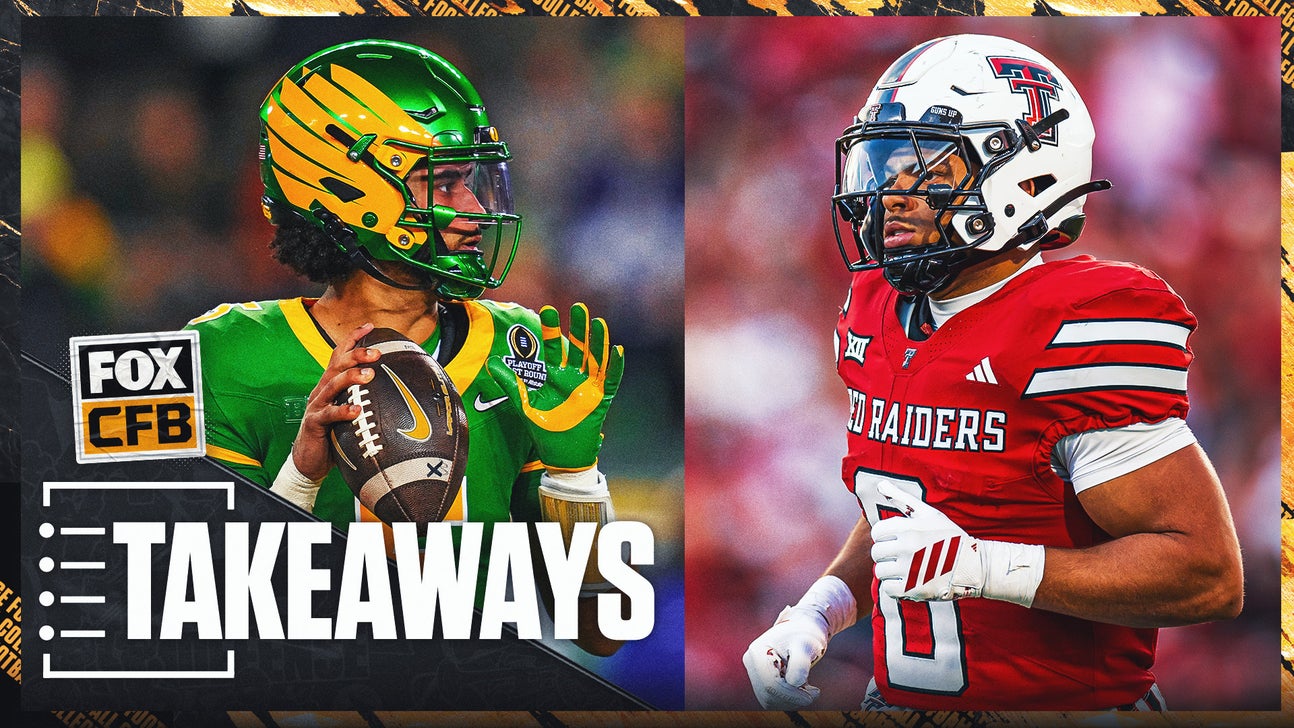
4 Takeaways From Oregon's Shutout Win vs. Texas Tech in the CFP Quarterfinals


In the same way that No. 10 Miami manhandled No. 2 Ohio State for large stretches of the Cotton Bowl on Wednesday night, bludgeoning the Buckeyes with grown-man football along the line of scrimmage, No. 5 Oregon manufactured a similarly dominant performance in a 23-0 victory over No. 4 Texas Tech — only the Ducks never let up Thursday.
For months, fans and analysts alike had wondered if the oil-fueled upstarts from the Big 12 could really compete with the best teams in the sport. The Red Raiders cruised to a conference championship with relative ease and notched all 12 of their victories by at least 20 points. Everything that head coach Joey McGuire and his players accomplished resembled dominance, underwritten by impressive statistics and future draft picks on both sides of the ball.
[2025 College Football Playoff Odds: Lines, Spreads for Each CFP Semifinal Game]
What the Ducks showed on Thursday in the College Football Playoff quarterfinal at the Orange Bowl, however, is that the Big Ten and the SEC are still a cut above everyone else, regardless of how much money the Red Raiders poured into their roster for 2025. The version of Oregon that kept Texas Tech off the scoreboard for all four quarters, that left opposing quarterback Behren Morton in tears on the sideline as the final seconds elapsed, is unquestionably one of the best teams in the country. A group more than capable of winning the CFP national championship.
Here are my takeaways from Oregon's CFP quarterfinal win over Texas Tech in the Orange Bowl:
1. Oregon’s defense bounced back from an uneven performance vs. James Madison

(Photo by James Gilbert/Getty Images)
It was difficult to evaluate the Ducks’ defense following a 51-34 home win over JMU in the opening round of the College Football Playoff. On one hand, Oregon surrendered more points to the Dukes than to any other opponent all season — even though the Ducks had faced high-flying offenses from Indiana, USC and Washington. They allowed 509 yards of total offense, including 323 through the air, and failed to stop JMU four times on fourth down. Such leakage invited pointed questions about how focused the Ducks really were, as defensive coordinator Tosh Lupoi balanced two jobs at once, having already been named the next head coach at Cal.
On the other hand, Oregon raced to a 34-3 lead over the Dukes that all but sealed the outcome before halftime. Lupoi’s group did not allow a touchdown until the opening drive of the third quarter and conceded three late scores when the game was clearly out of reach. Though far from ideal, a second-half dip in concentration was somewhat forgivable under those circumstances.
[MORE CFP: 4 Takeaways From Ole Miss' Dramatic Sugar Bowl Win vs. Georgia in CFP Quarterfinals]
Still, the Ducks’ defense entered the quarterfinal date with Texas Tech eager to prove that JMU’s statistical output was nothing more than an aberration, especially since Oregon still ranked sixth nationally in total defense (271.4 yards per game) and 10th in scoring defense (16.3 points per game). The effort Lupoi and his players put forth on Thursday should erase any lingering concerns about how good Oregon’s defense can be at its peak.
From start to finish, the Ducks smothered an explosive Texas Tech offense that came into the Orange Bowl averaging 42.5 points per game, second nationally behind North Texas. They forced four turnovers, limited the Red Raiders to 215 total yards and tallied three more turnovers on downs. Only three of Texas Tech’s drives gained more than 27 yards, and none of those ended with points.
The four takeaways by Lupoi’s defense (two fumbles, two interceptions) set a new season-high for the Ducks, who had only created more than two takeaways once all year. That Oregon played championship-level defense on an afternoon when its offense largely sputtered — only 64 rushing yards and four turnovers on downs — reminded everyone that head coach Dan Lanning has assembled a roster capable of winning in more ways than one.
[Joel Klatt: Scheduling Notre Dame 'Doesn't Make Any Sense' For USC, Any P4 Team]
2. Texas Tech's spending spree should have included a high-level QB

(Photo by James Gilbert/Getty Images)
For all the headlines that surrounded Texas Tech last winter, as general manager James Blanchard and billionaire donor Cody Campbell spearheaded what was arguably the most aggressive roster-building effort of the NIL era, none of them included news of a high-profile transfer quarterback joining the fray. The Red Raiders doled out massive financial sums to upgrade their offensive line, defensive line, running back room, secondary and receiving corps. Still, they decided to push forward with Morton at the sport’s most important position.
A former four-star recruit, Morton had already been with the program for four years. He appeared in at least nine games for three consecutive seasons, from 2022-24, and enjoyed a productive junior year in which he threw for 3,335 yards with 27 touchdowns and eight interceptions for a team that finished 8-5 overall. He flashed enough potential to understand why the staff believed he could reach another level amid what they hoped would be a national championship-level campaign this fall.
But when push came to shove on the grandest stage — when Texas Tech’s relatively docile regular season schedule gave way to a first-rate opponent in Oregon — Morton’s glaring shortcomings were there for everyone to see. He made questionable decisions in the face of relentless pressure from the Ducks, ultimately absorbing four sacks. He connected on just 18 of 32 passes for a 56% completion rate that was his second-lowest this year. He matched a season high with two interceptions, one of which led to a field goal. And the contrast between him and Oregon quarterback Dante Moore, who displayed near-flawless command while completing 26 of 33 passes for 234 yards, was glaring.
There were countless decisions that McGuire, Blanchard and Campbell got right in this record-setting season for Texas Tech. Believing that Morton could get them to the national championship wasn’t one of them.
[MORE CFP: 4 Takeaways From Indiana's Rose Bowl Demolition of Alabama in CFP Quarterfinal]
3. Turnover margin finally flipped on Texas Tech
(Photo by Kevin C. Cox/Getty Images)
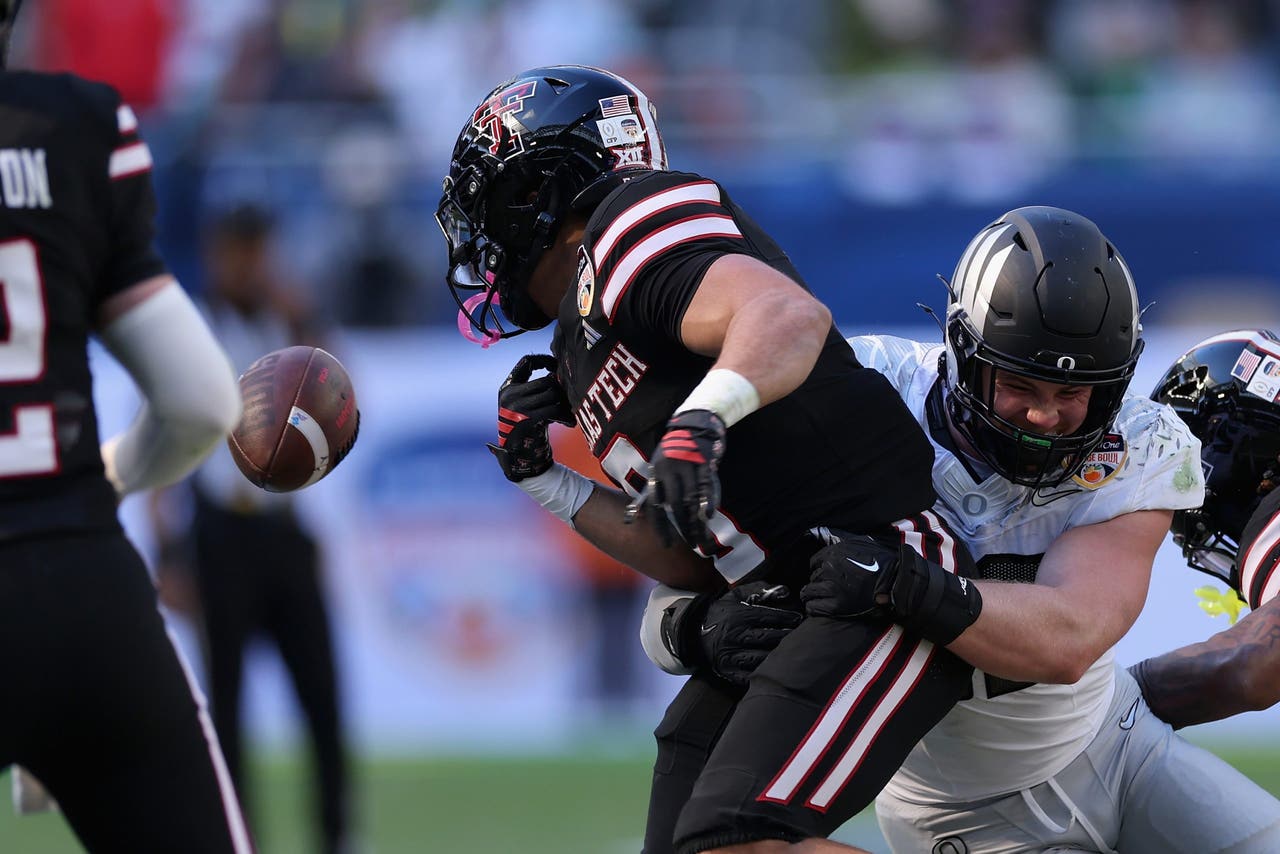
During his final on-field interview before kickoff, McGuire reiterated how important it would be for the Red Raiders’ defense to generate takeaways — just as that unit had done all season. In fact, no team in college football had forced more turnovers than the 31 snatched by Texas Tech under the direction of defensive coordinator Shiel Wood, who signed a contract extension last month. A mixture of 16 interceptions and 15 fumbles recovered across 13 games demonstrated how dominant Wood’s group had been while storming through the Big 12. Texas Tech entered the CFP tied with Indiana for the best turnover margin in the country at plus-17.
Yet the script unfolded quite differently for Texas Tech against Oregon, the most talented opponent McGuire’s team has faced. Morton tossed an interception early in the second quarter when wide receiver Reggie Virgil didn’t make a sharp enough cut on an out-breaking route, which allowed freshman cornerback Brandon Finney Jr. the chance to slice underneath the throw. Two possessions later — after the Red Raiders missed a lengthy field goal — tailback Cameron Dickey fumbled on a spinning run through traffic, with the ball ultimately recovered by Finney. That mistake led to a 39-yard field goal by Oregon kicker Atticus Sappington with 1:33 remaining in the half, pushing the Ducks’ lead to 6-0.
A minus-two turnover margin at halftime cut against the winning formula McGuire’s team relied on to win 12 games by at least 20 points this season, second-most in the AP Poll era. Texas Tech posted positive turnover margins in 12 of its previous 13 games entering the CFP, including six outings when the Red Raiders finished plus-two or better. The lone exception was a 26-22 defeat to Arizona State on Oct. 18, when the Sun Devils won the turnover battle, 1-0, and Morton was sidelined with an injury. A harbinger, perhaps, of things to come.
Texas Tech finished Thursday’s game minus-three in turnover margin.
4. Early tempo battle favored Oregon's deeper roster
(Photo by Megan Briggs/Getty Images)
One offensive drive for each team was all that viewers needed to understand how important ball control might be to Thursday’s outcome. Time of possession is often deemed a fickle statistic because of its indirect correlation to points. Simply keeping an offense on the field for extended periods doesn’t guarantee touchdowns or field goals, though it certainly helps.
But with Oregon and Texas Tech both aiming to manipulate the clock by changing the offensive tempo, rushing to the line of scrimmage to prevent defensive substitutions and employing check-with-me play-calling, any discrepancy in time of possession was going to feel magnified.
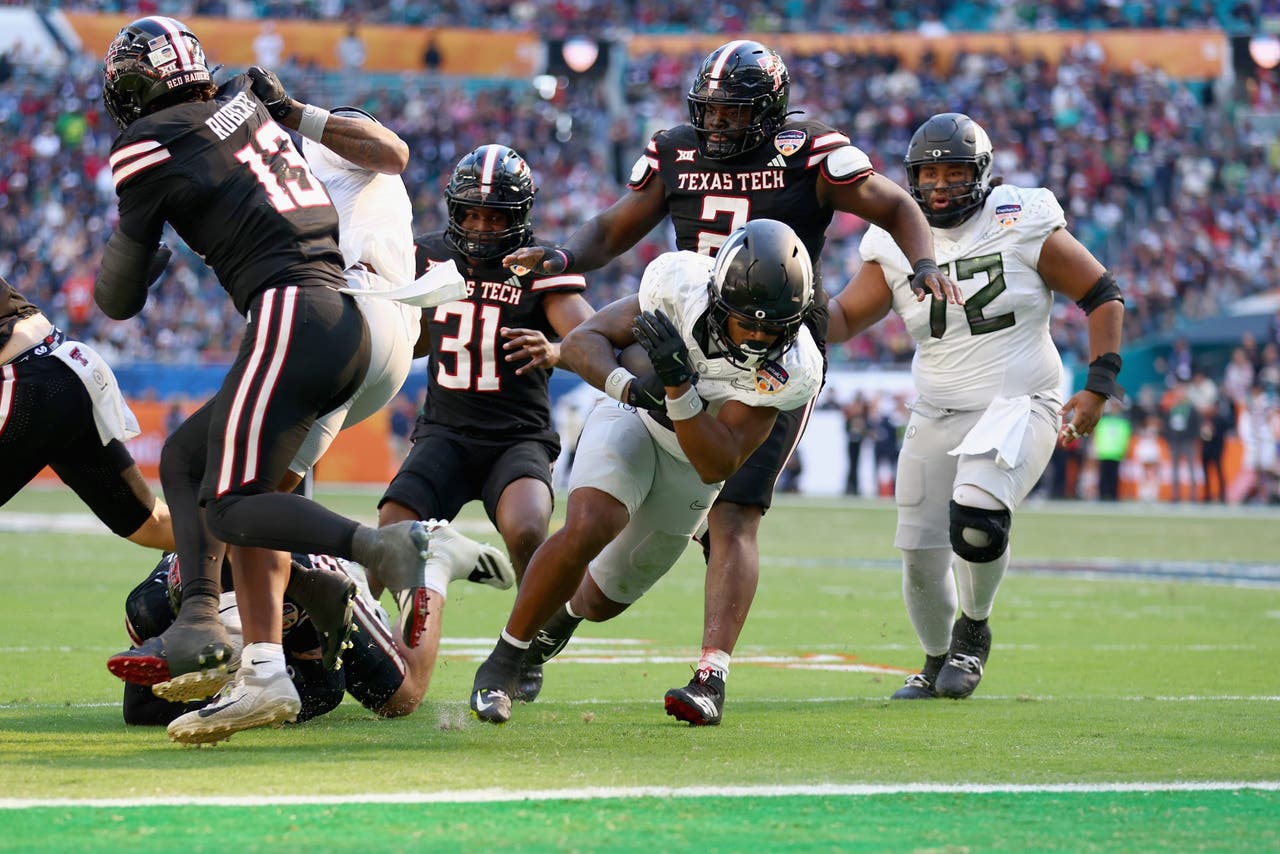
That is why the underlying statistics from the opening quarter, which ended with Oregon holding a narrow 3-0 lead, suggested a much larger, and potentially compounding, advantage for the Ducks. An effective play-calling blend from offensive coordinator Will Stein, who will take over as Kentucky’s head coach when the Ducks' postseason run ends, allowed Oregon to drain more than four minutes off the clock during its first possession and more than six minutes on its second, running 23 combined plays for 90 total yards.
When the Ducks’ defense countered by forcing consecutive three-and-outs to begin the game, weathering Texas Tech’s use of warp-speed tempo, momentum slowly shifted toward Oregon — a squad that ranks fifth in this year’s 247Sports Team Talent Composite and has nearly three times as many four- and five-star recruits as the Red Raiders.
By the end of the first quarter, Oregon had held the ball for more than 12 minutes and had run 19 more offensive plays than Texas Tech, at which point questions about potential second-half fatigue for the Red Raiders gained some legitimacy. Eleven of Texas Tech’s defenders entered the quarterfinals having logged more than 450 snaps this season, according to Pro Football Focus, with only one reserve surpassing 275 snaps. A unit that leans so heavily on its starters typically needs more balanced time-of-possession figures to avoid spats of late-game lethargy. And by halftime, the numbers reflected an even wider discrepancy: 49 offensive plays for the Ducks compared to just 23 for Texas Tech.
4 ½. What’s next?

(Photo by Megan Briggs/Getty Images)
Oregon’s victory over the Red Raiders secured a spot in the Peach Bowl, an Atlanta-based semifinal in the top half of this year’s bracket. The Ducks now await the winner of the Rose Bowl, which pits No. 1 Indiana against No. 9 Alabama on Thursday afternoon.
If the Hoosiers prevail, Oregon will have an opportunity to avenge its only loss of the season. Lanning & Co. were felled, 30-20, at home by then-No. 7 Indiana on Oct. 11, when Moore tossed two interceptions and struggled in the face of constant pressure.
If the Crimson Tide can pull off an upset, Oregon will face Alabama for the first time in program history.
Michael Cohen covers college football and college basketball for FOX Sports. Follow him at @Michael_Cohen13.
Want great stories delivered right to your inbox? Create or log in to your FOX Sports account, follow leagues, teams and players to receive a personalized newsletter daily!

College Football Rankings: Florida, LSU Up; Michigan, USC Fall — Plus 3 New Teams

USC Has A Lincoln Riley Problem, And It's A Familiar One

CFB Week 4 Superlatives: Oregon Shined, Iowa Stunned And Florida Is Undefeated

Big Bets Report: Rams-Broncos Cost Bettor $300k; Another Turns $2 Into $10k

Dante Moore Has Concussion After Late Hit; USC Suspends Desman Stephens One Game

NFL, CFB Weekend Betting Recap: Touchdowns Galore Benefit Bettors

South Carolina's Dylan Stewart Suspended Indefinitely After Punching Alabama TE

AP Top 25: Florida Surges Into Top 10; Texas, Georgia Remain At Top

Oregon QB Dante Moore Carted Off Field After Scary Hit To The Head



-
College Football Rankings: Florida, LSU Up; Michigan, USC Fall — Plus 3 New Teams
USC Has A Lincoln Riley Problem, And It's A Familiar One
CFB Week 4 Superlatives: Oregon Shined, Iowa Stunned And Florida Is Undefeated
-
Big Bets Report: Rams-Broncos Cost Bettor $300k; Another Turns $2 Into $10k
Dante Moore Has Concussion After Late Hit; USC Suspends Desman Stephens One Game
NFL, CFB Weekend Betting Recap: Touchdowns Galore Benefit Bettors
-
South Carolina's Dylan Stewart Suspended Indefinitely After Punching Alabama TE
AP Top 25: Florida Surges Into Top 10; Texas, Georgia Remain At Top
Oregon QB Dante Moore Carted Off Field After Scary Hit To The Head





 Your Privacy Choices | Closed Captioning


