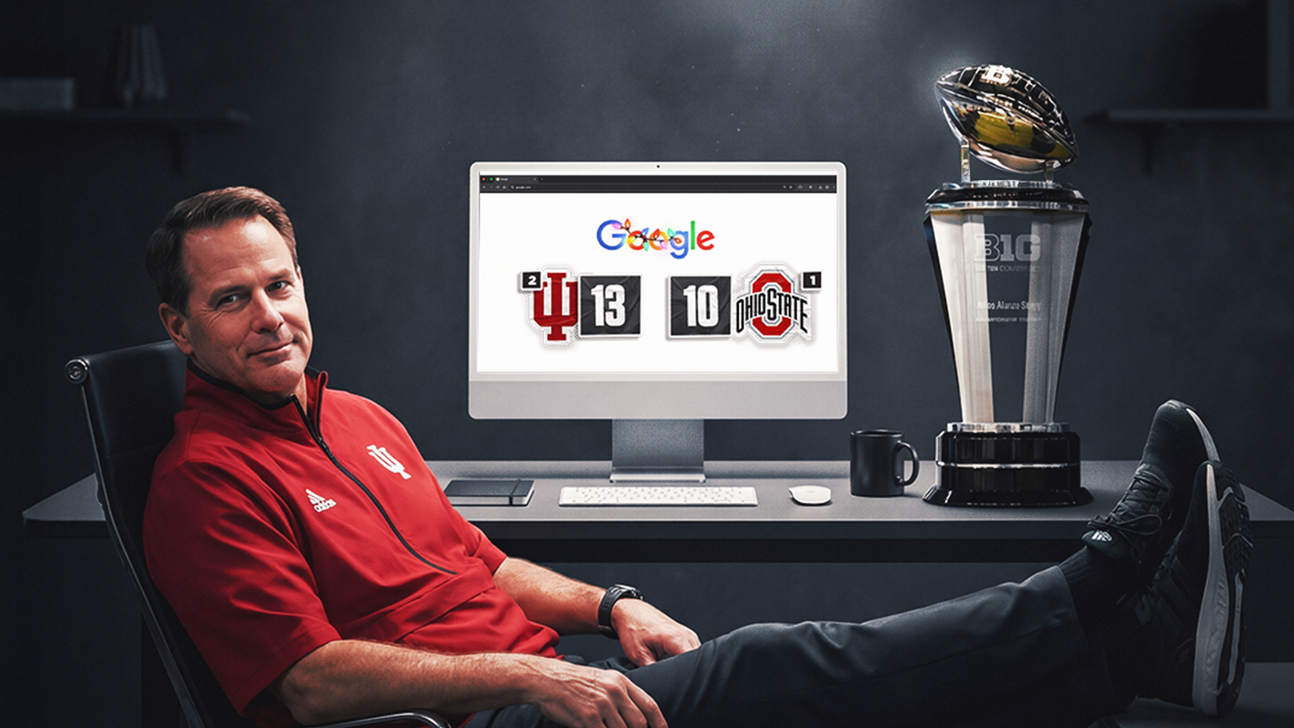
4 Takeaways From Indiana's Historic Big Ten Title Victory Over Ohio State


Consider the decision from Indiana head coach Curt Cignetti in the biggest moment of his football life: a third-and-6 from the Hoosiers’ 24-yard line with 2:41 remaining in the Big Ten championship game, as his No. 2-ranked team clung to a narrow lead. Almost everyone at Lucas Oil Stadium in Indianapolis expected him to call a simple run that would have forced No. 1 Ohio State to use its final timeout, further imperiling any potential game-winning drive the Buckeyes might have conjured.
But that’s just not how the cocksure Cignetti rolls. It never has been. And so he trusted quarterback Fernando Mendoza — a former two-star recruit and the No. 2,149 overall prospect coming out of high school — to launch a deep pass down the right side toward wide receiver Charlie Becker, another player who was never described as a blue-chip anything.
He trusted them the way he’s trusted that winning at Indiana was possible, even though nobody had ever dreamed that big before. And just as the Hoosiers have done since Cignetti arrived ahead of the 2024 season, they delivered Saturday for their unbelievable coach.
The 33-yard heave from Mendoza to Becker sealed a stunning 13-10 victory, in which the Hoosiers never trailed in the second half. It gave Cignetti & Co. the program’s first Big Ten title since 1967 — and first outright conference win since 1945 — and secured the No. 1 seed in this year’s College Football Playoff.
Here are my takeaways:
1. Curt Cignetti has authored the greatest turnaround in college football history
How did he do this? How on earth did Curt Cignetti, who had never been a Power 4 head coach prior to taking the Indiana job, drag these hapless Hoosiers from the cellar of college football to a Big Ten championship in two short seasons? How has he transformed a perennial laughingstock into a team that earned the No. 1 seed in the College Football Playoff and must be considered the prohibitive favorite to win the national championship?
Think about some of the numbers involved here: When Cignetti was hired away from James Madison two years ago, Indiana had endured more losses than any FBS program in history. It hadn’t won a Big Ten title since 1967 and could only claim two league championships across more than 70 years in the conference. It had lost 30 consecutive games to Ohio State dating to 1991 — the longest head-to-head streak in Big Ten history — and had never beaten the No. 1 team in the country in 16 previous tries.
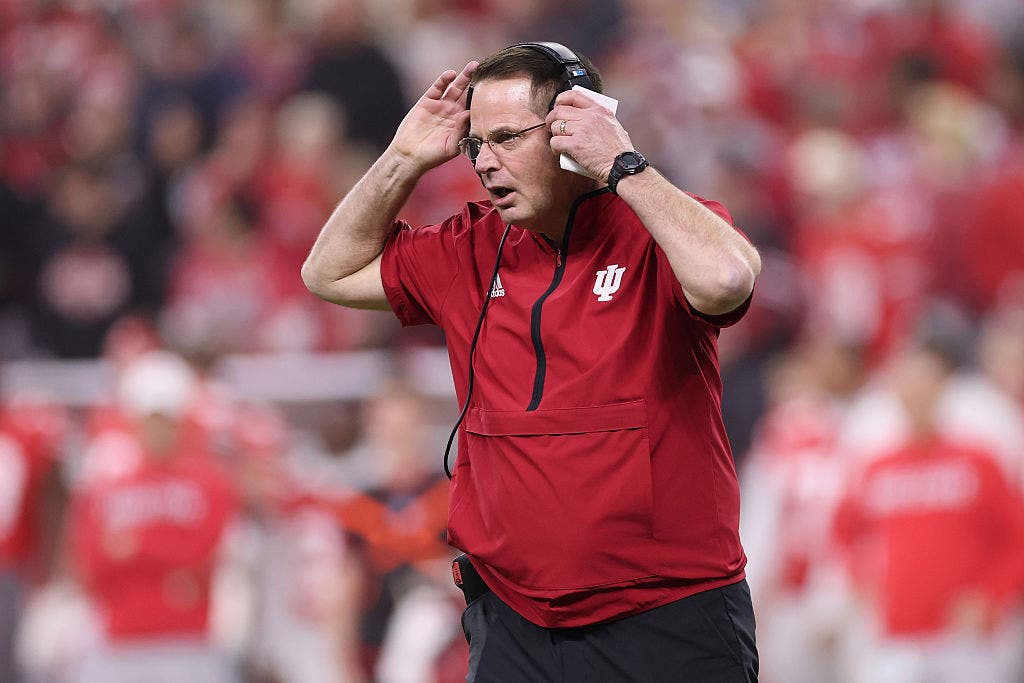
A year ago, Cignetti took his first team to the College Football Playoff in a season when the Hoosiers' only losses came against Ohio State and Notre Dame — the two programs that ultimately competed for the national championship. And then he had to replace 14 starters to field another playoff-caliber squad in 2025. That he did so without a hitch — constructing a roster that is even better than the one he had last season — speaks to how incredible Cignetti’s entire operation really is. This is one of the best building jobs college football has ever seen.
And these Hoosiers are far from finished, just as Cignetti noted in his on-field interview at Lucas Oil Stadium. This team has all the requisite talent and toughness to win a national championship. What an unbelievable next chapter that would be.
2. The Buckeyes finally faced some adversity — and crumbled
The moment critics across the country had been waiting for finally arrived with 8:02 remaining in the third quarter. That was when Indiana quarterback Fernando Mendoza lofted a beautiful back-shoulder fade to wide receiver Elijah Sarratt for a 17-yard touchdown that gave the Hoosiers a 13-10 lead. It marked the first time Ohio State trailed in the second half of a game this season.
In fact, the Buckeyes arrived at Lucas Oil Stadium as the only team in the country to reach December without falling behind after halftime, at some point or another. And they became just the third team in the College Football Playoff era to accomplish that feat, alongside Georgia in 2021 and Ohio State in 2019, which happened to be Ryan Day’s first season as head coach. Observers of college football everywhere were desperate to know how this group of Buckeyes — largely untested outside of a season-opening win against then-No. 1 Texas — would respond when the pressure was meaningful and real and leveraged by a quality opponent.
So, what happened next?
Immediately after Sarratt’s touchdown reception, the Buckeyes unfurled a gutsy 12-play, 70-yard drive that marched to within 15 feet of the goal line. With quarterback Julian Sayin having already been sacked five times to that point in the game — nearly as many sacks as the Buckeyes surrendered all season (six) — Day and offensive coordinator Brian Hartline tweaked the approach by moving their signal-caller outside the pocket. Sayin responded with poise and moxie while completing passes of five yards, 20 yards, 18 yards, eight yards and seven yards, spreading the ball to receivers and tight ends alike.
The drive was ultimately distilled to a decisive fourth-and-1 from the five-yard line, at which point Day decided to keep his offense on the field. Ohio State called a quarterback sneak. A replay review determined Sayin’s knee hit the turf when the ball was still short of the line to gain. Indiana secured a massive turnover on downs that intensified the pressure on the defending national champions as the fourth quarter began.
Ohio State would only have time to mount one more charge: a 15-play, 81-yard odyssey that chewed up nearly eight minutes of clock and seemed destined to end with a winning score. The Buckeyes maneuvered all the way to Indiana’s four-yard line when Day faced another fourth-and-1 decision. But this time he opted to send in the field goal unit, and that proved to be an unconscionable mistake. Kicker Jayden Fielding, maligned for long stretches of his career, shanked a 27-yard chip shot wide left with 2:48 remaining. It would have tied the game.
3. Early red-zone defense tilted the game in Ohio State’s favor
Based on the way Indiana and Ohio State had performed all season, one of the fascinating subplots when they met at Lucas Oil Stadium was always going to involve red-zone defense. The Hoosiers, under the direction of excellent defensive coordinator Bryant Haines, led the country in that particular category with a stingy opponent touchdown rate of just 27.8%. And the Buckeyes, who have thrived under first-year defensive coordinator Matt Patricia, ranked second nationally for that metric at 35%. To contextualize just how dominant those percentages really are — aside from the fact that both coordinators are in the running for the Broyles Award given to the sport’s best assistant coach — the only other Power 4 teams holding opponents below 41% are Oklahoma and SMU.
The early stages of Saturday’s game tilted firmly in Ohio State’s favor thanks to stellar red-zone defense that forced Indiana to settle for field goal attempts on its first three trips to that part of the field. Hoosiers’ kicker Nico Radicic, who was named the league’s Kicker of the Year earlier in the week, converted from 29 yards and 32 yards but hooked another try wide left. It was his first miss of the season after making 14 consecutive field goals, though none had been longer than 46 yards.
But even though Radicic missed from 39 yards against the Buckeyes, his team’s red-zone issues began with an inability to protect quarterback Fernando Mendoza in critical moments. Time and again on Saturday night, Mendoza was moved off his spot or flushed out of the pocket, sometimes absorbing tremendous punishment from an Ohio State defense that was clearly winning the line of scrimmage. The Hoosiers got all the way to the OSU 11-yard line in the opening quarter before edge rusher Caden Curry deflected Mendoza’s pass on third down to force a field goal. And when Indiana got to the OSU 16-yard line early in the second quarter, Mendoza was sacked by Curry’s edge-rushing partner, Kenyatta Jackson Jr., on third-and-6. One possession later, Mendoza was stopped for minus-2 on a quarterback draw from the OSU 20-yard line and then sacked on the very next play.
The Buckeyes’ offense, meanwhile, converted both first-half red zone trips into points, highlighted by a nine-yard touchdown pass from quarterback Julian Sayin to wideout Carnell Tate that gave Ohio State a narrow lead at the break.
4. The Heisman Trophy race is anything but sealed
Entering Saturday night’s game in Indianapolis, the betting favorites to win this year’s Heisman Trophy were Indiana quarterback Fernando Mendoza, Vanderbilt quarterback Diego Pavia and Ohio State quarterback Julian Sayin, with Notre Dame tailback Jeremiyah Love lurking just behind them. And given the stakes for the Big Ten showdown between Mendoza and Sayin — this was the Big Ten’s first No. 1 against No. 2 matchup in 19 years and just the second conference championship game in FBS history featuring two undefeated teams — an argument could be made that the winning quarterback could, and probably should, be lifting the trophy in New York later this month. Assuming, of course, that the winner played reasonably well at Lucas Oil Stadium.
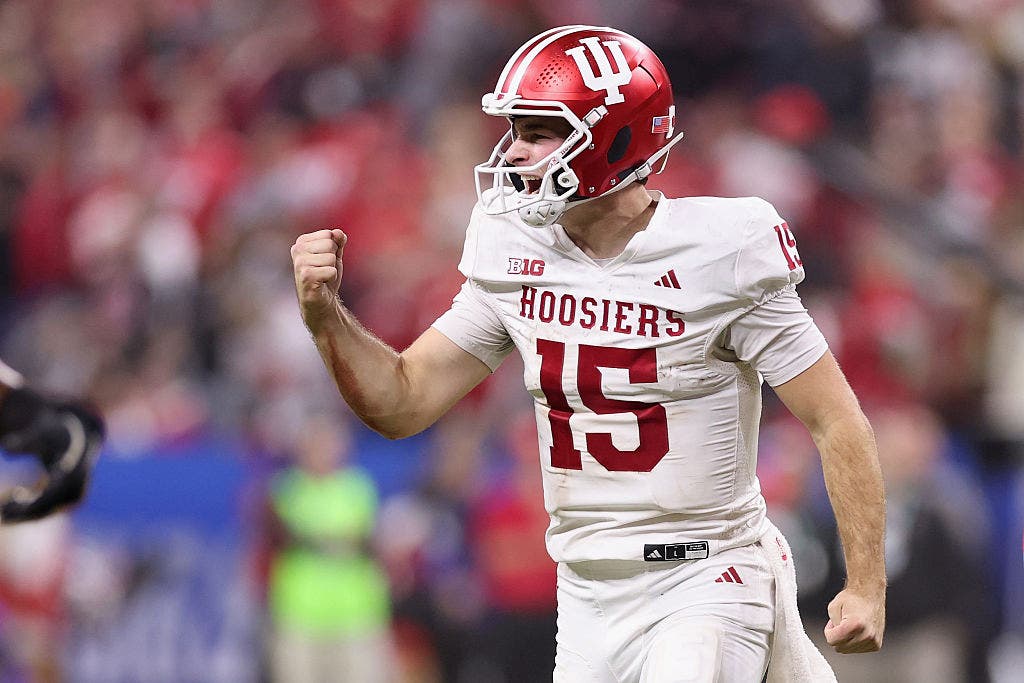
Fernando Mendoza gave the Heisman Trophy voters something to think about.
But an opening period in which both quarterbacks threw an interception — Sayin was picked off by Indiana safety Louis Moore on a pass over the middle; Mendoza’s bubble screen toward wideout Elijah Sarratt was deflected and snagged by cornerback Davison Igbinosun — breathed even more life into Pavia’s campaign, one that is certain to be backed by plenty of voters in the southern half of the country. Pavia has thrown more interceptions and fewer touchdowns than either Sayin or Mendoza, but he outpaced both of them in passing yards with 3,192 during the regular season and added tremendous punch as a runner: 152 carries, 826 yards, nine touchdowns. He guided the Commodores to a 10-2 overall record that kept them in the College Football Playoff conversation most of the year.
If the Commodores weren't likely narrowly missing the playoff field — they were No. 14 in the penultimate rankings last week — his candidacy would be far stronger given Vanderbilt’s unflattering football history. The same general premise of a star quarterback taking a program to new heights is what makes Mendoza’s story so compelling. It’s also why Sayin’s case is likely weakened by an assembly line of great quarterbacks at Ohio State and the otherworldly receivers he has at his disposal this season.
Perhaps Mendoza’s last-ditch throw to Becker will be enough of a Heisman Trophy-caliber moment for him to sway voters in the next few days. But a final stat line that showed 222 passing yards, one touchdown and one interception might not sway everyone down south. Pavia still has a legitimate chance.
4½. Three Big Ten teams await CFP bracket reveal
As far as general participation goes, there wasn’t much drama for the Big Ten entering conference championship weekend following a relatively straightforward regular season. Everyone inside and out of the league knew that Ohio State, Indiana and Oregon likely would be the only representatives in this year’s field once USC and Michigan both stumbled in late November. And everyone knew that the winner of Saturday’s game between the Buckeyes and Hoosiers would claim the No. 1 overall seed as the only unbeaten team remaining.
Still to be determined, however, was where the two non-champions would land in the selection committee’s hierarchy. Had certain results gone the Big Ten’s way earlier in the afternoon and evening on Saturday — if No. 9 Alabama had beaten No. 3 Georgia and if No. 11 BYU had toppled No. 4 Texas Tech — then it was entirely possible for the Buckeyes, Hoosiers and Ducks to earn three of the four opening-round byes. That would have offered the league some palatable consolation in a season when it will fail to match the number of SEC participants.
Instead, it seems likely that Ohio State and Indiana will both earn first-round byes given the competitive nature of Saturday night’s title game, with Georgia and Texas Tech claiming the other two spots. Oregon, which sat idle this weekend at 11-1 overall and 8-1 in the Big Ten, appears destined for the No. 5 seed and an opening-round home game at Autzen Stadium against a favorable opponent from outside the power conferences.
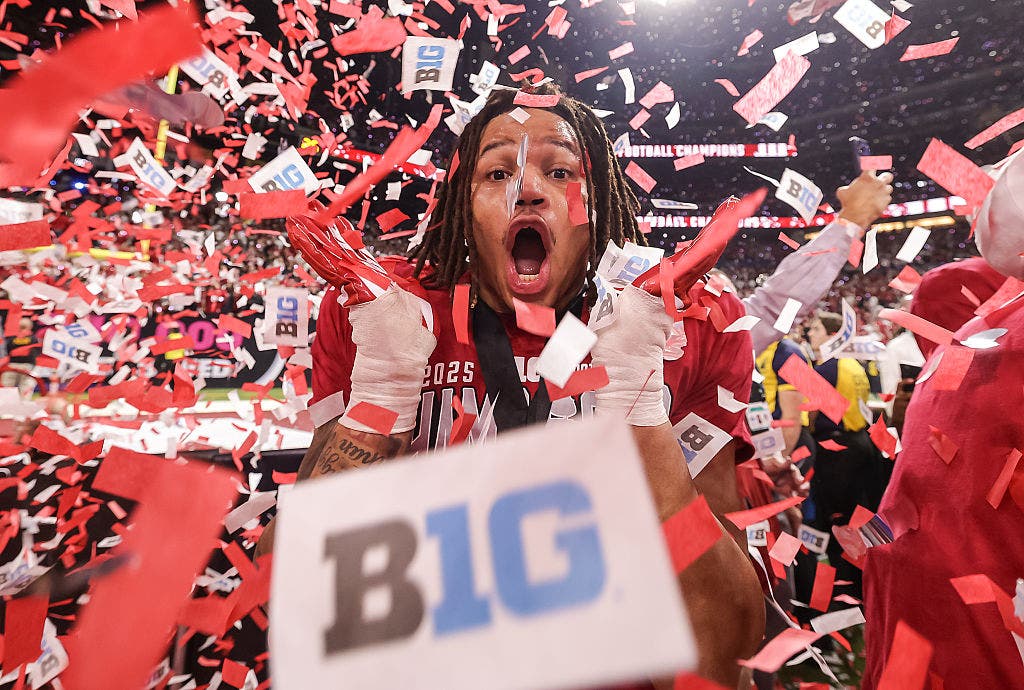
Defensive lineman J'Mari Monnette and the Hoosiers now await their CFP seeding.
Michael Cohen covers college football and college basketball for FOX Sports. Follow him at @Michael_Cohen13.

2026 College Football Odds: Texas Tech Looks To Make It Two In A Row

2026 College Football Odds: Miami Heavily Favored To Win ACC

Big Ten Takes Top Spots And SEC Leads With 9 Teams In 1st AP Top 25 Of 2026

Curt Cignetti: Indiana Can Play ND At Home 'Since They're Not In A Conference'

2026 College Football Playoff Odds: Irish Heavily Favored To Make Field

College Football's Top 10: Comparing RJ Young's, Joel Klatt's Rankings vs. AP Top 25
When Does 2026 College Football Start? Week 0 and 1 Schedule, How to Watch

Commanders Star Jayden Daniels Reportedly Issues NIL Cease And Desist To LSU

2026 College Football Odds: Can Indiana Repeat As Big Ten Champions?



-
2026 College Football Odds: Texas Tech Looks To Make It Two In A Row
2026 College Football Odds: Miami Heavily Favored To Win ACC
Big Ten Takes Top Spots And SEC Leads With 9 Teams In 1st AP Top 25 Of 2026
-
Curt Cignetti: Indiana Can Play ND At Home 'Since They're Not In A Conference'
2026 College Football Playoff Odds: Irish Heavily Favored To Make Field
College Football's Top 10: Comparing RJ Young's, Joel Klatt's Rankings vs. AP Top 25
-
When Does 2026 College Football Start? Week 0 and 1 Schedule, How to Watch
Commanders Star Jayden Daniels Reportedly Issues NIL Cease And Desist To LSU
2026 College Football Odds: Can Indiana Repeat As Big Ten Champions?




 Your Privacy Choices | Closed Captioning


