Get To Know a College Basketball Mid-Major: Mid-American Conference


You know all about the Power 5 conferences in college basketball. You hear about those more than any other, and those groups often dominate the March Madness conversation. There are 26 other conferences out there, however, and our goal is to get you up to speed on the teams, players and fights in the standings to know before the conference tournaments, Selection Sunday and the official start of March Madness.
It’s time for you to get to know a mid-major: this time, it’s the Mid-American Conference.
The format of the MAC tournament has changed a few times over the years. At first, seven teams made it into the three-round tourney, with the top seed getting a bye. In 2000, the Mid-American Conference changed things up so that every team qualified, and stayed basically that way until 2020, when qualification required being a top-eight team in the conference. With 12 teams in the conference now, that means four of them won’t be eligible for the conference tourney, on both the men’s and women’s sides.
There is no longer a bye for the top teams, but instead, the tournament begins already in the quarterfinals, and matchups are based on seeding — the top seed takes on the bottom seed as its reward, but still has to win three games to become MAC champion. With no byes, the regular season standings and seeding takes on significant importance, especially since, in both men’s and women’s MAC basketball, the only bid to March Madness historically comes by way of the automatic one for the conference tournament winner. With the specific performances of the conference this year, though, maybe — maybe — an at-large bid could exist.
MAC — Men’s College Basketball
Leaders:
- Points Per Game: Tavari Johnson, Akron, 20.3
- Rebounds Per Game: Delrecco Gillespie, 11.7 (3rd in D-I)
- Assists Per Game: Cian Medley, Kent State, 6.7
- Steals Per Game: Javontae Campbell, Bowling Green, 3.3 (1st in D-I)
- Blocks Per Game: Nathan Claerbaut, Central Michigan, 1.8
There is a national-level story going on in the MAC this year, and if you have not heard about it yet, now is the time: Miami (OH) is the only undefeated team left in men’s Division I basketball. The 26-0 RedHawks have the longest-ever win streak in MAC men’s history, and, as you can imagine, are atop the Mid-American as well.
What is a little less noticed unless you are paying attention to this conference, specifically, is that Miami (OH)’s lead in the MAC isn’t necessarily safe. Yes, the RedHawks are 13-0, but Akron is 12-1 and Kent State is 11-3. The problem for both of those teams is that neither faces Miami (OH) again this year — the RedHawks already handled those matchups, with Miami (OH) beating Kent State in overtime in mid-January and Akron a couple of weeks before. The Zips, ranked 60th in the NCAA Evaluation Tool, are the most significant competition for the RedHawks in the conference itself, given Miami (OH) is ranked No. 22 in the country but 49th in NET. While maybe nothing can be done to unseat the RedHawks in the regular season, Akron lost to them by just 3 points — a March dub for the Zips isn’t exactly a pipe dream here.
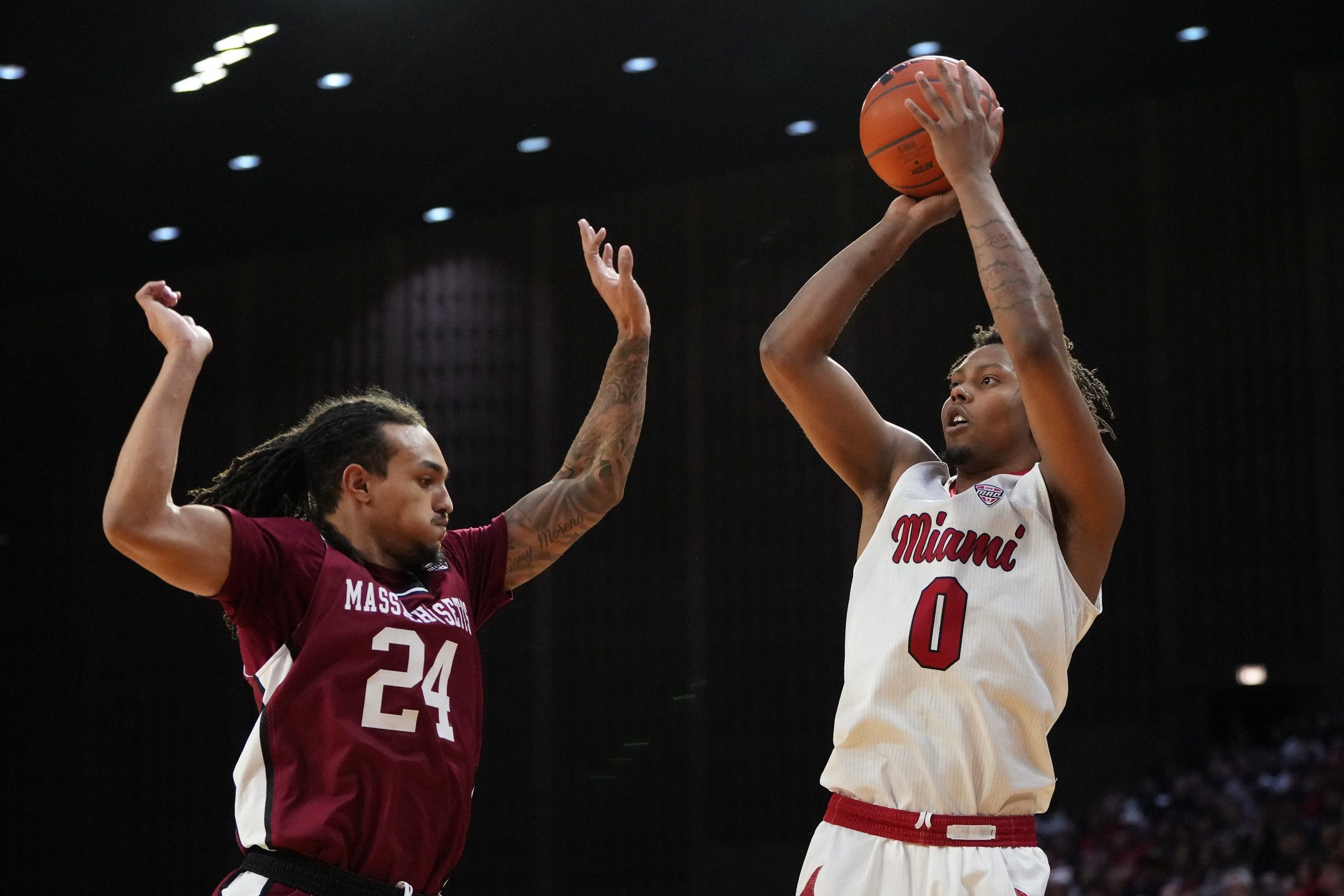
The RedHawks have played a lot of close games in 2025-2026, but they have also won them all. (Photo by Dylan Buell/Getty Images)
This isn’t meant to say that Miami (OH) is doomed to lose or Akron is fated to win, by any means. The point is that there is 1) a team five wins away from an undefeated regular season that 2) is genuinely good and a top-50, tournament-level team, contested by 3) a team that is also looking tournament-worthy, and both will be vying for the MAC title in March. And Kent State (138th) and Bowling Green (148th) are top-150 teams as well, that could easily throw a wrench into the best-laid plans of the RedHawks and Zips, while Toledo, Ohio, UMass and Buffalo are all MAC tourney-eligible at the moment, too, and all have played Miami (OH) from close to really close this season. That’s exciting! We are not short on MACtion this year.
Miami (OH) doesn’t show up on any of the conference leaderboards above, but that’s because there is a real distribution of labor going on with it. Six RedHawks are scoring at least 10 points per game (and up to 14.8), while a seventh is at 9.9. There is no one rebounding star, but six players grabbing at least 3.2 boards per game up to 5.8. Two different players — senior guard Peter Suder and sophomore guard Luke Skaljac — have 4.2 and 4.8 assists per game. This group is first in the MAC in FG% (51.8%), second in made 3s per game (9.8), and first in points (89.3) with an average margin of victory of 11.4. They move the ball, they rebound, they put themselves in position to get fouled — the RedHawks do the little things and the big things, a reminder that you don’t end up 26-0 as an accident.
MAC - Women’s College Basketball
Leaders:
- Points Per Game: Madi Morson, Central Michigan, 20.1
- Rebounds Per Game: Sisi Esko, Eastern Michigan, 10.3
- Assists Per Game: Tamar Singer, Miami (OH), 7.4 (4th in D-I)
- Steals Per Game: Johnea Donahue, Bowling Green, 4.0 (4th in D-I)
- Blocks Per Game: Ilse de Vries, Miami (OH), 1.9
Miami (OH) is in the thick of things on the women’s side, too, albeit not as an undefeated team either overall or in-conference. Ball State is the current leader at 12-1, with the RedHawks in second at 11-1. UMass is 10-2, Central Michigan 10-3, Ohio 9-4 and Toledo 7-5. Kent State (5-7), Bowling Green (5-8), Eastern Michigan (4-9), Western Michigan (3-9), Akron (3-9), NIU (2-11) and Buffalo (0-12) are all under .500, with the cutoff for tournament qualification ending, at present, at eighth-place Bowling Green.
Ball State is, through Feb. 17, on the bubble. It ranks 67th in NET, so it’s entirely possible that it would make it to March Madness even without winning the MAC tournament. However, the process of not winning the conference championship might also knock the Cardinals off that trajectory, so, safer — as is so often the case with mid-majors — to just win the automatic bid and take the Selection Committee out of it.
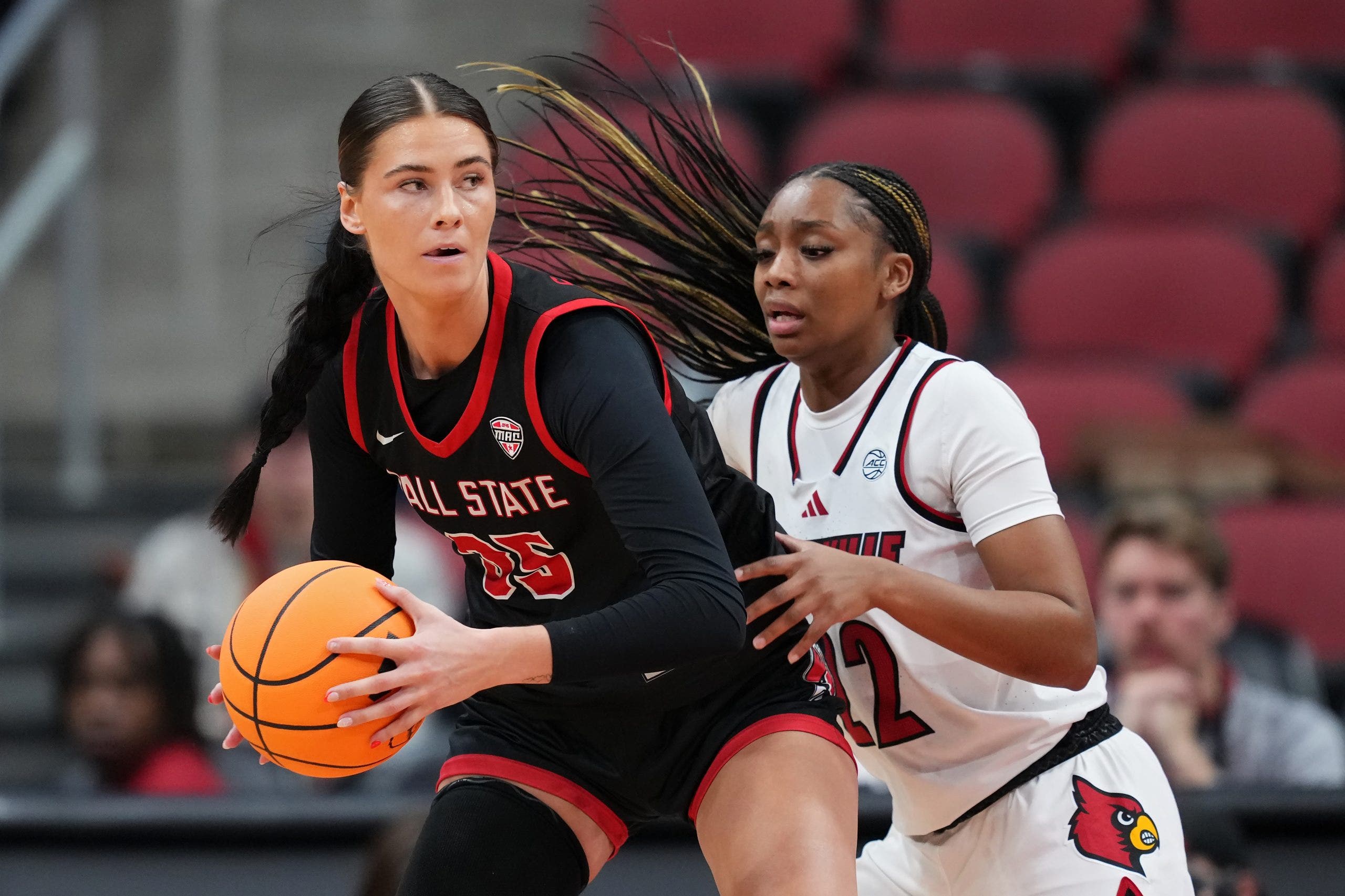
Bree Salenbien is one of the best players in the conference, and has helped push Ball State to the top of the MAC. (Photo by Dylan Buell/Getty Images)
The Cardinals have the 70th-best Offensive Rating in D-I women’s basketball thanks to falling just shy of 102 points per 100 possessions, but the defense will be a problem against high-scoring teams, as it allows 90.03 points per 100 possessions. While it does not have one of the leaders in the above basic categories, Ball State features MAC’s two best players per Player Efficiency Rating: junior center Tessa Towers (32.4) and fifth-year guard Bree Salenbien (29.6). In addition, sophomore guard Grace Kingery ranks 15th in PER, at 19.7. That’s a fearsome threesome.
Miami (OH) is just 80th in NET, but it has a significantly better defense than Ball State’s at 86.24 points per 100 possessions, 73rd in Defensive Rating. The RedHawks also have four players in the MAC top 20 in PER: junior forward Amber Tretter (5th, 27.3), sophomore forward Ilse de Vries (12th, 20.7), sophomore guard Tamar Singer (14th, 19.8) and senior guard Amber Scalia (20th, 17.7). Miami (OH) is first in blocks in the conference, second in forced turnovers, third in steals, and allowing just 56.3 points per game. It also already beat Ball State for the Cardinals’ lone loss in conference play, 72-52.
Massachusetts is 95th in NET, with Central Michigan 111th — there are some solid (and dangerous for Ball State and Miami (OH)) teams here in the MAC. Like with the men’s side, the conference tournament is going to be a fight, whether there ends up being an at-large bid available in addition to the automatic or not.



.vresize.40.40.medium.0.png)




5 Candidates Oregon Basketball Could Turn To After Dana Altman's Retirement

Oregon Men's Basketball Coach Dana Altman Announces Retirement After 16 Seasons

Senate Overwhelmingly Passes College Sports Bill Aimed At Player Pay, Transfers

UConn Huskies, Silas Demary Jr. Top Big East Preseason Polls

Ole Miss Set To Drop Nike For New 7-Year Deal With Adidas

Protect College Sports Act: What It Is And What It Means

Top 25 college athletes with highest NIL valuations

Former Celtics, Jazz Player RJ Luis Jr. Cleared By Judge To Play For LSU





 Your Privacy Choices | Closed Captioning


