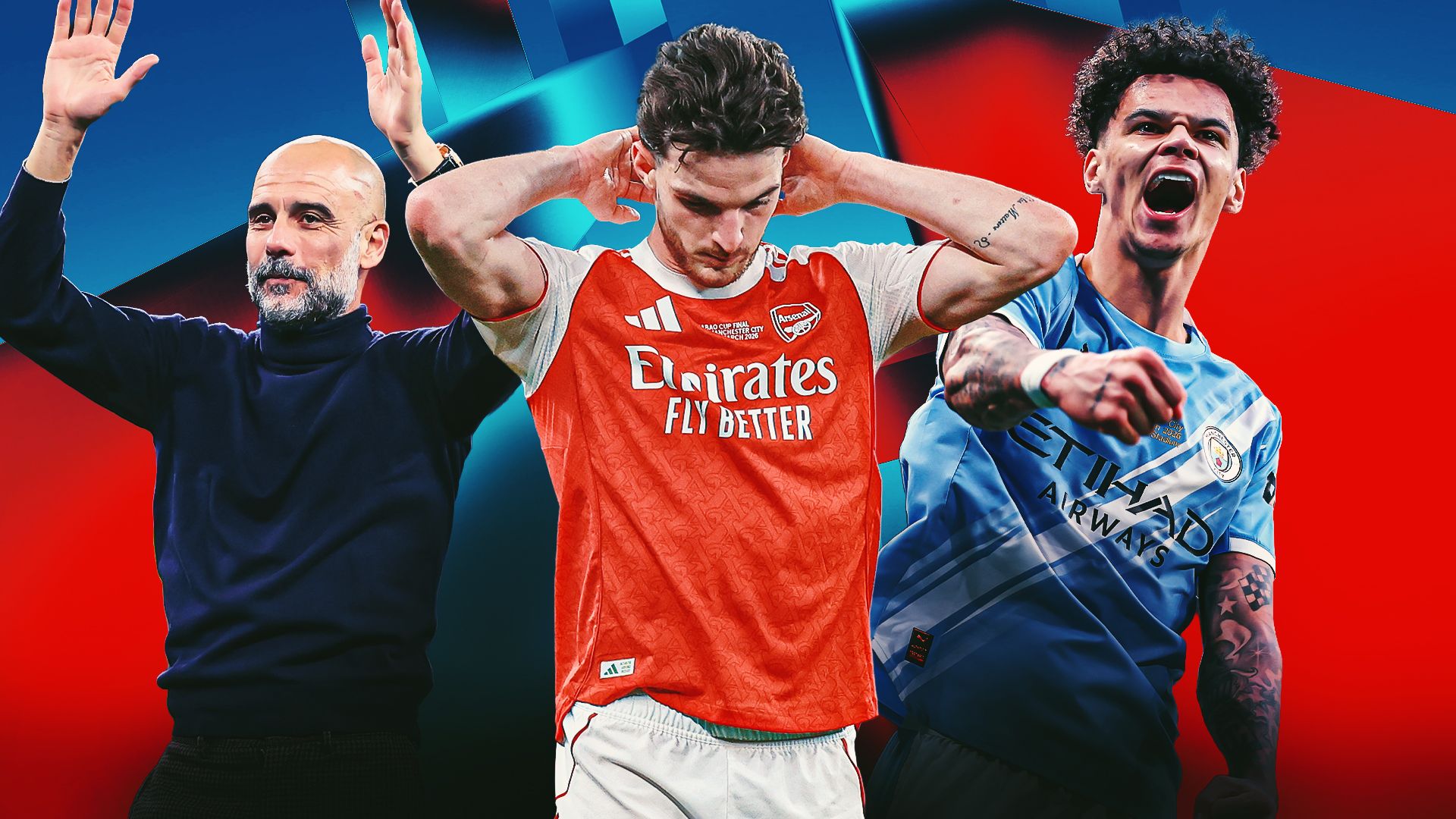
Arsenal's Carabao Cup final defeat has been in the post for weeks! Winners and losers as Gunners get wake-up call that they must improve while Pep Guardiola and Man City rediscover their mojo ahead of the run-in


Manchester City beat Arsenal in the first final of the English football season, with Pep Guardiola schooling former apprentice Mikel Arteta to secure the Carabao Cup at Wembley on Sunday. The contest was decided by two second-half goals from Nico O’Reilly, who twice crept into the Gunners’ box effectively unmarked to score from a pair of almost identical crosses.
An error from Kepa Arrizabalaga allowed O’Reilly to break the deadlock, and from then on, City never looked like giving up a trophy they have now won nine times, Guardiola claiming five of those alone. Only Liverpool have won this competition more, with 10 victories.
City delivered arguably their best performance of the season, but it was a display that Arsenal and Arteta will need to watch back in disgust if they are to learn from mistakes and ensure this season won’t be defined by a collapse.
The modern rivalry between City and Arsenal meant this was always going to be a final wrapped in narrative. Indeed, it was a spectacle that delivered on that front.
GOAL breaks down the winners & losers from Wembley...
WINNER: Nico O'Reilly

Before kick-off, City fans held up a tifo in tribute to Dennis Tueart, the hero of their 1976 League Cup final, who scored an incredible bicycle kick to snatch victory over Newcastle and was hailed as 'The King of All Geordies'. It would prove to be City's last trophy win for 35 years, the curse broken by Yaya Toure at Wembley in 2011. But in 2026, the man who made City's day was one of their own.
Nico O'Reilly was raised in Collyhurst, north Manchester, and supported City along with his mother and sister. He has '0161', Manchester's dialling code, tattooed on his bicep. He even snubbed the chance to play for Manchester United after being scouted by them as a child.
O'Reilly's emergence from the academy into the first team was one of the few feelgood stories of last season for City, and he has kept on bringing more good news. His recent goal-scoring streak had been helped by him playing in midfield, but despite being restored to left-back at Wembley, he played as if he was prime Toure and even gave Erling Haaland a lesson in goal-scoring. O'Reilly showed real hunger to get to the loose ball after Kepa dropped it for the opener and then ghosted into the box to glance in Matheus Nunes' cross less than four minutes later.
It capped an incredible weekend for the youngster, who was named in the England squad on Friday and celebrated his 21st birthday on Saturday. And on Sunday, he joined Tueart among the pantheon of City's Wembley heroes.
LOSER: Kepa Arrizabalaga

There is a long and storied history between the Carabao Cup and Kepa Arrizabalaga, who played in two previous finals with Chelsea. In 2019, he refused to be substituted deep into extra-time after seemingly picking up an injury, with the Blues going on to lose to City on penalties. Three years later, he was introduced from the bench specifically for the shootout, but let in 11 spot kicks from Liverpool players before skying his own.
When team news was leaked on Saturday that Kepa would start this final for Arsenal, it felt like there would be only two ways to spin the result. Either he would finally get his redemption in the Carabao Cup final after all these years, or another calamitous chapter would be added to the picturebook.
And, well, it turned out to be the latter. He flirted with danger early in the second half when he fouled Jeremy Doku outside the box, woefully misjudging a long ball over the top of the Arsenal backline, and those of a Gunners persuasion must have hoped that was Kepa’s moment over and done with.
Instead, he flapped at a straight cross from Rayan Cherki that lacked venom, allowing O’Reilly to saunter on in at the back post and grab the opening goal. Arsenal never recovered from that blow and Kepa will surely never play a Carabao Cup final again, this the last entry in a personal diary of misadventure.
WINNER: Pep Guardiola

Pep Guardiola is never down for very long. He has had a chastening March, featuring hugely disappointing draws against Nottingham Forest and West Ham to hand Arsenal momentum in the title race, and two defeats to Real Madrid, his eternal enemy in the Champions League. But he bounced back by outsmarting his former apprentice and masterminding his side's victory over their biggest rival of the last few years.
In the process, he became the first manager in English football history to win the League Cup five times. A lot of top-level managers have been accused of disrespecting the competition, but Guardiola has bucked that trend, taking it deadly seriously.
He suffered a setback before kick-off when Ruben Dias was ruled out, but his side barely noticed his absence. Guardiola got his selections bang-on, from sticking with James Trafford as his cup goalkeeper, to playing Doku and Antoine Semenyo together despite it not working against Madrid, to showing no sentiment to Phil Foden and only bringing him on in the 90th minute.
LOSER: Mikel Arteta

This was Arteta’s chance. His chance to silence any doubters he and his team had left, his chance to end a trophy drought spanning nearly six years, his chance to finally take the crown from his mentor and former boss, Guardiola.
It was a chance missed. Arsenal were so unthreatening in this final that there isn’t even an appropriate opportunity on the pitch to compare it to.
This sort of result, a massive match gone awry, had been coming. Too many Arsenal performances in 2026 have seen them crawl over the finish line when, given the depth of their squad compared to their rivals, they should be sprinting over it. If City were closer to Arsenal in the Premier League table, there would not be a debate over Arteta’s style and philosophy, rather whether this team was performing at its maximum level despite results going in their favour.
The Gunners were blunt for much of the final and Arteta did little to try and change that. He prepared his first two substitutes - Noni Madueke and Riccardo Calafiori - with Arsenal one goal down, but they were only introduced by the time City had scored their second. Guardiola’s men dominated the start of the second half to snatch complete control of a final there for the taking.
WINNER: Hugo Viana

This was the first trophy City won in the Guardiola era without sporting director Txiki Begiristain being present. But his successor, Hugo Viana, must have felt a huge sense of satisfaction as he watched two of his recent signings, Semenyo and Cherki, boss the match, while Trafford also made his mark.
Viana has been given plenty of money, spending £260 million across the summer and winter windows, but nearly all of his additions have been successes, with the exception of Tijjani Reijnders.
In terms of value for money, it is hard to beat Cherki, who has been a real coup for £34m, the same price Manchester United paid for Joshua Zirkzee a year previously. Cherki is known for his devilish flair, and Guardiola was seen shaking his head when he preceded to taunt Arsenal with kick-ups during the game. And yet it was his hard work and guile which stood out here. Semenyo, meanwhile, was a constant thorn in Piero Hincapie's side, with his speed and power also helping nullify Arsenal.
The one thing Viana and Co. could be criticised for is leaving Trafford in the lurch by signing Gianluigi Donnarumma late in the window, but the goalkeeper had a day to savour here. His triple-save early in the match, which was in complete contrast to Kepa's blundering display, vindicated the decision to sign two quality goalkeepers last summer.
LOSER: 'The Quadruple'

Plenty of English teams get to February and March in a season still alive in all four competitions. None has ever gone on to win all four.
Arsenal were the latest team to tackle this gauntlet and lose. Arteta and sporting director Andrea Berta have built a squad that is capable of reaching this stage of a campaign, favourites in four competitions without running on empty, yet if they can’t get over this almost mythical hump, will anyone?
Arteta actually gave a wise answer that foreshadowed this final a few weeks ago when asked how difficult it is to win the quadruple: "Has it been done? That's how difficult it is. Let's go game by game, let's try to earn the right to continue to be there until the last stage of every competition, and then we'll see what happens."
WINNER: James Trafford

Trafford admitted recently that he was left in the dark by the club's decision to sign Donnarumma two months after re-signing him from Burnley, and left the door open to a summer exit to get more playing time. He did, though, vow to keep plugging away.
"I didn't expect the situation to happen, but it happened, so just get on with it," he said. "It’s happened so I work very hard every day and see what happens, give it my best shot."
What happened was Trafford got to play in a final at Wembley, and he stood out with his salvo of saves to deny Kai Havertz and Bukayo Saka in one crazy play. He kept alert in the second half even when City were on top and kept a clean sheet by making an extra save for good measure to thwart Riccardo Calafiori.
"This moment, means a lot to me," said Trafford. "Four or five years ago when they beat Spurs to win it, I think I was fourth or fifth choice, and I always imagined that I would win it won day."
LOSER: Arsenal's self-belief

The final third of the season tends to be when this version of Arsenal come unstuck. They threw away Champions League qualification in 2021-22. A year later, they broke the record for spending the most days top of the Premier League without winning it. They put together a run of 16 wins from their final 18 games in 2023-24, but it was a 0-0 draw at City along the way that is the most-remembered result of that bunch.
Rodri questioned Arsenal’s mentality at the end of that season: “When they came here, they faced us at the Etihad, I saw them and said: 'Ah, these guys, they don't want to beat us, they just want a draw'. And that mentality, I don't think we would do it the same way. And we caught them. At the end, if you give us one point, we will win the last seven, eight games even though it's so tough. So I think it comes down to mentality.”
This was the first time the League Cup final had been contested by the top two teams in the football pyramid, yet the one in first was the side who seemed to have some sort of imposter syndrome.



World Soccer Rankings: Why Manchester City Is Ahead Of Barcelona, For Now
Top 100 Players In The 2026 FIFA World Cup, Ranked

PSG’s Luis Enrique Hopes Man City Avoids Sanctions After Financial Rules Verdict

Timeline: How Man City's Financial Case Went From Leaked Emails To Verdict

Balogun: Premier League 'Definitely' Still An Option After Collapsed Everton Move





 Your Privacy Choices | Closed Captioning


