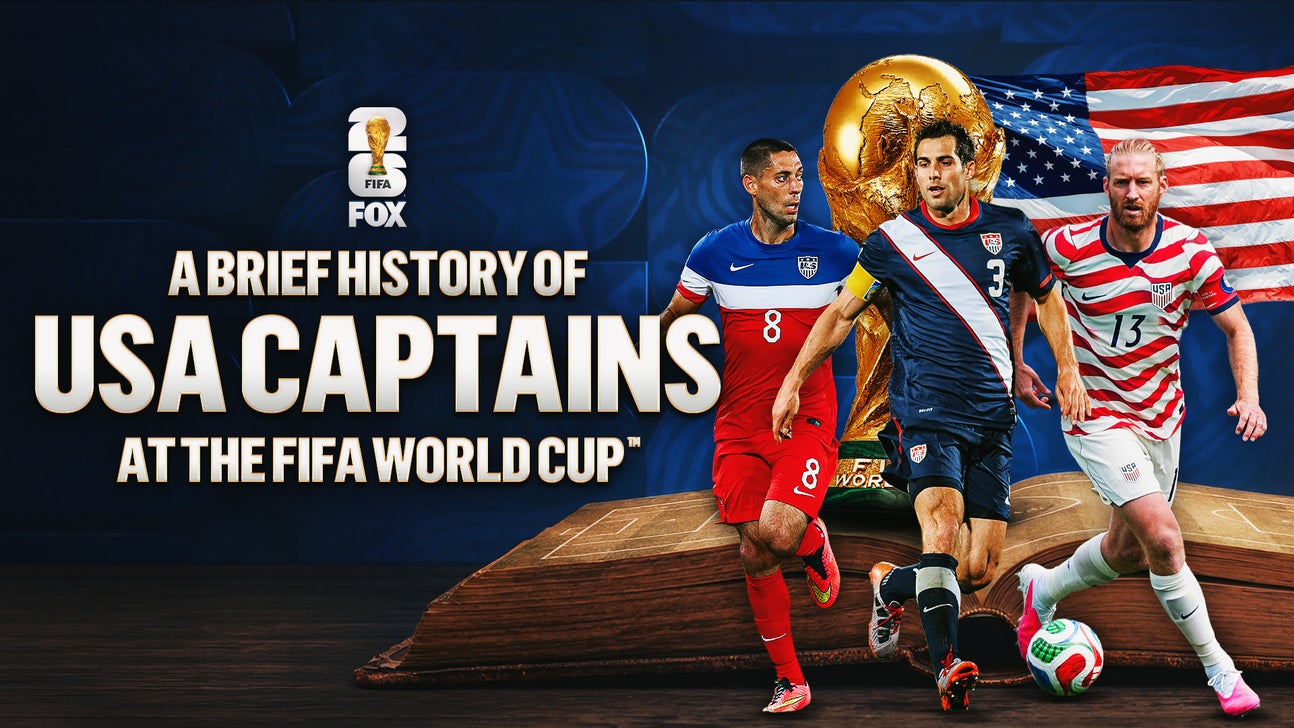
USA's World Cup Captains: From Inaugural Edition To 2026's 48-Team Tournament


To play for the U.S. men's national team at the World Cup is a unique honor, but only a handful of players have had the distinction of being called captain.
In the modern era, the job entails a lot of responsibilities, such as being the figurehead on the pitch while keeping your teammates composed during high-stakes moments.
With the United States co-hosting the 2026 FIFA World Cup, it will be the 12th time the U.S. has participated in the tournament. Aside from the 1950 squad that featured a three-player rotation and Claudio Reyna twice wearing the armband, each appearance by the USA at soccer's marquee event has had a different player holding the honor.
With defender Tim Ream now tabbed as captain for this summer's 26-man squad, here's the history of the U.S. World Cup captains, starting with the inaugural edition in 1930.
Tom Florie | 1930 World Cup
Born in 1897 to Italian immigrants in Harrison, New Jersey, Florie was one of the top American soccer players of the early era. He began his professional career after serving in the U.S. Navy during World War I. In the American Soccer League, he thrived as a forward for Providence FC and the New Bedford Whalers. While he was not named to the Olympic team in 1928, he served as the U.S. national team’s first World Cup captain for the tournament in 1930. In the tournament, he scored in a 3-0 win over Belgium in the group stage and helped the team advanced to the semifinals, which is still its best finish in the history of the tournament. Florie's final appearance with the U.S. team came in a 7-1 loss to Italy at the 1934 World Cup.
George Moorhouse | 1934 World Cup
Born in Liverpool in 1901, Moorhouse moved to the United States after serving for Great Britain during World War I. Upon arriving, he played for several clubs in the New York area. He initially featured as the left back for the U.S. team at the 1930 World Cup. The U.S. team did not play any games until the 1934 World Cup in Italy. For that tournament, Moorehouse was named captain. The U.S. team defeated Mexico 4-2 in its lone qualification match. The format of that tournament was single-elimination and in the first round, the U.S. team drew hosts Italy and lost 7-1.
Harry Keough, Ed McIlvenny, Walter Bahr | 1950 World Cup

The captains of England and USA, Billy Wright and Ed McIlvenny, ahead of their iconic 1950 World Cup match. (Photo by Keystone/Getty Images)
The U.S. team rotated captains for its three games at the 1950 World Cup. Two of them, Harry Keough and Walter Bahr, became well-known figures and ambassadors for the sport. Keough was the captain for the U.S. team’s 3-1 opening loss to Spain because he could speak Spanish. He worked for the U.S. Postal Service as a player but then went on to become an influential coach at St. Louis University, leading it to five national titles.
Bahr was the captain for the team’s 5-2 loss to Chile in the group stage finale. Bahr would go on to coach Penn State’s soccer team from 1974-1988 and was named the College Coach of the Year in 1979.
Of course, the middle group stage game was a 1-0 win over England which still serves as one of the biggest upsets in World Cup history. The Scottish-born McIlvenny was given the honor of captaining the team that day because he was born in Great Britain. His playing career began England at the lower levels where he featured for the now-famous Wrexham before moving to the United States in 1949. The 1950 World Cup would be the only time he played for the United States. Following the tournament, he would move back to England to continue with his career, first with Manchester United, before retiring in 1958.
Mike Windischmann | 1990 World Cup

Mike Windischmann, left, at the 1990 World Cup. (Photo by brandstaetter images/Votava via Getty Images)
Born in Germany but raised in New York City, center back Mike Windischmann played in the youth leagues of the Big Apple before playing college soccer for Adelphi University on Long Island. Upon graduating, Windischmann elected to play for the Brooklyn Italians, one of the most storied semipro clubs in American soccer history. He used his success with Brooklyn to earn a spot on the 1988 Olympic team where he scored in a 1-1 draw with Argentina. Following the success of the Olympics, Windischmann joined the MISL's Los Angeles Lazers (an indoor club) and later the Albany Capitals of the outdoor American Soccer League.
During his only season with the Capitals, Windischmann was selected to be part of the 1990 World Cup team which was competing in the tournament for the first time in 40 years. He started all three games as the U.S. team exited without a point. Following the 1990 season, Windischmann retired from professional soccer while opting to play two more years with the U.S. national futsal team. He helped to a second-place finish at the 1992 FIFA Futsal World Championships.
Tony Meola | 1994 World Cup

Tony Meola was one of the breakout stars at USA '94 (Mandatory Credit: Al Bello/Allsport)
Captaining the U.S. national team in 1994 was a big job as it entailed being the face of a team that was hosting the tournament and was the first time many Americans were watching the team, or even the sport. Meola handled the job extremely well as the pony-tailed goalkeeper made several big saves in the tournament and displayed charisma that made many in the country embrace the team. In fact, he even earned a preseason invite as a placekicker for the NFL's New York Jets.

Tony Meola tried out for the New York Jets after the World Cup (Simon Bruty /Allsport)
Meola began playing for the U.S. national team while he was still in college at the University of Virginia and earned the starting job at the 1990 World Cup. He played in the lower levels of the domestic professional game, both outdoor and indoor, that existed at the time.

When MLS began play in 1996, Meola became one of the most important players in the league’s early seasons with the Metrostars and Kansas City Wizards. He made the 2002 World Cup team as a third-string backup. He retired from playing in 2008.
Thomas Dooley | 1998 World Cup
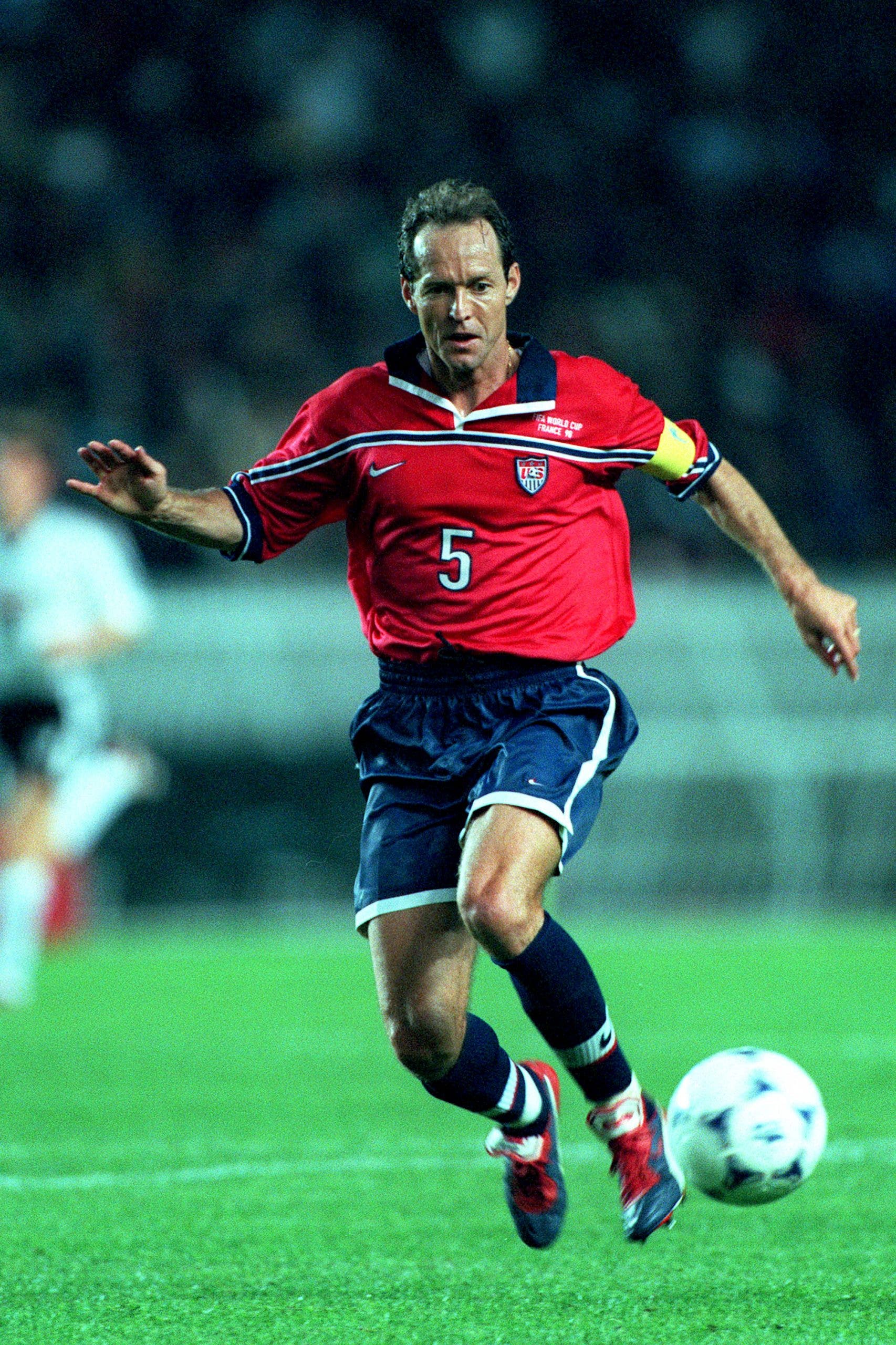
Thomas Dooley at USA's ill-fated 1998 World Cup run. (Photo by Richard Sellers/Sportsphoto/Allstar via Getty Images)
The run-up to the 1998 World Cup was a mess for the U.S. team as head coach Steve Sampson dismissed captain John Harkes from the team for "leadership issues," but it was later revealed Sampson cut Harkes because he became aware of an affair between Harkes and the wife of teammate Eric Wynalda. To help settle the team, Sampson turned to 37-year-old veteran Thomas Dooley. The German-born Dooley began playing for the U.S. team in the years preceding the 1994 World Cup when U.S. Soccer was scouting for a more professional contingent of players. Dooley was discovered to have U.S. eligibility through his American father who served in Germany while in the Army.

John Harkes was removed as captain ahead of the 1998 World Cup. (Brian Bahr/Allsport)
Despite being an outsider to the country, Dooley won over the team when he joined with his professionalism and dedication. To this day, he remains the only American player to have ever won the German Bundesliga, which he did in 1990/91 with Kaiserslautern. Unfortunately for Dooley, the 1998 World Cup remains a low point in the history of the U.S. national team as the team lost all three group stage games, including a 2-1 loss to Iran that eliminated the team from the knockouts.
Dooley was given a send-off game with the national team in 1999 to finish with 81 appearances. Following his playing days, he turned to coaching and most of his years have been in Asia. In April, he was named manager of the national team of Bangladesh.
Claudio Reyna | 2002, 2006 World Cups

Claudio is only USA captain to wear the armband at two different World Cups. (Photo by Tony Marshall/EMPICS via Getty Images)
As one of the most decorated American players of all-time, Claudio Reyna remains the only player to captain the U.S. national team in two World Cups. Early in his career, he became the first American to captain a club in a top European league with Wolfsburg in Germany's Bundesliga. He became a legend for Scottish powerhouse Rangers when he scored the game-winning goal over Parma to clinch qualification for the 1999–2000 Champions League.
But Reyna’s time with the United States was groundbreaking. He was a member of four World Cup teams, although an injury prevented him from playing in 1994. He helped the U.S. team advance to the semifinals of the 1995 Copa América in Uruguay. He captained the 1996 Olympic team and scored against Argentina. In 2002, he captained the U.S. team to its best World Cup finish in the modern era with a run to the quarterfinals. That year he became the first U.S. player to be named to the World Cup all-tournament team.

Claudio Reyna taking on Italy at the 2006 World Cup. (PATRICK HERTZOG/AFP via Getty Images)
Injuries negatively impacted the final years of his career and a knee injury in a 2-1 loss to Ghana at the 2006 World Cup was his final moment for the team. After the U.S. loss, which eliminated the team after the group stages, he announced his international retirement.
Carlos Bocanegra | 2010 World Cup

Carlos Bocanegra alongside Landon Donovan. (Photo by Phil Cole/Getty Images)
The years following the 2006 World Cup disappointment were successful. When Bob Bradley was hired as coach in 2007, he immediately settled on Carlos Bocanegra to be the team’s captain, and he ended up leading the team to several important accomplishments. In 2007, he wore the armband for the team’s Gold Cup triumph. At the 2009 Confederations Cup, Bocanegra led the team to victories over Egypt and top-ranked Spain before falling to Brazil in the final. The following year at the 2010 World Cup, the U.S. team won its group for the first time since 1930.
At the club level, Bocanegra’s long career also was marked by impressive times of leadership. He wore the armband for Fulham in the Premier League, Saint-Étienne in Ligue 1, Rangers in the Scottish Premiership, and he ended his career as captain for Chivas USA in its final MLS season before folding in 2014.
A native of California, Bocanegra finished his international career with 110 caps.
Clint Dempsey | 2014 World Cup

Clint Dempsey is tied for the all-record for most goals for a USA player. (Photo by Michael Steele/Getty Images)
As one of the most popular and successful American players of all time, Clint Dempsey was Jurgen Klinsmann’s choice to captain the 2014 World Cup team in Brazil after he had been serving in that role since 2013. The lead up to that tournament was dominated by the story of Klinsmann’s controversial decision to cut the team’s all-time leading scorer Landon Donovan. But Dempsey immediately delivered an important goal just seconds into the first game as the U.S. team came away with a crucial 2-1 win over long-time nemesis Ghana, who eliminated the U.S. team from the two previous World Cups.
Dempsey played in three World Cups and scored goals in each tournament. He finished his career tied with Donovan as the all-time U.S. national team leading scorer with 57 goals. He wore the armband a total of 20 times.
At the club level, Dempsey enjoyed tremendous success with Fulham. His best season came in 2011-12 when he scored 23 goals for Fulham in all competitions, including 17 in the Premier League. In 2010, he scored a memorable goal against Juventus in a Europa League knockout victory that is sometimes considered the most important goal in Fulham’s history.
Tyler Adams | 2022 World Cup

Tyler Adams at the 2022 World Cup in Qatar (Getty Images).
After failing to qualify for the 2018 World Cup, the U.S. team went with a youthful approach throughout the cycle leading to the 2022 World Cup. Head coach Gregg Berhalter settled on Adams, just 23 years old, as the captain shortly before the World Cup began. After the Americans advanced to the Round of 16 before losing to the Netherlands, Adams was named U.S. Soccer’s Male Player of the Year for 2022.
In a club career that saw him begin as a homegrown player for the New York Red Bulls, and then progress to Europe with RB Leipzig, Leeds United, and now AFC Bournemouth (which he helped to a sixth place finish this season and a spot in the Europa League next year), Adams is part of the generation that reset the program following the embarrassing failure to qualify for the 2018 World Cup.
Adams is still a key part of the U.S. national team program under Mauricio Pochettino, but he was not selected to captain the 2026 World Cup team as the position was given to Tim Ream.
Tim Ream | 2026 World Cup

Tim Ream will lead the USA this summer. (Photo by Andrew J. Clark/ISI Photos/USSF/Getty Images)
When Tim Ream made his United States national team debut in 2010, few expected it would be the start of a remarkable international career that has continued for over 15 years — and has the center back now serving as the USA's captain at the 2026 FIFA World Cup. At 38 years old, he will be the oldest player to ever serve as the USA captain at a men's World Cup.
Now with MLS club Charlotte FC, the St. Louis native had a solid career in the English Premier League, most notably with Fulham. He joined an elite group of American players who have worn the armband in a Premier League game (others including Brian McBride, Carlos Bocanegra, Claudio Reyna, Clint Dempsey and Tim Howard).
2026 FIFA World Cup: How To Watch
The 2026 FIFA World Cup will run from June 11–July 19, 2026. Spread across three countries, the tournament will culminate with the final on July 19 at New York New Jersey Stadium in East Rutherford, New Jersey. All 104 tournament matches will air live across FOX and FS1 with every match streaming live and on-demand within both the FOX One and the FOX Sports app.
The opening match on June 11 between Mexico and South Africa (3 p.m. ET) will stream for free on Tubi, as well as the USA's opening match against Paraguay on June 12 (9 p.m. ET).

Lionel Messi Points Finger At MLS Commissioner Don Garber After Campeones Cup Final

Youth Movement Afoot: 3 Takeaways From USA's First Roster Of 2030 World Cup Cycle

Lionel Messi Scores 100th Inter Miami Goal In Campeones Cup Final Win vs. Cruz Azul

Jürgen Klopp Calls Up 44 Players For First International Window With Germany

USA Roster Prediction: Will Christian Pulisic Make The First Post-World Cup Roster?

James Rodríguez Ends 15-Year Colombia Career At 35

Ballon d'Or 2026 Nominees: Kane, Mbappé And Yamal Headline 30-Man Shortlist

USA Coach Mauricio Pochettino Waits On Noahkai Banks — And Warns Cavan Sullivan

Julián Quiñones Becomes Second-Ever Mexican Player Nominated For Ballon d'Or


-
Lionel Messi Points Finger At MLS Commissioner Don Garber After Campeones Cup Final
Youth Movement Afoot: 3 Takeaways From USA's First Roster Of 2030 World Cup Cycle
Lionel Messi Scores 100th Inter Miami Goal In Campeones Cup Final Win vs. Cruz Azul
-
Jürgen Klopp Calls Up 44 Players For First International Window With Germany
USA Roster Prediction: Will Christian Pulisic Make The First Post-World Cup Roster?
James Rodríguez Ends 15-Year Colombia Career At 35
-
Ballon d'Or 2026 Nominees: Kane, Mbappé And Yamal Headline 30-Man Shortlist
USA Coach Mauricio Pochettino Waits On Noahkai Banks — And Warns Cavan Sullivan
Julián Quiñones Becomes Second-Ever Mexican Player Nominated For Ballon d'Or





 Your Privacy Choices | Closed Captioning


