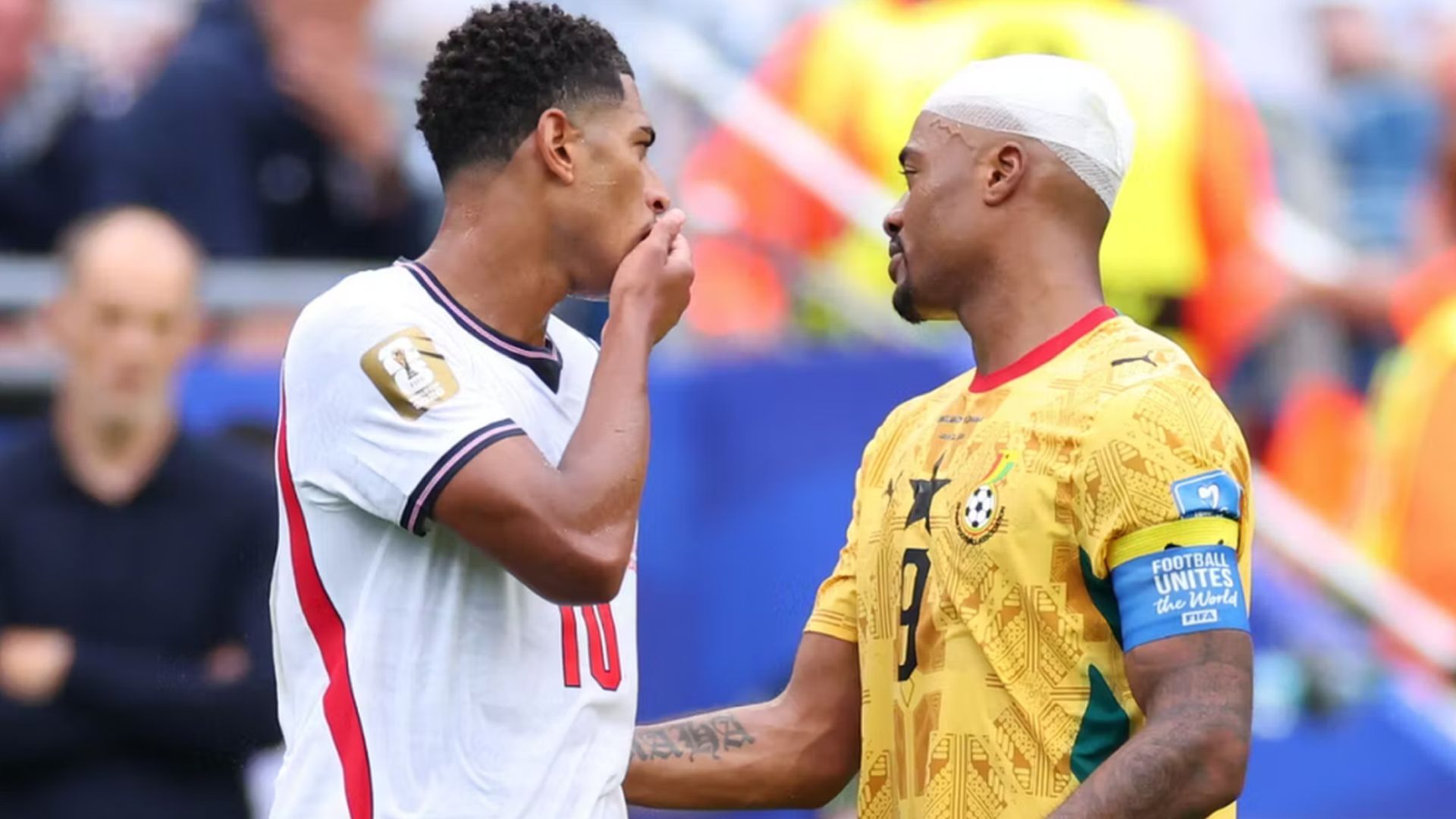
Explained: Why Jude Bellingham was NOT shown red card for covering his mouth when talking to Jordan Ayew during England's World Cup draw with Ghana


The new FIFA mouth-covering law
The controversy surrounding Bellingham stems from a recently introduced regulation for the 2026 World Cup, which mandates that a player can be sent off if they deliberately hide their mouth when speaking to an opponent. This move was championed by FIFA president Gianni Infantino following an incident involving Benfica's
The rule was designed to ensure accountability and respect on the pitch. Infantino noted: "It's about respect. It's about the example that we should give. If you have nothing to hide, you don't cover your mouth when you speak to somebody. The rules have been made very clear to everyone."
Why Bellingham escaped punishment

While images showed Bellingham covering his mouth during a chat with Ayew, context is everything in the eyes of the officials. Pierluigi Collina, FIFA's head of referees, clarified before the tournament that the act itself isn't banned, only the act of doing so during a heated confrontation. "Players can continue to cover their mouth with an arm and the shirt because they may chat with friends," Collina explained. "So if the conversation is a friendly conversation, they can continue to do it without any problem."
In the case of the Real Madrid midfielder and Ayew, there was no detectable animosity between the two players. It was viewed as a standard tactical discussion or friendly chat. Unlike the recent dismissal of Miguel Almiron, who used the gesture during a heated melee, Bellingham’s actions did not meet the confrontational threshold required for VAR to intervene.
The Almiron precedent and rule consistency
The football world was put on notice when Paraguay's Almiron became the first player sent off for this offence against Turkey. In that instance, a general melee was occurring, and Almiron’s decision to cover his mouth while speaking to Mert Muldur was interpreted as hiding abusive language during a flashpoint. He received a one-game ban for the infraction.
There remain significant concerns regarding the consistency of this law. Critics argue it could be weaponised by players trying to get opponents sent off by initiating a conversation and then pointing out the covered mouth to officials. As it stands, the rule is an opt-in measure for competitions, and it remains to be seen if domestic leagues like the Premier League will choose to adopt it given the potential for controversy.
Touchline tensions and Queiroz's fury

The mouth-covering incident wasn't the only time Bellingham found himself in the spotlight. The midfielder was involved in a
Queiroz was later vocal after the final whistle, suggesting the

Ballon d'Or 2026 Nominees: Kane, Mbappé And Yamal Headline 30-Man Shortlist

Brazil Begins Post-Neymar Era With João Pedro And Estevão In Squad

USA Coach Mauricio Pochettino Waits On Noahkai Banks — And Warns Cavan Sullivan

Goalkeeper Ronald Koeman Jr. Scores Twice To Salvage Point For Telstar

Marcos Llorente, 31, Announces Shock Retirement From Spain After Winning World Cup

Lionel Messi To Get Mid-Game Tributes By Soccer Teams Across Argentina

Kylian Mbappé Believes 'It's A Good Year' For His First Ballon d’Or

USA's Next Generation: 12 Youngsters In The Early Mix For The 2030 World Cup

Lionel Messi Retires From Argentina: A Legend Steps Away From International Stage



-
Ballon d'Or 2026 Nominees: Kane, Mbappé And Yamal Headline 30-Man Shortlist
Brazil Begins Post-Neymar Era With João Pedro And Estevão In Squad
USA Coach Mauricio Pochettino Waits On Noahkai Banks — And Warns Cavan Sullivan
-
Goalkeeper Ronald Koeman Jr. Scores Twice To Salvage Point For Telstar
Marcos Llorente, 31, Announces Shock Retirement From Spain After Winning World Cup
Lionel Messi To Get Mid-Game Tributes By Soccer Teams Across Argentina
-
Kylian Mbappé Believes 'It's A Good Year' For His First Ballon d’Or
USA's Next Generation: 12 Youngsters In The Early Mix For The 2030 World Cup
Lionel Messi Retires From Argentina: A Legend Steps Away From International Stage





 Your Privacy Choices | Closed Captioning


