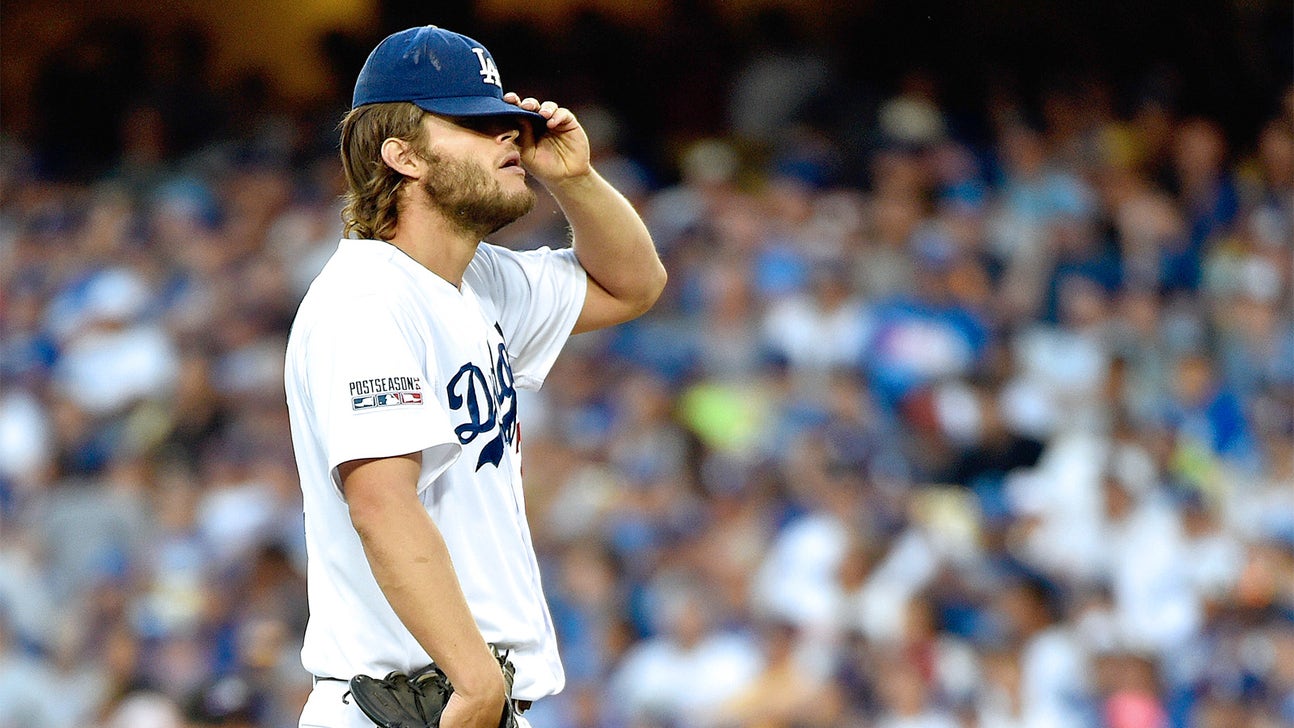
Did Clayton Kershaw tip his pitches in the fateful inning of Game 1?


The St. Louis Cardinals shocked the Los Angeles Dodgers after dropping six earned runs on ace starting pitcher Clayton Kershaw in the seventh inning en route to a 10-9 victory in Game 1 of the NLDS on Friday. It was just the third time in Kershaw's career where he allowed six or more earned runs in an inning.
During the game, I received a message from a long-time major leaguer and former colleague of mine. He essentially told me, "They got him. It's his first time in the stretch all game and they picked up something."
I knew what he meant. He felt the Cardinals saw something in Kershaw's delivery and he was tipping his pitches. The Cardinals are known to be one of the savviest teams when it comes to things like this and my friend, a former Cardinal, was confident they had something on the Dodgers ace.
Before we go any further, let's be clear about a couple of things. First, if Kershaw was tipping his pitches, it is perfectly ethical for the St. Louis Cardinals to take advantage of that misstep. It is not against any written or unwritten rule in baseball to use this information to your advantage. Secondly, players have been attempting to steal signs or look for tells from pitchers for a lot longer than I have played this game. I remember talking with Mike Stanley one time, the former major league catcher about this. He was a master at it. He spent hours on the bench studying pitchers, looking for the subtle change in their delivery, specifically when they came set when throwing a certain pitch. Most teams have at least one guy who is pretty good at this, at least that was the case during my tenure in the major leagues. Lastly, I can't say with any certainty that Kershaw was tipping his pitches. There was some evidence to suggest that he may have been, but we don't know for sure, and in no way do I want to discredit the Cardinals for the great game they played.
Now let's get back to that seventh inning. My friend made a very good point. Kershaw was pitching from the stretch for the first time the entire game. Up until that inning, he had not walked a batter and the only hits he allowed were two solo homeruns. He had been in the windup through 6+ innings. It was the stretch where he felt things had changed, and this is not uncommon.
Kershaw has a unique stretch delivery. After getting the sign from the catcher, he brings his hands together then raises his arms high above his head and then he slowly lowers them and comes set right around chest high. During all that movement is an opportune time to get his grip on whatever pitch he may be throwing -- fastball, curveball, slider, etc. For Kershaw all that movement allows him to avoid any opponent zoning in on his hands while he is setting the grip on his pitch.
But like every pitcher, Kershaw does have to come to a complete stop and set before he throws any pitch. If he was tipping pitches, this is likely where it was happening.
Without even realizing it, pitchers will sometimes come set with their glove in a slightly altered position depending on which pitch grip they have in their hand. More often than not a curveball or a split/changeup will have you changing your glove position ever so slightly and you likely don't even realize it.
That is one possibility. Here is another.
Pitchers will sometimes unknowingly change the pace in which they come set depending on which pitch they are throwing. For example, I always started with a changeup grip in my hand when looking into the catcher for the signs. Habitually I would come set quicker when I was either throwing a changeup or a fastball because those were two grips I could get to easily from my starting grip. If I were throwing a curveball I would sometimes fall into the habit of coming set slightly slower in order to give myself more time to get the grip right before coming set. This is another possibility for Kershaw.
A third possibility is that Kershaw actually doesn't set his grip until he comes set. This is also not uncommon for pitchers to do. Ideally you look the same on every single pinch but sometimes you may have more wrist movement or forearm flexion while setting certain grips, giving away what pitch you are throwing. I played with a guy who wore long sleeves all the time, regardless of the weather, because he did not want any movement in his forearm muscles to give away what pitch he might be gripping. The slightest movement in your hands or forearms could give a pitch away. You could be doing this and not even realizing it.
Any of these are possible for Kershaw, or none of these. It could have been something else or it could have been nothing at all, and we're just chasing the wind. But let's assume it was one of these or something else that was giving away all or one of Kershaw's pitches. Now what?
For any hitter, if you know what's coming every pitch, that's great. If a pitcher only tips one pitch, that's great too. Imagine Clayton Kershaw was tipping only his curveball, that every time he went to throw his curveball out of the stretch you knew it was coming. That would certainly be a huge advantage.
Kershaw is a three-pitch pitcher, fastball, slider/cutter and curveball. He throws a changeup, but only around 3 percent of the time over his career and less than 1 percent of the time in 2014, so you don't even act like that pitch exists. If you know when it's coming, you can sit on it and track the amazing curveball that Kershaw throws just a little bit better than you otherwise would be able to. You may still not hit it hard, but the odds just tilted in your favor.
If you know for sure a curveball is not coming you can now sit on a fastball or cutter. Kershaw's fastball averages around 92-93 mph and his cutter 88-89 mph. The speed differential is not so vast that a major league hitter would be fooled when knowing one or the other is coming.
Now, what evidence do we have? Back to that seventh inning. Matt Holliday led the inning off with a single, Kershaw was now in the stretch for the first time all game. Then Jhonny Peralta, Yadier Molina and Matt Adams all hit bullet singles, they were scorched. In those three at bats none of those hitters saw one curveball, it was mostly fastballs and a couple of sliders, and they looked very comfortable. The degree of solid contact was high and that is not something we are accustomed to seeing so consistently against Clayton Kershaw.
Four batters latter, Matt Carpenter was up with the bases loaded and two outs. This was the at-bat to watch if you are a conspiracy theorist.
1st pitch -- 95 mph fastball fouled off, a healthy hack from Carpenter.
2nd pitch -- 95 mph fastball fouled off, another comfortable swing from the lefty Carpenter.
3rd pitch -- 94 mph fastball fouled off. Not your typical 0-2 comfort level swing against Kershaw.
4th pitch -- 89 mph slider, a good strikeout pitch. Carpenter took it like a champ without flinching.
5th pitch -- 88 mph slider, up and in, Carpenter comfortably took it for ball two.
6th pitch -- 94 mph fastball fouled off, another very comfortable swing. Carpenter looks locked in.
7th pitch -- 89 mph slider fouled off. Kershaw is not fooling Carpenter at all.
8th pitch -- 95 mph fastball ripped into the gap for a three RBI double. Cardinals take the lead.
Here's the easy answer: Matt Carpenter -- who had already homered off of Kershaw earlier in the game and has hit him well in his career (7 for 24, two doubles, one triple, five strikeouts) -- was having a great day at the plate and just seeing the ball really well against Kershaw. His teammates for an inning were also seeing Kershaw well and hitting him hard. That is 100 percent entirely possible. Kershaw is tremendous but still human.
Here's another possibility: The Cardinals got something on Kershaw when he was in the stretch, like my friend said. They were able to pick up on one or all of his pitches which gave them a huge advantage. Including playoffs, Kershaw was 68-0 when getting four or more runs of support in a game. That record dropped to 68-1 after the Cardinals put a six spot on him in the seventh inning of Game 1 of the 2014 National League Division Series. 68-0 is no small sample size.

MLB Free Agency Rumors, Buzz: Nationals Hire New General Manager

Touching Base: MLB Managers Share the Most Important Part of Their Job in 2026

Twins Add 3 Limited Partners, Change Ownership Control Person

3 MLB Free Agents New York Yankees Should Target Amid Slow Offseason

Dodgers Owe $1.06 Billion in Deferred Money After Signing Edwin Diaz

Behind the Plate: Tony Vitello Is Setting Example To 'Marry' MLB and College Baseball

Way-Too-Early 2026 MLB Power Rankings: How Teams Stand Before Winter Meetings

World Series Winners: Complete list of champions by year

What are the 100 best athlete nicknames of all time?



-
MLB Free Agency Rumors, Buzz: Nationals Hire New General Manager
Touching Base: MLB Managers Share the Most Important Part of Their Job in 2026
Twins Add 3 Limited Partners, Change Ownership Control Person
-
3 MLB Free Agents New York Yankees Should Target Amid Slow Offseason
Dodgers Owe $1.06 Billion in Deferred Money After Signing Edwin Diaz
Behind the Plate: Tony Vitello Is Setting Example To 'Marry' MLB and College Baseball
-
Way-Too-Early 2026 MLB Power Rankings: How Teams Stand Before Winter Meetings
World Series Winners: Complete list of champions by year
What are the 100 best athlete nicknames of all time?