QB Notebook: What's Going On With Sam Darnold; Inside Justin Herbert's Worst Season


Welcome to the Quarterback Notebook, where I’ll cover the past week in NFL quarterbacking – from the most interesting passers, plays and storylines to some other stuff that caught my eye while watching film this week.
This week, we’ll ask if the Seahawks have a Sam Darnold problem, dig into Justin Herbert's season from hell, and defend the concept of an arm punt.
Let’s talk quarterbacks.
 Does Seattle Have A Sam Darnold Problem?
The simple answer is "no," but it's a bit more complicated than that.
Sam Darnold’s numbers are down from 2025 across the board, but the tape shows the same quarterback who led the Seahawks to a Super Bowl just last season. It’s Seattle’s offense that looks a lot different.
In video game terms, Darnold is playing on a harder difficulty this year. Playing quarterback in the NFL is never easy, but doing it when the defense knows a pass is coming raises the difficulty considerably. And Darnold is finding himself in those situations more often for reasons largely outside his control.
The Seahawks weren’t down on the scoreboard often in 2025, and Darnold found himself in obvious passing situations at a league-low rate. He took just 73 dropbacks while trailing in the second half last season. In just three full games this year, he’s already taken 22. Darnold’s already logged 19 third-and-long dropbacks this season; he logged just 74 in all of 2025.
Darnold's clean playoff run skewed the perception of his 2025 season. Seeing him lift the Lombardi Trophy made it easy to forget he led the NFL in turnovers. Even with Seattle’s offense suppressing his degree of difficulty, you could still make out the flaws in his game. In this environment, they’ve become glaring.
The loss to San Francisco put those flaws on full display. Both of his interceptions came on tight-window throws that were left inside his receiver, allowing the defensive back to undercut the route. And both came in passing situations.
The first came on third-and-10 with Seattle backed up in its own territory. Darnold blindly trusted Jaxson Smith-Njigba to beat his man on an out-breaking route. That's typically a bet that works out for Darnold, but not this time.
His second interception was the product of a bad throw – not a bad decision. On second-and-8, Darnold sees tight end Elijah Arroyo with a step on his defender as he runs across the field. That’s the route the play is designed for, and if Darnold can just lead Arroyo towards his upfield shoulder, there’s enough of a window to justify the throw. But Darnold throws it flat and across the field, allowing Renardo Green to undercut Arroyo for the pick.
These two mistakes didn’t tell us (or the Seahawks) anything we didn’t already know about Darnold. He’s a talented thrower who will take chances that many other quarterbacks don’t have the arm to take. When he’s rushed into those decisions, which often happens when the defense goes into pass-rush or blitz mode, mistakes are bound to happen. Even during Darnold’s career year in 2025, we saw plenty of examples.
If the Seahawks get their running back room healthy and their ground game back on track – which will keep Darnold out of obvious passing situations – his play should return to the level we saw last year, which was good enough to get Seattle the top seed in the NFC. If the offensive issues around Darnold persist, these mistakes will, too.
Darnold’s Super Bowl triumph may have raised expectations for his play, but the Seahawks are getting what they paid for. He’s not making the kind of money top-tier quarterbacks get. He’s making "good enough to win with" money. On the bright side for Seattle, if Darnold’s production doesn’t improve over the next three months, the inevitable offseason contract discussions will be much easier to navigate – and cost the new ownership far less money.
 Justin Herbert Is Spiraling
Justin Herbert is making mistakes we’ve never seen him make before. The fourth-quarter interception he threw directly to a Broncos cornerback may be the worst interception I’ve ever seen him throw.
That was Herbert’s league-leading 13th turnover-worthy play of the season, per Pro Football Focus. If you just counted his fourth-quarter turnover-worthy plays, he’d still rank seventh. The Chargers quarterback has had several ugly crunch-time moments that are impossible to defend, and those plays have played a clear role in the team's 0-5 start.
Herbert is playing the worst football of his career, but any talk of the Chargers moving in a different direction is outrageously premature, for two reasons: (1) the team has never considered trading the 28-year-old – not even for three first-rounders, per ESPN’s Adam Schefter – and (2) he’s really the only thing the Chargers have going for them at the moment. Other than Herbert, the best players on the roster are two offensive tackles who are never healthy, and a 30-year-old safety who’s off to the worst start of his career. I mean, take a look at the offense L.A. was trotting out on the field in Sunday’s game:
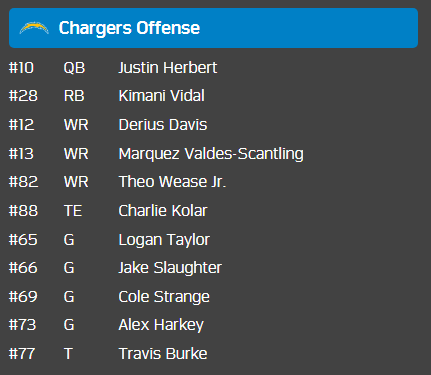
I don’t know if that lineup makes the playoffs in the UFL; it’s definitely not viable in the NFL.
A crappy roster doesn’t excuse Herbert’s poor play or the unsightly errors he’s made in the fourth quarter, but it can help to explain them. Before this season, the 2020 first-round pick was one of the best at avoiding turnovers – and not just in this era. We’re talking about all-time. Even including this season, Herbert’s 1.8% interception rate ranks fourth all-time. He’s tied with Patrick Mahomes and Tom Brady in that metric.
Herbert didn’t transform into Jameis Winston overnight. Even during this season from hell, he’s been safe with the football outside of the fourth quarter. But as he gets deeper into the game, and the reality of the Chargers offensive environment sets in and the pressure to make plays mounts, you can see the desperation grow. His feet get happier, he rushes his decisions, he takes reckless chances.
Herbert’s fourth-quarter fumble against the Broncos is a prime example. The Broncos have him dead to rights in the pocket. Instead of just taking the third-down sack, Herbert fights to get a pass off, and his offensive lineman kicks the ball out of his hand.
It’s an indefensible mistake that swung the game's momentum, but it was just one of two bad plays Herbert made all game. The interception being the other one. Here are all seven of Herbert's negatively graded plays on Sunday, according to PFF. The two turnovers are squarely on him; the rest are plays where none of his receivers get open, and his protection breaks down.
Sunday’s loss to Denver played out much like the other four losses, with Herbert scratching and crawling to make enough plays to put points on the board, before he finally broke down and made the mistake(s) that put the game away.
 Defending Josh Allen's 'Arm Punt'
With 37 seconds remaining in the first half of Buffalo’s win in Los Angeles, Josh Allen broke the pocket and chucked the ball 40 yards downfield. It was intercepted. Or as some might put it, Allen threw an "arm punt."
If you wandered into the replies to that post – I strongly suggest you stay away – you’ll find that many people take umbrage at the term. Some see it as the media coddling our golden boy, Josh. After all, when other quarterbacks throw interceptions, people roundly criticize them. When it’s Allen, it’s called an "arm punt." That's the prevailing idea, at least.
Allen has made enough mistakes to warrant criticism – like his game-ending interception in Week 4 in the Patriots loss – but this wasn't one of them. The interception was no different from your run-of-the-mill third-down incompletion. In fact, Allen threw two other third-down incompletions against the Rams. Here’s how they stacked up based on win probability loss, via Next Gen Stats:

Of the three third-down failures, the interception was the least consequential!
Throwing an interception is never "good," but sometimes it’s "less bad." This is a clear example of the latter. Here’s another Allen arm punt, which pins the Patriots at their own 1-yard line:
Allen gets the "arm punt" defense more often than other quarterbacks because he’s one of the few who throws them regularly. If we define an "arm punt" as any interception that is (a) thrown from outside of field goal range and (b) travels at least 40 yards through the air, here’s the "arm punt" leaderboard since Allen was drafted in 2018:
1. Josh Allen: 6
2. Patrick Mahomes: 6
3. Tua Tagovailoa: 4
4. Aaron Rodgers: 4
5. 10 players tied with 3
If you can ignore Tagovailoa, that’s not a bad list to be on, is it? The other three quarterbacks have won MVP in five of the last eight seasons. Instead of chastising quarterbacks for being aggressive when it’s situationally appropriate – like on third down at the end of the half – we should encourage other quarterbacks to throw more arm punts. The great quarterbacks (and Tua) are all doing it.
 The NextGen Stats Passing Map That Makes Me Appreciate Caleb Williams
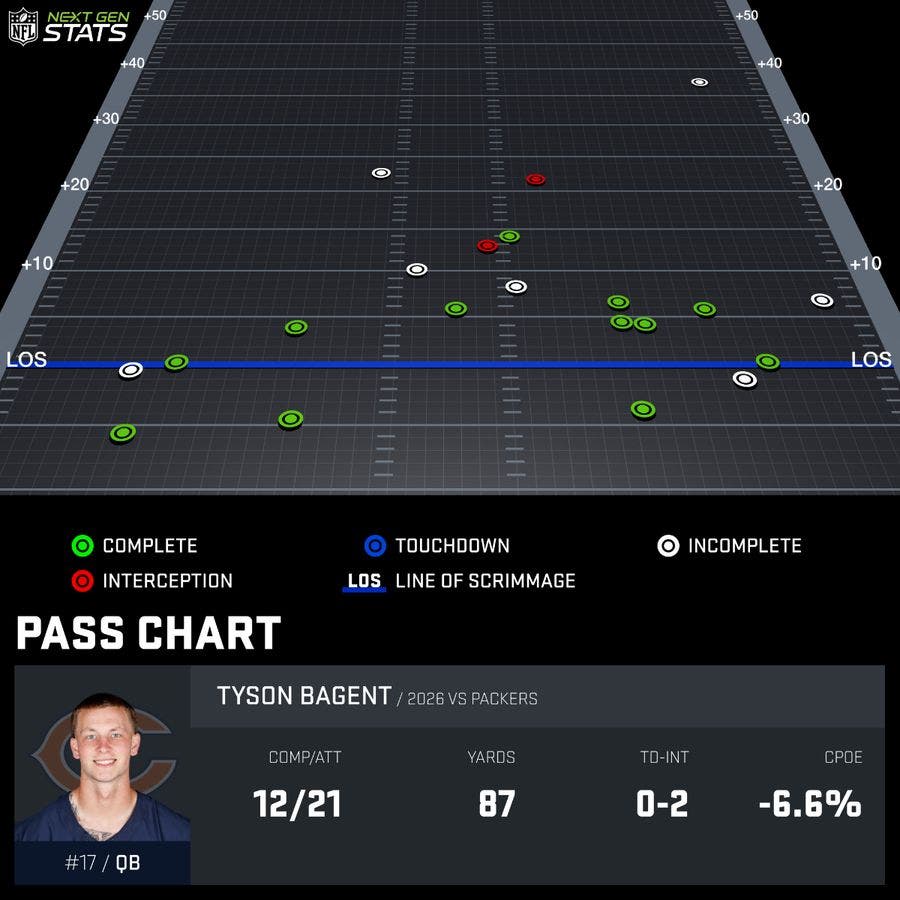
Caleb Williams is on track to return in Week 6, so we can all rejoice. As cool as it was to see Ben Johnson cook the Eagles' defense with a 38-year-old Case Keenum, Chicago’s loss to Green Bay was a harsh reminder that a good play-caller can only take you so far. Defensive coaches in this league are too good and too attentive to keep pushing the same buttons and pulling the same levers to mask your quarterback’s limitations. The past few weeks have shown us how much of a boost Williams’ playmaking provides the Bears offense.
 The Best Throws I Saw This Week
Drake Maye, Jordan Love, and C.J. Stroud all put on a show this week, so instead of picking just one, I put together a super-cut of their best throws. Sit back and enjoy the dimes.
The Worst Throw I Saw This Week
Tyler Shough failed the Brian Flores Stress Test. I could have picked either of his two interceptions for this honor. Both were thrown directly at Byron Murphy and would have been his most accurate passes of the day if the Vikings cornerback had been his intended target.



QB Stock Market Week 6: Can Dak Overcome Cowboys? Can Seahawks Overcome Darnold?

Josh Allen Is Superman: 3 Takeaways From Bills' Overtime Thrilling Win vs. Rams

NFL Week 5 All-Stars: Drake Maye Is Playing Like An MVP, As Is Jahmyr Gibbs

NFL Best And Worst: From 49ers-Seahawks Thriller To Giants-Commanders Blunder

Monday Morning NFL Top 10 Rankings: 49ers Stand Tall; 3 Teams Move In

Missed Field Goals Obscure Real Issue For Rams: This Super Team Is Not Super

The Week 5 Plays That Stood Out, From Jayden Daniels' Blunder To Mike Evans' Dominance

2027 NFL Mock Draft: Arch Manning First QB Selected, Jeremiah Smith No. 1 Overall

Big Bets Report: Huge Wager On Ravens Moneyline Cashes In For Six Figures





 Your Privacy Choices | Closed Captioning


