What If? The 2006-2007 Suns Revisited


I’ve been a Suns fan for practically my entire existence. 2007 was the year we were supposed to win it all. It’s been a decade since that season, and I’m still not over it.
I wasn’t born yet in 1976 and thus unable to experience the Sunderella Suns’ shocking run to the NBA Finals. In 1993 I was a young child and have only vague memories of the Suns’ return to the Finals and subsequent loss to the Jordan led Chicago Bulls. I have more vivid memories of the following two years, seasons filled with championship expectations that both ended to the Houston Rockets in the playoffs. The 1994-95 season ended in excruciating fashion, a 115-114 defeat in game 7 of the Western Conference semi-finals at home. These years typically make up the list of any Suns fan’s “What If?” seasons. While it’s obvious that these seasons haunt the dreams of many Suns fans (thanks in no small part to John Paxson and Mario Elie), the year at the top of my list is definitely 2006-2007.
Phoenix entered 2006-2007 with high expectations. The Suns were in the midst of their “7 Seconds or Less” popularity and were coming off back-to-back Western Conference finals appearances. The hype around the team specifically celebrated the heralded return of Amare Stoudemire. Amare, an All-NBA forward, had missed all but 3 games of the previous season due to knee surgery. The 2005-2006 team had surpassed expectations without Stoudemire, losing in the conference finals in six games to eventual champion Dallas Mavericks. With the team now back at full strength, championship talk was at a fever pitch.
The Suns maintained the majority of their roster from 2005-06 to 2006-07. They traded their first round pick in the draft and made no high-profile free agent signings during the offseason. Tim Thomas, who started 10 games at small forward during the injury plagued 2005-2006 season, and new faces at the end of the rotation comprised the only turnover on the roster. Eddie House and Brian Grant joined Thomas in departing Phoenix. They were replaced by Marcus Banks, Jalen Rose and Eric Piatkowski.
Current Suns guard Leandro Barbosa was the 6th man of the year in 2006-07. Mandatory Credit: Jennifer Stewart-USA TODAY Sports
Entering the season the starting lineup consisted of 2-time MVP Steve Nash at PG, Raja Bell at SG, Shawn Marion at SF, Boris Diaw at PF and Amare Stoudemire at C. Leandro Barbosa was the 6th man and led the bench portion of the rotation, which mainly ran 9 players deep. Other reserves in the rotation included Kurt Thomas, James Jones and Banks. Rose, Piatkowski and fan favorite reserve C Pat Burke also played in a decent amount of games throughout the season.
Nash and Amare (who would both be named to All-NBA First Team after the season) anchored the lineup. However, the other starters, especially Marion, were all key contributors during the season. The Suns were flat-out more athletic at just about every position than anyone else in the league. Any starter could go for 30 points in a night, especially with a player like Nash leading the break.
In typical fashion for a Mike D’Antoni coached team (entering his 3rd full season with the Suns in 2006-07), Phoenix didn’t play much defense during this era. The gameplan was built around putting more points on the board than the opposing team, and doing it as quickly as possible. No lead of any size, on either side, was safe. Phoenix would routinely rally from 15-20 points down at times, and they also gave up just as many leads of the same margin.
It was the dawn of the space and pace NBA and the Suns were the hottest ticket in the league. Every game was a show and Phoenix was the most exciting team in the NBA. The Suns might give up 115 points, but they’d drop 120 and still get the W.
2006-2007 did not start out kindly for Phoenix. The Suns stumbled out of the gates to a 1-5 record including an opening night loss to the hated Los Angeles Lakers. In 4 of the 5 losses, Phoenix gave up over 110 points.
Fortunately, the Suns turned it around from there. Phoenix went on a 15 game winning streak from Nov. 20th thru Dec 19th and a franchise record 17 game winning streak from Dec 29th thru Jan 28th. At that date in the season the Suns were 36-8, an astounding 35-3 run from the first 6 games of the season. Phoenix was running over the league and had only been held under 100 points seven times in those 43 games.
The Suns cooled off a bit in February, finishing the month 8-5, as Nash missed sometime with a shoulder injury. By the break Phoenix had three players chosen for the NBA All-Star game: Nash (who withdrew because of his injury), Stoudemire and Marion.
Post break the Suns finished the season on a 17-7 run to end the regular season with a 61-21 record, the second best regular season record in franchise history, cruising to their third straight division title.
Due to the Dallas Maverick’s 67-15 regular season record, Phoenix opened the Western Conference playoffs as the 2-seed with a matchup against the 7 seed Los Angeles Lakers. The opening round series was a rematch of the 2005-06 playoff first round when the Suns rallied from a 3-1 series deficit to beat the Lakers in 7 games, moving on in their Western Conference Finals run.
Kobe Bryant struck back in game 3, scoring 45 points. Mandatory Credit: Robert Hanashiro-USA TODAY Sports
The Suns rallied from a nine point deficit at halftime to take game 1 in Phoenix with a final of 95-87. Game 2 wasn’t close as Phoenix outscored the Lakers in each quarter leading to a 126-98 victory. Kobe Bryant struck back in game 3, scoring 45 to LA to the win 95-89, but the Suns took care of business in games 4 and 5 to close out a 4-1 series win. The opening round win set Phoenix up with a matchup against arch-rival 3-seed San Antonio Spurs with a 3rd straight trip to the Western Conference Finals on the line for the Suns.
Phoenix entered the Western Conference Semifinals redged and rolling. The Dallas Mavericks had been upset by the 8 seed Golden State Warriors in the first round and the expectation was now that whoever came out of the Phoenix-San Antonio series would be the odds on favorite the win the title.
Nash led the way for Phoenix in game 1, scoring 31 points. Mandatory Credit: Jennifer Stewart-USA TODAY Sports
Game 1 was a close affair, Phoenix led by 2 at halftime behind a strong game from Nash. However, with less than three minutes to go in the game Nash and Tony Parker collided and Nash suffered a bloody gash on his nose. Despite attempts to control the bleeding so Nash could continue playing, the injury eventually forced him to the sideline for the rest of the game. Without Nash and his 31 points in the lineup, San Antonio was able to pull away and win 111-106. Embattled and bruised but unrelenting in achieving their goal, Phoenix came back and won game 2 at home by twenty points, sending the series back to San Antonio in a 1-1 tie.
Game 3 was a Tim Duncan masterpiece, as the one of the greatest power forwards in history amassed 33 points and 19 rebounds, finishing 12-19 from the field. Duncan led the Spurs to the victory 108-101 and to a 2-1 series lead, turning game 4 into a must win for the Suns. The Spurs controlled the game through three quarters, leading by eight entering the final period of play. But as they had done so often during the D’Antoni era, the Suns got hot when they needed it and won the final quarter, outscoring the Spurs 32-18 in the process earning a 104-98 win.
But the victory was not cheap for Phoenix. With under 30 seconds to play, leading by 3 points, Phoenix grabbed the rebound from a San Antonio miss and got the ball to Nash to bring upcourt. As Nash approached halfcourt, Robert Horry slid up the floor to body check Nash, sending him flying into the scorer’s table. As can be expected, mayhem ensued for a few moments as Raja Bell went at Horry. Nash also got up to con front his offender. Most importantly, Amare and Boris Diaw came off the bench walking towards Nash while he was on the ground violating a league rule that players do not leave the bench area during an altercation.
Horry was ejected and eventually suspended for two games. Bell was assessed a technical foul, but the biggest blow came after the game as David Stern and the NBA levied one game suspensions against Stoudemire and Diaw for leaving the bench. The Suns argued that neither player was involved in the altercation with Horry but Commissioner Stern held steadfast to the rule which stated that a player could not leave the bench during an altercation, regardless of the result. The decision by the league was a huge blow to the Suns. Amare and Diaw were their two most skilled big men, and Phoenix’s rotation would be severely limited for game 5.
Backed by an incensed home crowd, the undermanned Suns took it to the Spurs during the first half of game 5, leading by 11 at halftime. Unfortunately, Phoenix ran out of gas and San Antonio took control during the 4th quarter to secure the victory, 88-85, taking a decisive 3-2 series lead back to Texas. At this point in the series, the Spurs had all the momentum and used a big third quarter to win game 6 at home 114-106. Amare scored 38 points in his return from the suspension and the Suns mounted a late comeback in the 4th quarter, but it wasn’t enough to stop San Antonio from closing out the game and ending Phoenix’s season.
What if David Stern hadn’t suspended Amare and Diaw? That question has echoed in my mind for almost ten years now. Horry rightfully would still be out two games but Phoenix would be at full strength for game 5 at home. Stoudemire was at the peak of his career and was averaging 23.5 points and 10.3 rebounds per game in the series so far. Diaw was the first big off the bench and vital to Phoenix because of his versatility and offensive ability in the pick and roll.
Without both of them in game 5, Phoenix was forced to start a small ball lineup with Kurt Thomas and Marion in the frontcourt and a three guard lineup of Nash, Raja Bell and Leandro Barbosa in the backcourt. The Suns ran a six-man rotation with James Jones as the only Suns reserve to play significant minutes. Even without their two most important big men (in my opinion Diaw was more important than Thomas for his versatility, especially offensively) and virtually no bench, the Suns led at halftime and only lost by three. It’s almost certain that part of the reason the Suns blew the lead in the second was due to fatigue, which wouldn’t have been as much of a factor with two more players in the rotation.
It’s impossible to say definitively that the Suns would have won game 5 if Amare and Diaw played, but now we’ll never know. Amare himself was absolutely enough to swing the course of a game and it’s not a reach to say that Phoenix would have protected home court and taken the 3-2 lead in the series. At that point, Phoenix would only have to win game 6 in San Antonio or game 7 back at home. San Antonio would have been without Horry in game 6 still, and would have had their backs to the wall. In that circumstance, I think the Suns win one of those two games and clinch the series.
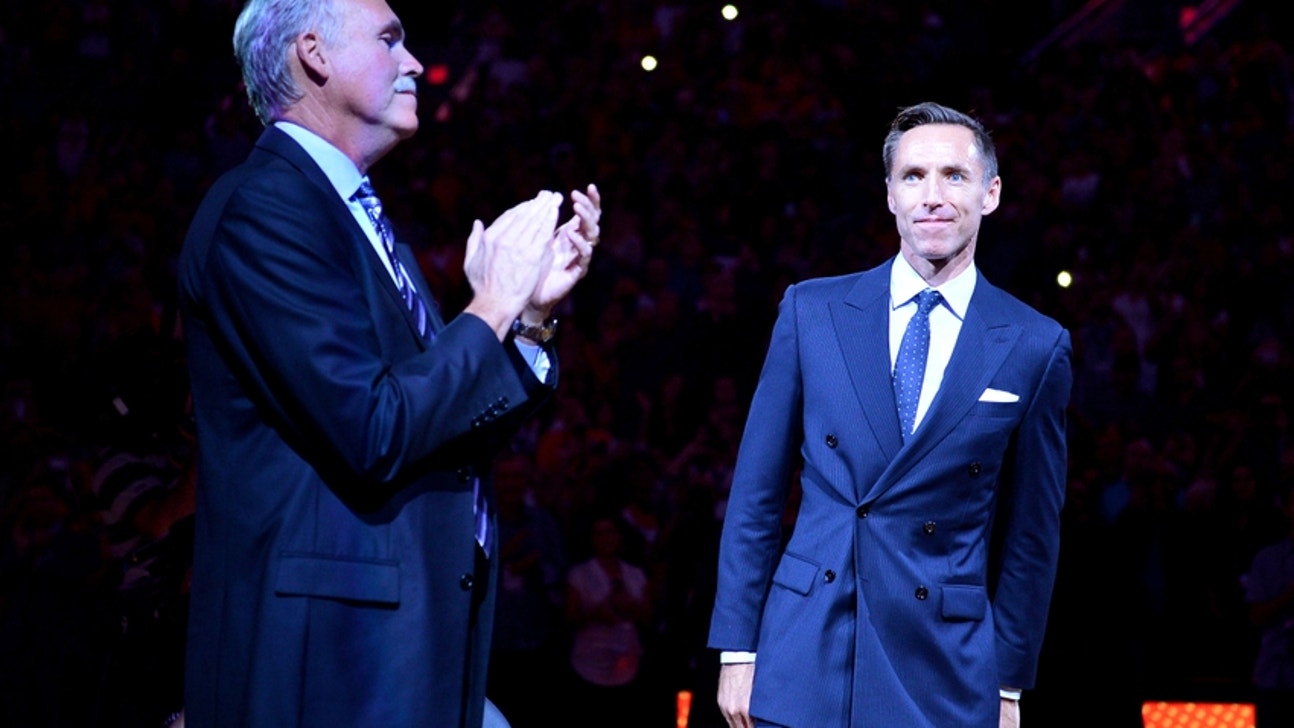
Oct 30, 2015; Phoenix, AZ, USA; Two-time NBA Most Valuable Player Steve Nash during his induction into the Suns Ring of Honor speech during half time at Talking Stick Resort Arena. Mandatory Credit: Jennifer Stewart-USA TODAY Sports
Phoenix would have been awaited by a Utah Jazz team that was the weakest conference finals opponent that Phoenix would have faced in that three year span (2005-2007). In the actual conference finals vs San Antonio, Utah looked outmatched in all but one game (game 3 at home in Utah) and were eliminated in five. Phoenix would have been coming out of the San Antonio series with focus and confidence, knowing they had eliminated the biggest obstacle left in their path to the title. Maybe the Suns don’t win in 5, but I think they would have got the job done within 6 games.
In the NBA Finals, Phoenix would have played the Cleveland Cavaliers with a young LeBron James and not much else. Phoenix had blown them out in two games during the regular season and would have certainly won a series with them, possibly matching what the Spurs actually did by winning in a sweep. It’s easy to say all of this since Phoenix didn’t actually have to play any of these games, but it’s obvious that the path after the Spurs was ripe for the taking. I think it’s completely plausible, and actually probable, that Phoenix would have won its first NBA championship if the Suns had won game 5 against San Antonio.
At the end of the day, “What if?” exercises are pointless. The past can’t be changed, heartaches can’t be removed, only treated and left behind. To a small extent, I have experienced most of what basketball has to offer. I played in high school, I’ve coached both high school and college ball, and I’ve been a fan since I can remember. With a few exceptions, I’ve been able to accept it (not always happily) whenever my team has lost on the court and move forward.
I’m not sure if I’ll ever be able to accept that series loss to San Antonio in 2007. That was it. That was the year we were going to win it all. That series with San Antonio WAS the finals, and everyone knew it. There should be a championship banner hanging in Talking Stick Resort Arena. There should have been a city holiday and a giant parade down Jefferson Street in downtown Phoenix. All the heartache from the Barkley years, all the memories of Paxton and Elie, they were supposed to be forgotten because of 2007. Instead, they’ve just been added to.
What if Amare and Diaw hadn’t been suspended? What if the series had been decided on the court? I don’t know if I’ll ever fully cleanse the image of Horry checking Nash into the scorer’s table from my head. Even when I’m old and senile, I might be able to see it when I close my eyes. Hopefully, at that point in my life, I’ll also be able to close my eyes and see a Suns’ trophy celebration.
More from Valley of the Suns
This article originally appeared on 
2025-26 NBA Playoff Odds: Spreads, Lines for Second-Round Series

Who are the 10 best 3-point shooters in NBA history?

NBA Champions by Year: Complete list of NBA Finals winners

2025-26 NBA Title Odds: Thunder, Spurs Favored; East Up For Grabs

2025-26 NBA Odds: Thunder, Knicks Favored to Meet in Finals

NBA Title Runs for Lakers, 76ers Could Bolster Bettors' Bankrolls

NBA Draft History: Complete list of overall #1 picks since 1947

What are the 100 best athlete nicknames of all time?

Who are the 10 best father-son sports duos of all time?



-
2025-26 NBA Playoff Odds: Spreads, Lines for Second-Round Series
Who are the 10 best 3-point shooters in NBA history?
NBA Champions by Year: Complete list of NBA Finals winners
-
2025-26 NBA Title Odds: Thunder, Spurs Favored; East Up For Grabs
2025-26 NBA Odds: Thunder, Knicks Favored to Meet in Finals
NBA Title Runs for Lakers, 76ers Could Bolster Bettors' Bankrolls
-
NBA Draft History: Complete list of overall #1 picks since 1947
What are the 100 best athlete nicknames of all time?
Who are the 10 best father-son sports duos of all time?





 Your Privacy Choices | Closed Captioning


