
How Northwestern's New $900 Million Stadium Offers A 'Magical' European Soccer Vibe


College sports aren’t exactly slowing down this week.
The Protect College Sports Act passed in an overwhelming "Yes" vote in the Senate on Monday night, College Football Playoff stakeholders are meeting this week in Chicago to discuss expansion, oh, and there’s a full slate of games this weekend. Week 5 features three games with both teams being ranked in the AP's Top 25, a handful of other ranked teams face potential trap games against some possibly plucky opponents and one school is finally debuting its nearly $900 million stadium on Friday.
Dizzy from all that? Same.
Let’s get into one of the other big storylines this weekend.
 The Main Event: Northwestern's New Stadium
This week made me think back to my first few weeks living in Chicago.
I was a high school sophomore, and I’d only been in town for a few weeks after moving from Washington, D.C., where I’d spent my entire childhood. We had an off day from JV football practice one September Saturday, and my mom snagged tickets for a Vanderbilt-Northwestern football game.
Sure, why not?
As I looked at Ryan Field that evening, it wasn’t exactly what I’d imagined in checking my second Big Ten football stadium off my list. My parents were Michigan grads, and I’d grown up going to games at the Big House. This was, uh, not exactly that.
No more.
Northwestern debuts the new Ryan Field on Friday when Penn State comes to town — a $862 million project funded in large part from contributions by the Ryan family.
More crucial, however, is that the project may well be a preview of future college football stadium construction as schools grapple with marrying affordable premium offerings with dwindling attendance.
"I joked for a long time: If we're right in these bets that are different than the way stadiums normally done, you'll see echoes of it in some other buildings over time," Pat Ryan Jr., who has overseen the development of the project, told me. "And if we're wrong, well, we'll have a one-of-a-kind stadium because no one will ever do it again."
I caught up with Ryan — the stadium was named for his father, Pat Ryan Sr., in 1997 after major contributions to the university — this week ahead of the opening of the stadium to talk about the project, why it’s meant so much to his family and why this isn’t just a colossal moment for Northwestern, but one that could signal a shift in how programs build their homes moving forward.
Ben Portnoy: Can you walk me through the genesis of this stadium project and what the vision was for what we’ll see on Friday?
Pat Ryan Jr.: There's a real, proven, best practices-driven approach to how you build a football stadium. In college, the general rule has been: You either do a big renovation of an old building where you're adding seats and suites, or if you're a [Group of Six] or FCS program, you build a more basic but new stadium. That’s been the playbook.
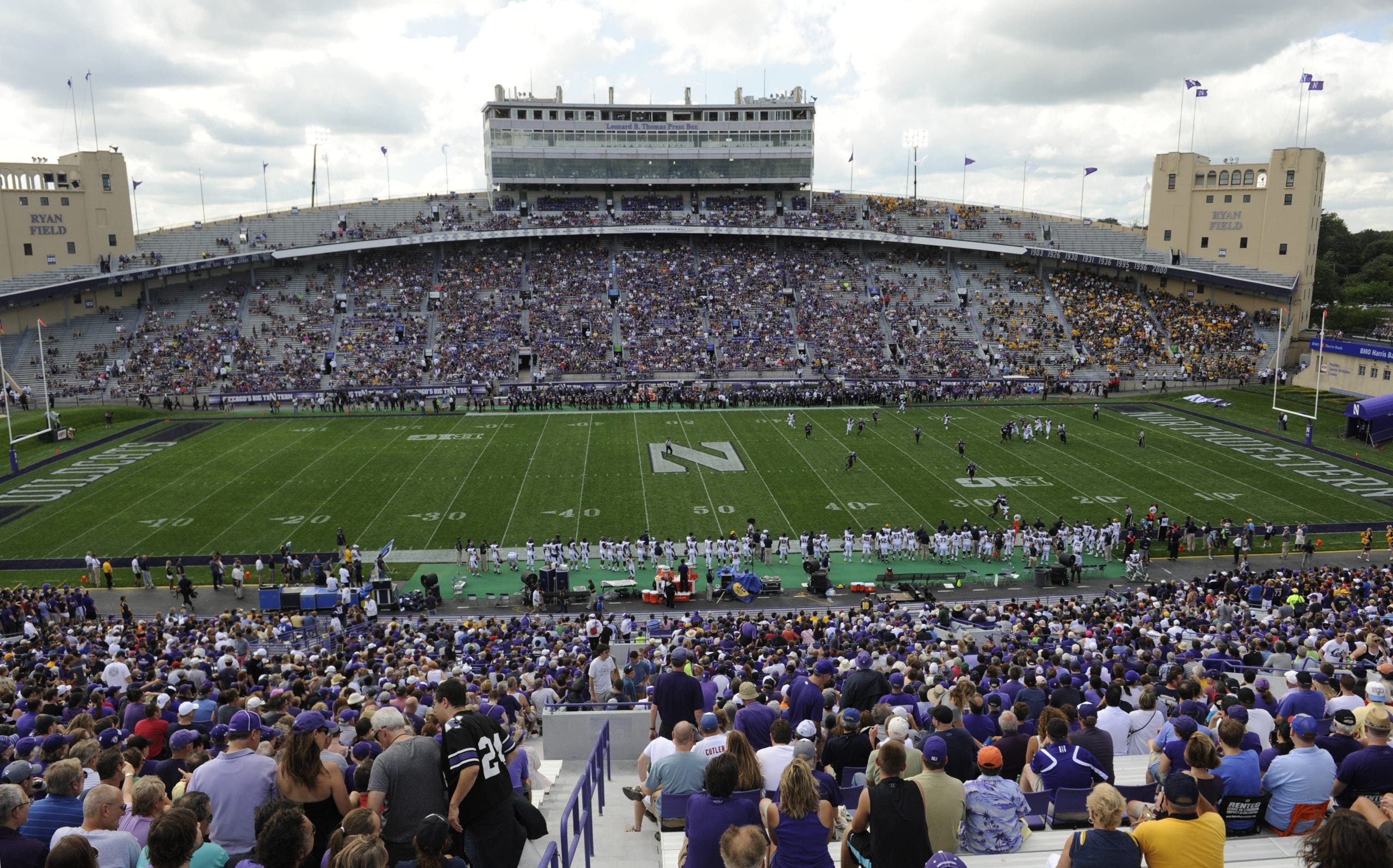
The old Ryan Field, which hosted Northwestern football games. (Photo by David Banks/Getty Images)
In the NFL, you have people building smaller seating capacity, but a larger building and a larger budget. We pursued, for the first time in college, the NFL model. That was a big departure, and I think that was very startling for people.
Of course, people said, "Will anyone ever do a project this big again?" and, of course, the answer is Nebraska is doing a billion-dollar renovation, and Florida's doing a billion-and-a-half-dollar renovation. The difference for us isn't the dollars. It's actually what we did with them and how we did it. By starting from scratch, it allowed us to really reimagine what it could be like now. … We decided to do some things very differently, and we made some bets that people would tell us we shouldn't have made, but I think we feel like those bets are going to pay off.
BP: To that end, what do you see as the most unique features of the building? What makes this so different from other stadiums?
PR: This is a bigger building than the old building. Our ticketed area is 520,000 square feet larger than the old stadium, but we have a capacity that's 12,500 less. What do we do with that? The answer is by getting rid of the worst seats. I call it the "death of the nosebleed."
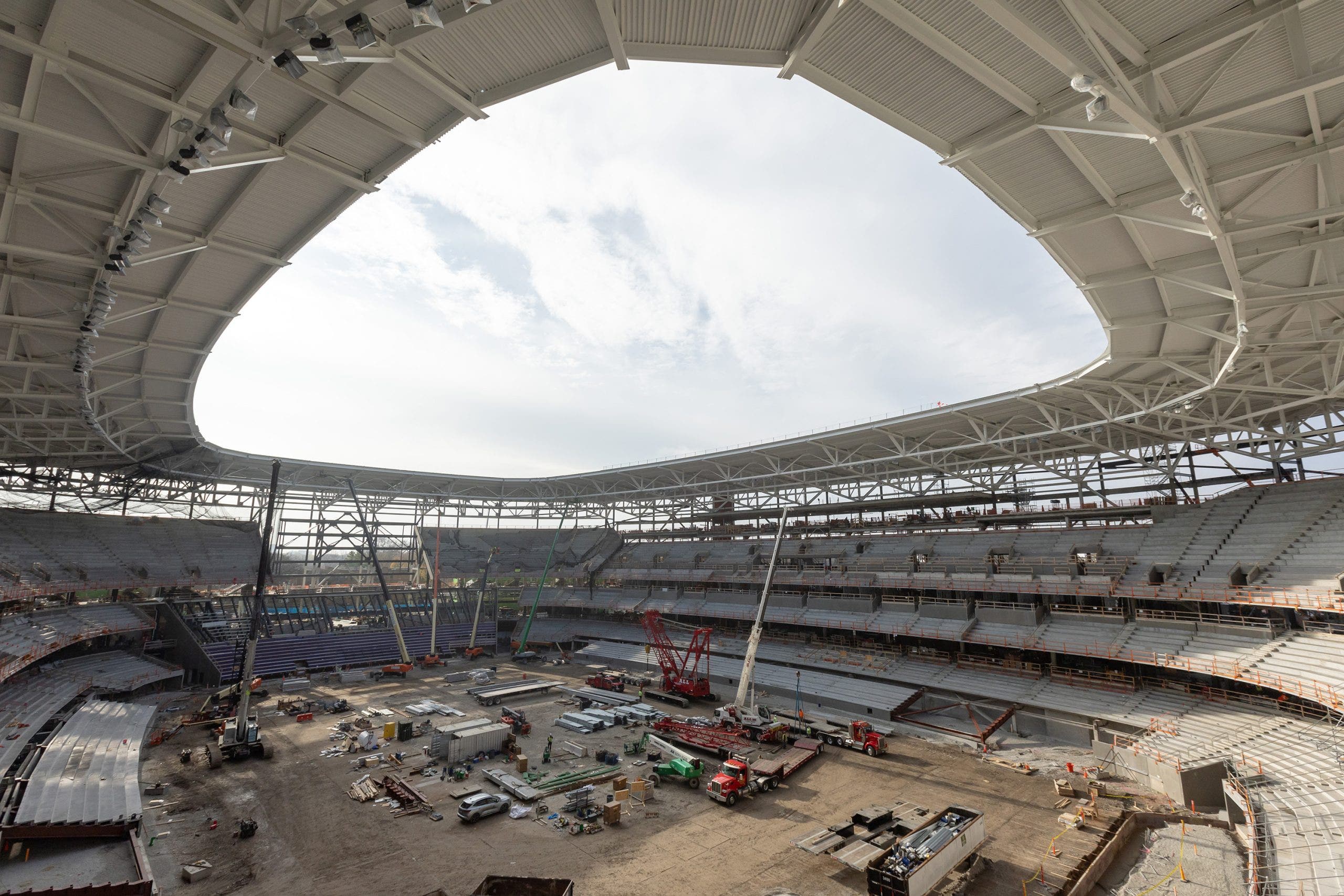
Workers continue their construction of Northwestern University's Ryan Field in 2025. The stadium's exterior was complete at this point. (Dominic Di Palermo/Chicago Tribune/Tribune News Service via Getty Images)
When you get rid of the nosebleeds, you don't just get rid of bad seats. But if you're willing to be bold with it, you actually have an opportunity to get rid of your worst seats, make your good seats great, and it makes your great seats the best anywhere.
What we did was, not only got rid of bad seats, but that allowed us to push all the other seats forward, and we used an engineering concept called "cantilevering." Instead of just being a steep rake like you see in a lot of traditional bowls, this has this deck that’s three layers stacked, or it's like a layer cake. It's three layers stacked. And we invested in the structural steel to push all of those closer. Our furthest seat on the home sideline is 136 feet from the sideline, and in a traditional stadium like a Notre Dame or a Michigan, that seat would be 235 feet.
BP: The student section setup has also drawn headlines. Can you explain a bit of the design idea there?
PR: We started with each individual fan, and we had a conversation with them, and each group leader said, "What would make their experience magical?" It starts with the student athletes, and, for them, it's really straightforward. They want to have an energized home field advantage. You start with that.
They said, "Well, the heartbeat of any college football stadium are the students." What do they want? Well, they want to matter. They want to be in it. They want to have a great time. They want to be together as a community, and they want to have an impact on the game.
Now we have a challenge, which is: We have, by far, the smallest student body in the Big Ten, with just a bit over 8,000 students, and so what we've done very differently than others is [say]: How do we create a force multiplier for our students? Because when you have 14-, 15-, 20,000 students come to a game, you don't need a multiplier effect. But we've been averaging 1,500 students a game the last couple years, so you need something, so we built this "Wildcat Wall."
We basically said, "Who are the most intense fans in sports?" If you went to watch the World Cup, you know it's hard to compete with European football fans because they don't get amplified sound. They have to bring all the energy and all the noise, and they're really hardcore, and they do it without the benefits of the technology that we in the U.S. have grown accustomed to.
We’ve basically imported what is effectively a European soccer concept, European football concept, which is this safe-standing supporter section. … It's a set of aluminum bleachers that are at a 33-degree angle, 65% slope, and what you're going to see is that the intensity of putting 2,000 students on top of the end zone where you might normally have 50 is going to bring thunder.
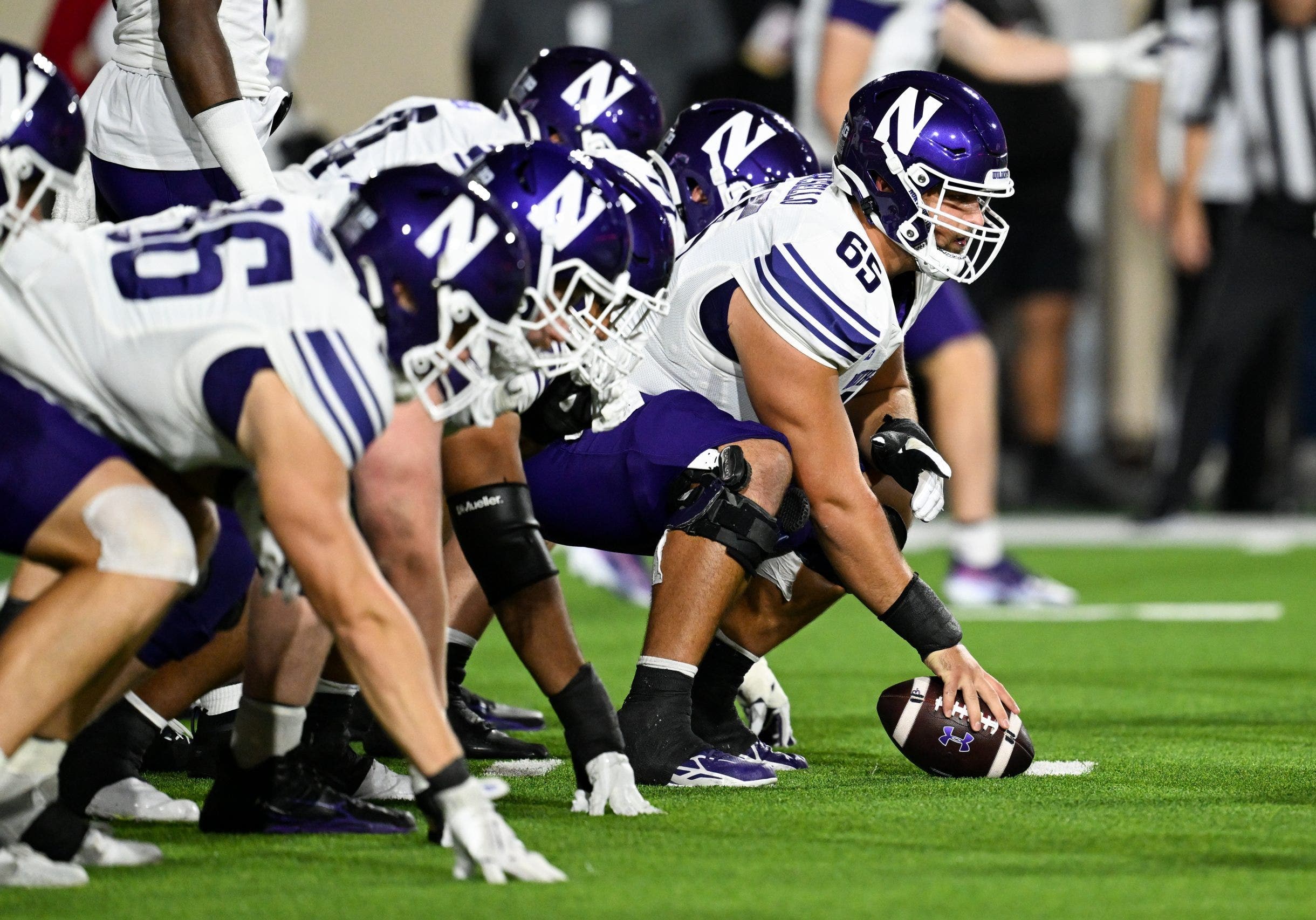
(Photo by James Black/Icon Sportswire via Getty Images)
BP: This project has taken five years, but you’re finally going to unveil it on Friday. What’re you most looking forward to when people get to come see this themselves?
PR: What I've really enjoyed with the kind of preview events we've done, and I'm going to enjoy even more, is people actually getting in here and getting a chance to see what the building is, what makes it different and how that can be magical.
When you see your seat, and you see how close to the action you are, there's something magical about that.
 Best Deal I Saw This Week

(Photo by Scott Marshall/Getty Images)
More trophy games coming to college football? Hell yeah.
Wyoming and North Dakota State have dubbed their now-annual matchup the "Battle of the Basins," and it will be sponsored by North Dakota Petroleum Council.
For all the jokes about oil money in college football, glad Wyoming and North Dakota State are just getting to the point here. The trophy is also going to include a drill bit (!!) — we love to see that.
Great work, everyone involved here.
 Best Quote I Saw This Week
"Three wins against these guys. I guess if you’re interested in winning football games, you’re from this area, you should go to Oregon. You want to go to a Chris Brown concert, you should go here." — Dan Lanning following Oregon’s Week 4 win over USC.
Dan Lanning didn’t exactly, uh, mince words following his latest win over USC on Saturday night. The dirty hit on Dante Moore likely didn’t help the post-game situation either, but the Ducks’ head coach was throwing haymakers in the post-game press conference.
Then again, Oregon has won all three meetings with USC under Lanning. Talk your talk.



The Joel Klatt Show










 Your Privacy Choices | Closed Captioning


