Blake Griffin's absense shows change that has to come in his game


For all the talk there is today about how offenses have to maximize their efficiency by either darting at the rim or spreading to the three-point line, not all attacks subscribe to that strategy. Heck, not even all efficient ones do. The Spurs have the third-ranked offense in the NBA (based on points per possession), and they rely on the midrange shot while taking few three-pointers. The Clippers have the fourth-ranked one and rarely ever get to the rim. Meanwhile, they're near the top of the league in mid-range attempts per game.
The Clippers can score, but they aren't actually maximizing their ability because of that stat.
For the second year in a row, the Clippers are winning games despite the absence of Blake Griffin. Last season, when the arguable best power forward in the NBA went down with an elbow injury, the team maintained, going 9-6 over that 15-game span. This time, Griffin is sitting with a quad injury, and though the sample is small, the Clips have managed to win their first three games without him.
What's the most notable trend over this time? The shot distribution.
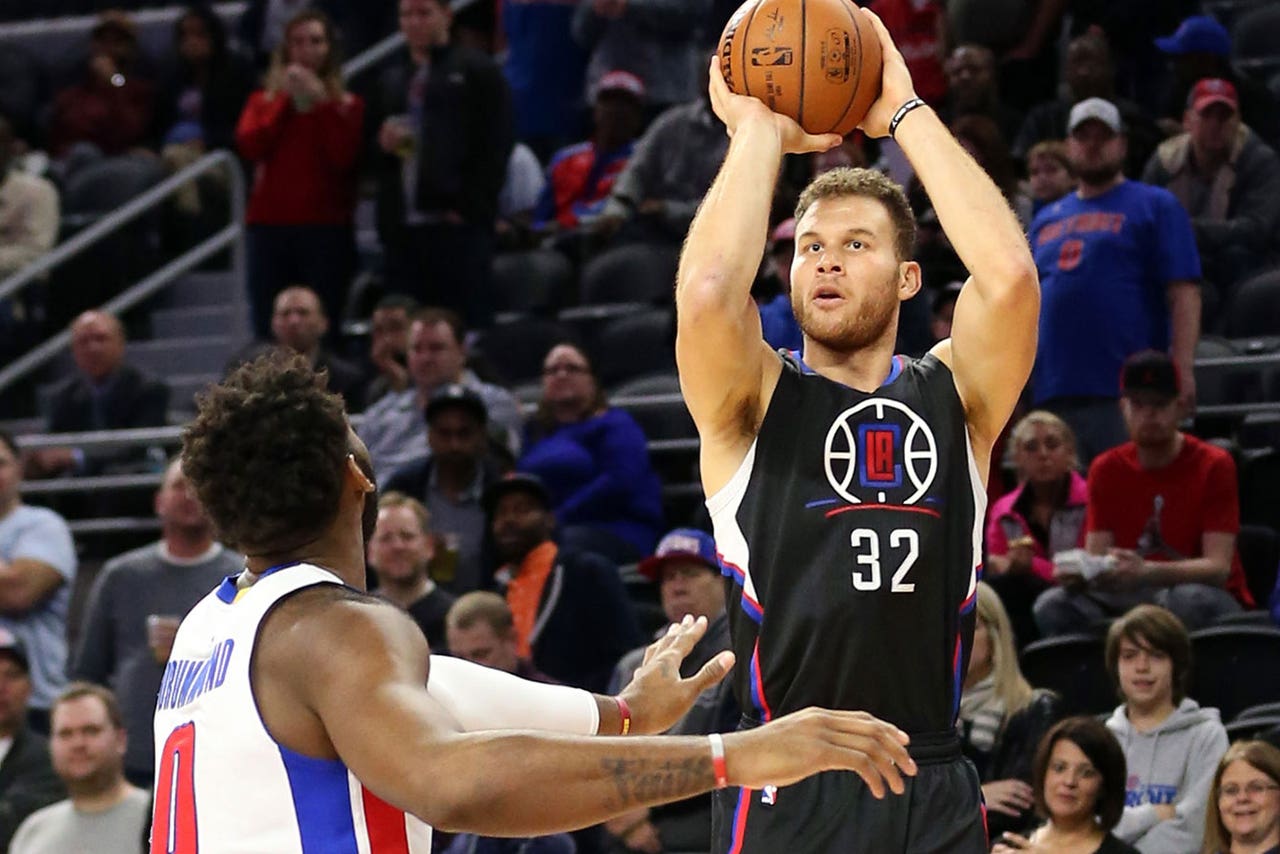
Griffin has become progressively more midrange-heavy over the years. Actually, the percentage of his shot attempts that have come from the midrange area has risen each individual year he's been in the NBA. This year has been no exception. According to Basketball-Reference, almost 46 percent of Griffin's attempts are coming from the area between 16 feet and the three-point line. But that's the worst shot in the league, and whether Griffin is becoming more jumper-reliant and less rim-oriented because of an overconfidence in his obviously improved skill set or merely because he believes less physical play will prolong his career, he's not helping the Clippers offense as much as he could on a nightly basis because of his exaggerated style. Add in Chris Paul's pull-ups from the elbow (which aren't actually inefficient shots because Paul is exceptionally and almost unrealistically dominant from that spot), and Clippers fans end up seeing far more long 2s than your average group.
Before the Griffin injury, almost 33 percent of the Clippers' shot attempts were coming from midrange, a ratio that put them near the top of the league. In the three games since his injury, the team has regressed more toward the middle of the pack. The offense has vastly improved over that stretch, averaging 116.3 points per 100 possessions compared to the 103.6 it was averaging on the season before Griffin went down.
Of course, there are other more obvious (and more impactful) reasons for the Clippers' recent offensive explosion. L.A. has gone up against a Rudy Gobert/Derrick Favors-less Jazz squad and inconsistent Wizards hopefuls. They put up a 122 spot on Charlotte with hot shooting performances from Austin Rivers and Paul Pierce, who, at some point in the past week, must've stood under mistletoe and kissed a much sweeter shooting stroke than the one we saw for the first two months of this season.
This all comes back to Griffin, though. The Clippers offense is clearly better with him there. That's not the debate here. Even last year, when he missed those 15 games with the elbow injury, the offense took an unsurprising dip despite a similar trend to what's continued this year: Fewer shots from midrange, more shots around the rim and from three with him out. From a schematic point, the shot selection does become more efficient when he leaves, and that shouldn't be the case when it comes to a top-10 NBA player.
So, how do the Clipper solve this? How does Griffin remain comfortable, sustain his body for the season and avoid becoming beat up by playoff time or his 30th birthday? Just take a step back instead of attempting those 22 footers.
Doc Rivers has talked about it. He's hinted he'd like Griffin to grow more comfortable shooting threes, though he's hardly pushed him to an area where physically, he seems comfortable but mentally, it's been a bit more of a struggle. Griffin appears at ease when he has to fling a long ball at the end of the shot clock or a quarter or a catch-and-shoot from the corner, where the Clippers offense rarely places him since you can't create much or at all from there. Otherwise, no dice.
"He can shoot them," Rivers said less than two weeks ago, via RealGM. "It's funny, he works on them. I still think at times he doesn't really want to shoot them unless we draw the play up for him to shoot it or it's late clock."
So, maybe the next step here isn't to force it. It's to draw some actual plays for Griffin to shoot 3s, slide him into natural 3-point scenarios, and then build from there.
One every other game. Then, once a game. Then, one-and-a-half a game. Get to a juncture that eventually, at some point, at some moment down the line, the game's possible most athletic big man who also just so happens to be an above-average shooter isn't leaking talent around the midrange area half the time. Use that oil to grease a new comfort zone, not just to spill out of him.
The Clippers have led the NBA in offensive efficiency two years in a row now. This year, the attack has slid considerably back from where it was a season ago, though with offense down around the league, the team remains fourth in the NBA. But the offense isn't maxing out. One way to get it there is to shy away from midrange reliance and spread the floor even more than it already does.
Fred Katz covers the NBA for FOX Sports. Follow him on Twitter: @FredKatz.