
Get to Know a College Basketball Mid-Major: Big West


You know all about the Power 5 conferences in college basketball. You hear about those more than any other, and those groups often dominate the March Madness conversation. There are 26 other conferences out there, however, and our goal is to get you up to speed on the teams, players and fights in the standings to know before the conference tournaments, Selection Sunday and the official start of March Madness.
It’s time for you to get to know a mid-major: this time, it’s the Big West.
The Big West name works in a couple of different ways. For one, most of it is located in California, which is about as big and west as you can get — for the purposes of this wordplay, Alaska is more like the big northwest. Hawaii is there, too, and while that isn’t big, it’s more west than the rest. While there have been plenty of other non-California schools in the Big West over the years and decades, in the present, it’s all California besides Hawaii. And next year, it will be all California besides Utah Valley, but that’s a 2026-2027 discussion.
As of now, there are 11 teams in the conference, and the top eight will qualify for the Big West conference tournament in March. The top two seeds receive byes straight to the semifinals, awaiting whichever teams come out of the battles of the first two rounds, while seeds three and four get a pass to the quarterfinals.
In both men’s and women’s basketball, the automatic bid has been the only way into March Madness over the last three years. Given the makeup of the conference in 2025-2026, that is unlikely to change, either, but that isn’t the same thing as saying that we already know who is going to represent the conference in March. That is an open question for both the men and women.
Big West — Men’s College Basketball
Leaders:
- Points Per Game: Hamad Mousa, Cal Poly, 20.0
- Rebounds Per Game: Joshua O’Garro, Cal State Northridge, 9.6
- Assists Per Game: Josiah Davis, Cal State Northridge, 7.2 (5th in D-I)
- Steals Per Game: Brayden Fagbemi, UC Davis, 2.0
- Blocks Per Game: Kyle Evans, UC Irvine, 3.3 (1st in D-I)
Hawaii and UC Irvine are tied at 10-4 atop the Big West, and have already played each other twice: the Rainbow Warriors won the first matchup by the narrow score of 67-66, and the Anteaters took the second in overtime, 87-76. Behind these two in the standings is UC Santa Barbara, at 10-5, Cal State Northridge (9-5), UC Davis (9-6), Cal State Fullerton (8-7), UC San Diego (8-7) and Cal Poly (7-8). The other teams — all below the Big West tournament qualification as of now — are Long Beach State (4-10), UC Riverside (3-12) and Cal State Bakersfield (2-12).
The lone top-100 team in the NCAA Evaluation Tool is Hawaii, just sneaking in at 99th. UC Irvine is 119th, UC San Diego 126th, UC Santa Barbara 135th, rounding out the top-150 teams. Hawaii has four of the conference’s top-20 players in Player Efficiency Rating (PER), with senior center and seven-footer Isaac Johnson second at 25.6, senior guard Quandre Bullock (18.2), senior forward Harry Rouhliadeff (18.1) and senior forward Gytis Nemeiksa (17.0) 15th, 17th and 18th in PER — no one else in the conference has more than three (UC San Diego has the 4th, 14th and 20th players), while UC Irvine has two. Top-rated senior forward Kyle Evans (26.5) sophomore guard Jurian Dixon, at 19th (16.5).
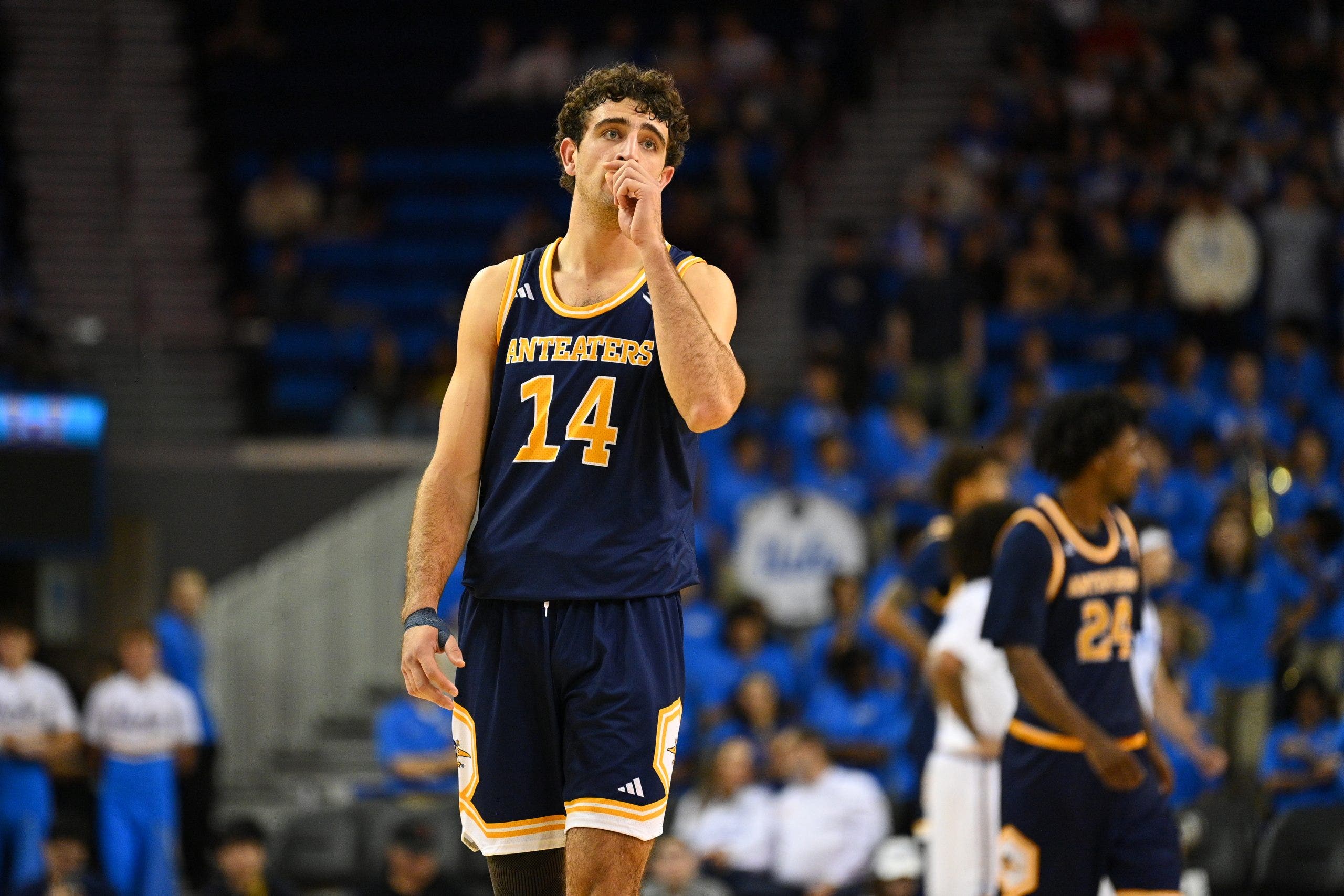
Kyle Evans has been the Anteaters – and the Big West's – best player in 2025-2026. (Photo by Brian Rothmuller/Icon Sportswire via Getty Images)
Hawaii, UC Irvine and UC San Diego are much closer together in KenPom, at 103, 115 and 118, respectively, with Hawaii’s defense being the reason the Rainbow Warriors are first up. While adjusted for strength of schedule Hawaii doesn’t stack up against the competition, on the season it has allowed 99.9 points per 100 possessions, the 36th-best Defensive Rating in Division I. The offense, however, comes in at 216th. UC Santa Barbara is best in class there, at 70th with 116.3 points per 100 possessions, basically making it the opposite of Hawaii because of its own defensive issues.
Given the stacking at the top and the relative closeness of these teams in NET and KenPom, just who will emerge from the Big West tournament is unclear. Hawaii and UC Irvine have the best chance through Feb. 17, however, almost entirely because of seeding: getting a pass right to the semifinals as one of the top two seeds is the path of least resistance, and that is going to matter in a conference where so many teams stack up well against each other.
Big West - Women’s College Basketball
Leaders:
- Points Per Game: Hannah Wickstrom, UC Riverside, 23.2 (6th in D-I)
- Rebounds Per Game: Megan Norris, UC Davis, 13.1 (3rd in D-I)
- Assists Per Game: Dymonique Maxie, UC San Diego, 4.4
- Steals Per Game: Cristina Jones, Cal State Fullerton, 4.0 (4th in D-I)
- Blocks Per Game: Imani Perez, Hawaii, 1.8
Things are a little less clustered, though not entirely so, on the women’s side of the Big West. UC San Diego is in first at 13-2, with 12-2 UC Irvine holding the second seed. UC Davis is half-a-game back at 12-3, with Cal State Fullerton 11-4. Some space begins to open up for the teams looking at byes, however, as UC Santa Barbara is two games back at 9-6 and Hawaii 8-6. Then the last two teams currently qualifying for the Big West tournament are the under-.500 UC Riverside (6-9) and Cal State Northridge (4-10). Cal State Bakersfield and Long Beach State are both 2-12, while Cal Poly is 1-14.
UC Irvine is in bubble territory, at 71st in NET: it’s the lone school in the conference with that designation. UC San Diego might be first in the conference, but NET has it 132nd overall. UC Santa Barbara (143), UC Davis (159), Hawaii (166) and Cal State Fullerton (198) are all within the top-200 in the NCAA Evaluation Tool. After that, the rest of the teams are in or near the bottom-100 in Division I. So, plenty of competition at the top, even if UC Irvine sticks out more than the rest as a potentially genuine tourney-caliber team, but it gets thin.
The Anteaters are the lone team in the Big West with an Offensive Rating putting them at over 100 points per 100 possessions (100.34). UC Davis is next up, at 93.33, and again, it thins out in a hurry. Hawaii has the 91st-best Defensive Rating, however, best in the conference, at 87.91 points per 100 possessions. UC Irvine is right behind it, then UC San Diego, so it’s not much of an advantage — there is a reason the Anteaters are on top in more ways than one, basically.
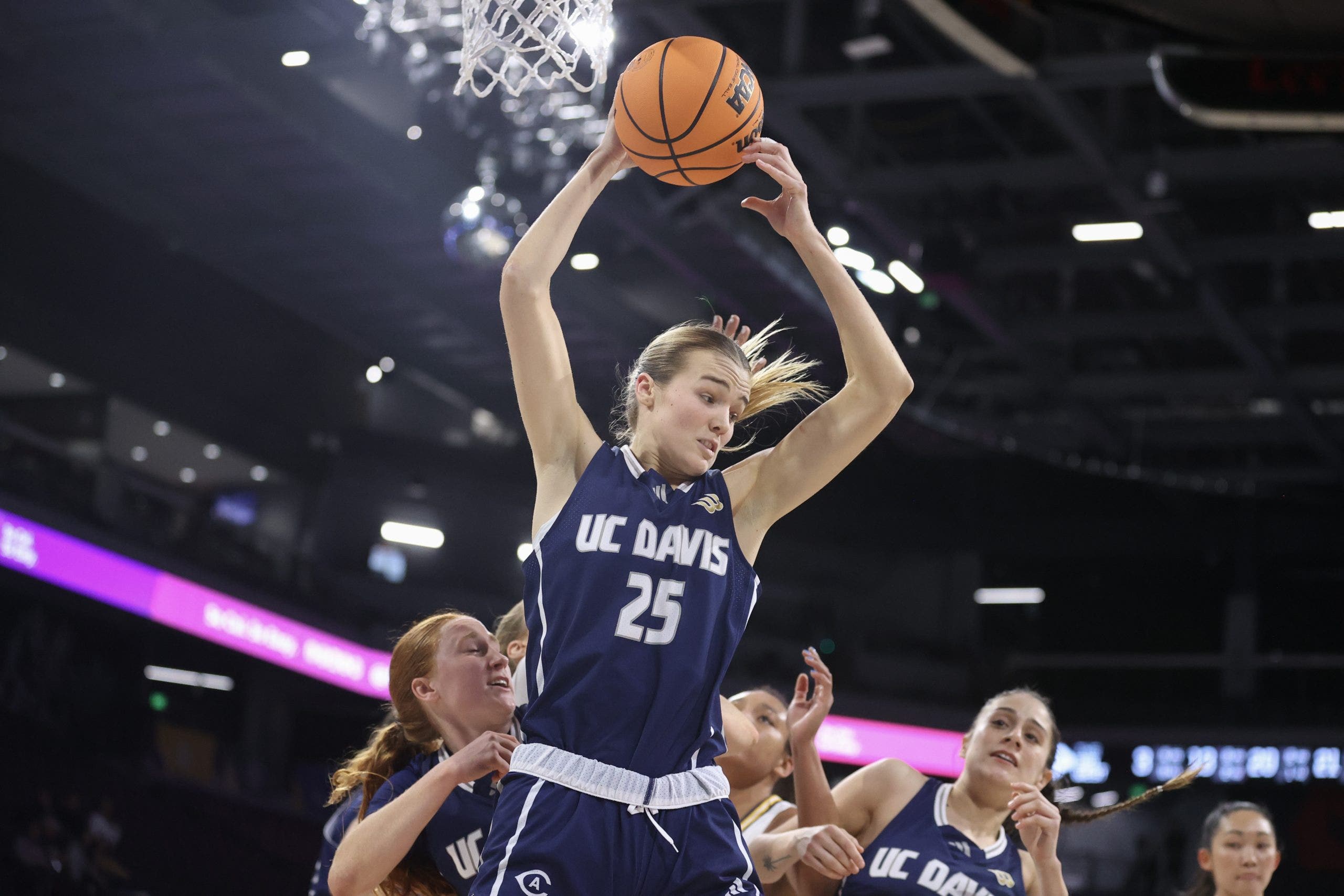
Megan Norris has been one of the best rebounders in the country, not just the Big West. (Photo by Ian Maule/Getty Images)
UC Irvine is 22nd in made 3-pointers per game in D-I women’s basketball, with 8.76, and 26th in 3-point shooting percentage at 35.8%. It’s a top-100 rebounding school, too, and while it doesn’t stack up fantastically defensively against the larger Division I landscape, within the Big West its 53.1 points per game allowed is the best mark in the conference.
UC Riverside’s Hannah Wickstrom is a legitimate scoring threat, currently sixth in D-I at 23.2 points per game. She’s also first in PER, and it isn’t close — 35.2 to Cal State Fullerton’s Cristina Jones, at 28.4. (Jones, in addition to being one of D-I’s best thieves, is scoring 16.5 points per game as a freshman guard while pulling down 9.4 rebounds). It hasn’t helped UC Riverside to a great record, but the presence of the star sophomore guard and a potential big scoring game does make the Highlanders a potential threat in every conference tourney game regardless. Then there is Megan Norris, out of UC Davis: the 6-foot-3 senior center is third in all of Division I in rebounds per game, but she’s also managed 12.6 points, 2.6 assists, over a steal and 1.5 blocks per game, and is seventh in the Big West in PER, as well.





UConn Huskies, Silas Demary Jr. Top Big East Preseason Polls

Senate Overwhelmingly Passes College Sports Bill Aimed At Player Pay, Transfers

Oregon Men's Basketball Coach Dana Altman Announces Retirement After 16 Seasons

Top 25 college athletes with highest NIL valuations

Ole Miss Set To Drop Nike For New 7-Year Deal With Adidas

Australian Star Point Guard Luke Paul Commits To Duke For 2027-28 Season

Protect College Sports Act: What It Is And What It Means

Former Celtics, Jazz Player RJ Luis Jr. Cleared By Judge To Play For LSU





 Your Privacy Choices | Closed Captioning


