Ex-SEC commissioner Roy Kramer, whose vision paved the way for college football playoffs, dies at 96


Pretty much every debate over who should play for the national title, every argument about the staggering amounts of money, every tirade about how college football is nothing like what it used to be, traces back to a man who saw a lot of this coming, then made a lot of it happen — Roy Kramer.
Kramer, the onetime football coach who became an athletic director at Vanderbilt, then, eventually, commissioner of the Southeastern Conference where he set the template for the multibillion-dollar business college sports would become, died Thursday. He was 96.
The SEC said he died in Vonore, Tennessee.
The man who currently holds his former job, Greg Sankey, said Kramer “will be remembered for his resolve through challenging times, his willingness to innovate in an industry driven by tradition, and his unwavering belief in the value of student-athletes and education.”
Kramer helped transform his own conference from the home base for a regional pastime into the leader of a national movement during his tenure as commissioner from 1990-2002.
It was during that time that he reshaped the entire sport of college football by dreaming up the precursor to today’s playoff system — the Bowl Championship Series.
“He elevated this league and set the foundation," former Florida athletic director Jeremy Foley said. “Every decision he made was what he thought would elevate the SEC. It’s the thing that stands out most when I remember him: his passion and love for this league.”
A conference title game sets the stage for money, playoffs and more
Kramer was the first to imagine a conference title game, which divided his newly expanded 12-team league into divisions, then pitted the two champs in a winner-take-all affair that generated millions in TV revenue.
The winner of the SEC title game often had an inside track to Kramer's greatest creation, the BCS, which pivoted college football away from its long-held tradition of determining a champion via media and coaches’ polls.
The system in place from 1998 through 2013 relied on computerized formulas to determine which two teams should play in the top bowl game for the title.
That system, vestiges of which are still around today, produced its predictable share of heated debate and frustration for a large segment of the sport’s fans. Kramer, in an interview when he retired in 2002, said the BCS had been “blamed for everything from El Nino to the terrorist attacks."
But he didn't apologize. The BCS got people talking about college football in a way they never had before, he said. And besides, was it so wrong to take a baby step toward the real tournament format that virtually every other major sport used?
A four-team playoff replaced the BCS in 2014, and that was expanded to 12 teams starting last season.
Turning the SEC into a national power
Before Kramer was named commissioner, the SEC was a mostly sleepy grouping of 10 teams headlined by Bear Bryant and Alabama whose provincial rivalries were punctuated by the Sugar Bowl every year where, often, the league's best team would show what it could do against the guys up north.
Kentucky was the basketball power.
Not content with that role in the college landscape, one of Kramer's first moves was to bring Arkansas of the Southwestern Conference and independent South Carolina into the fold. That small expansion previewed a spasm of bigger reshufflings that continue to overrun this industry some 35 years later.
Kramer sold the rights to televise his newly created league title game to ABC, then in 1996 added a deal with CBS worth a then-staggering sum of $100 million over five years.
A look at some numbers tells the story that Kramer saw before most people:
— In his first year as commissioner, the SEC distributed $16.3 million to its member schools.
— In his last, in 2002, the amount rose to $95.7 million.
— In 2023-24, it was $808.4 million.
“By any standard,” former Big East commissioner Mike Tranghese said in 2002, “Roy’s influence has been mind-boggling.”
Archie Manning, the great Ole Miss quarterback who is now chair of the National Football Foundation, said Kramer's “vision, integrity, and steady leadership helped shape college football into what we know today.”
The changes keep coming and not everyone loves them
Not everyone agrees that all this change has been good.
Kramer was long gone before college sports started paying players above the table — a result of the billions those players produce, most of which had, for decades, been largely paid out only to coaches and administrators.
On Saturday, the 34th version of Kramer's SEC title game will take place in Atlanta. Virtually every big conference has followed suit, yet the future of those games has been muddled by expansion (divisions were recently phased back out because the leagues are so huge), big money and the title games' impact, or lack of impact, on the expanded playoff field.
On Sunday, the bracket for this year's 12-team tournament will come out. Kramer's old school, 14th-ranked Vanderbilt, is likely to be left out despite a historically great 10-2 season that Commodores fans will argue is something to be celebrated, not ignored.
Vandy wouldn't have been in under the old system either, but part of Kramer's legacy is that the bowl games that defined this sport back in the day have been reduced to near irrelevance. Vanderbilt's postseason turn this season will likely be nothing more than a holiday-season afterthought. And a spot in the Sugar Bowl today only means something if it's part of that playoff.
Southern roots and not a spotlight seeker
Roy Foster Kramer was born Oct. 30, 1929 in Maryville, Tennessee. He earned a bachelor’s degree from Maryville College, where he was a football lineman and wrestler.
He was named head coach at Central Michigan in 1965 and earned national coach-of-the-year honors there in 1974 after winning the Division II national championship. Kramer ended his coaching career in 1978 when he became athletic director at Vanderbilt, where he served until leaving for the SEC.
Quick with a quip and slow to true anger, Kramer did most of his work behind the scenes. He was reluctant to sit for interviews and didn't much like the spotlight — or the idea that he was reshaping college sports.
Foley, the former Florida AD, recalled rushing into a locker room full of umpires to berate them after he thought they'd robbed the Gators baseball team with a bad call.
The next day, there was no mass email to media announcing a fine for the AD, no penalty being meted out to the program, no appearance on ESPN by the commish to discuss the confrontation.
But Foley's phone rang. It was Kramer.
“'That can never, ever happen again,'" Foley recalled Kramer telling him. "That was his style. He wasn’t a grandstander or a showman. He had an unbelievable ability to read people and deal with people.”
___
AP Sports Writers Mark Long and Dave Campbell contributed to this report.
___
Get poll alerts and updates on the AP Top 25 throughout the season. Sign up here and here (AP News mobile app). AP college football: https://apnews.com/hub/ap-top-25-college-football-poll and https://apnews.com/hub/college-football

2027 Mock Draft: Arch Manning No. 1 Overall? 5 QBs Go in First Round

Former Angels Top Prospect Jordyn Adams, 26, Commits To SMU Football
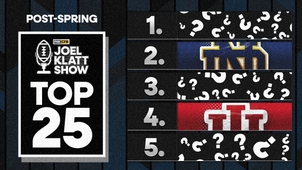
2026 College Football Rankings: Oregon, Notre Dame Highlight Post-Spring Top 25

Ruling Looming After Judge Hears Texas Tech QB Brendan Sorsby’s Eligibility Case

Top 25 college athletes with highest NIL valuations

Top 10 Breakout Candidates Heading Into The 2026 College Football Season

2026–27 College Football Playoff Schedule: Dates, Times and Networks Revealed

Top-10 Impact Freshmen Heading Into the 2026 College Football Season

Court Documents Show Texas Tech QB Brendan Sorsby Made Thousands Of Bets


-
2027 Mock Draft: Arch Manning No. 1 Overall? 5 QBs Go in First Round
Former Angels Top Prospect Jordyn Adams, 26, Commits To SMU Football
2026 College Football Rankings: Oregon, Notre Dame Highlight Post-Spring Top 25
-
Ruling Looming After Judge Hears Texas Tech QB Brendan Sorsby’s Eligibility Case
Top 25 college athletes with highest NIL valuations
Top 10 Breakout Candidates Heading Into The 2026 College Football Season
-
2026–27 College Football Playoff Schedule: Dates, Times and Networks Revealed
Top-10 Impact Freshmen Heading Into the 2026 College Football Season
Court Documents Show Texas Tech QB Brendan Sorsby Made Thousands Of Bets





 Your Privacy Choices | Closed Captioning


