UFC champion Luke Rockhold's secret family


All too often, athletes are asked slightly different versions of the same question. One of the most common ones is, "Why do you think you'll be able to beat Opponent X?"
Answers can vary from technical advantages to physical superiority to mental acuity or focus. Luke Rockhold recently gave an insightful and slightly inflammatory answer when asked why he thought he'd beat Chris Weidman in their scheduled rematch.
"You're not capable of getting it back," Rockhold said to Weidman, who was sitting a few feet away during an FS1 interview.
"I've dedicated my life to this sport and you've dedicated your life to a family. You can't push as hard. You can't do what I do."
Weidman was the defending UFC middleweight champion when he and Rockhold met last December. They battled closely for four rounds before the challenger got the advantage on the ground, battering Weidman with strikes and ending the fight.
As new middleweight champ, Rockhold was tasked with running it right back in an immediate rematch against Weidman, scheduled for this Saturday at UFC 199. Now, that fight is off because of a serious neck injury Weidman sustained, requiring surgery and forcing him off the card.
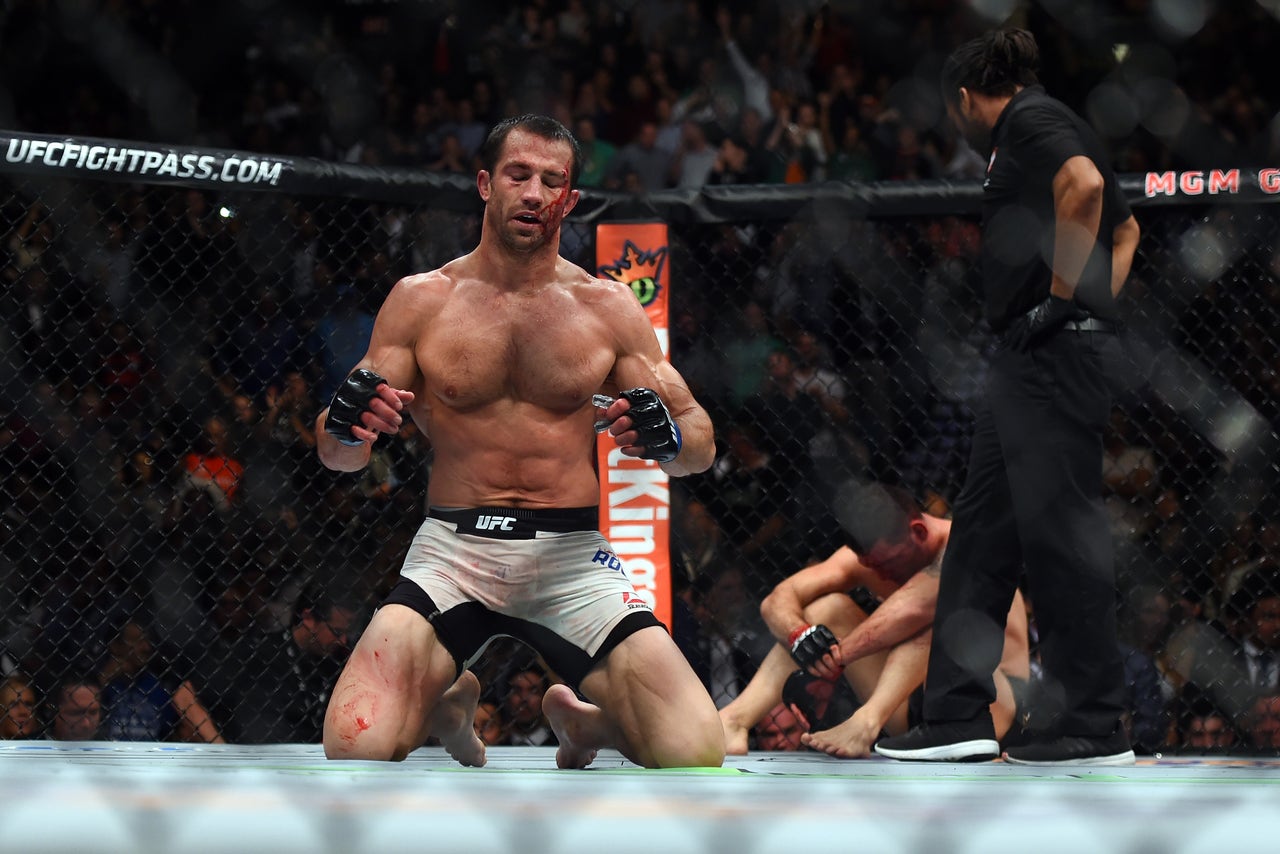
Rockhold has said that Chris Weidman (R) can't beat him because, as a father and husband, he can't devote as much time and energy to training as Luke can.
Instead, Rockhold takes on short-notice replacement Michael Bisping, and the champ's thinking would seem to apply to family man Bisping as well.
Rockhold was suggesting that he simply is more focused on his career than opponents like Weidman and Bisping, since he doesn't have a family to take care of, think about, care for, spend time with. In the individual sport of fighting, Rockhold was saying he lived a singular, independent life, and that necessarily prepared him better.
Some fighters, like Weidman, say that being mindful of their beloved family helps motivate them. Certainly, his results are hard to argue with — he became middleweight champion after beating perhaps the best MMA fighter in history, Anderson Silva.
Then, he did it again. After that, Weidman successfully defended the belt twice. After Weidman's first professional loss, however, Rockhold was bringing up perhaps a disturbing reality to "The All-America."
There are only so many hours in each day. Many fighters fill those hours with a combination of raising a family, being a husband or wife, and training for world-class fights.
Callous as his theory sounded, perhaps the new champion was on to something. There may be no more independent, lonely sport role than that of a fighter.
You train for a one-on-one competition. You get up on your own for early-morning runs. Your meal, sleep and every other type of schedule is focused on bringing yourself to a performance peak at a precise time. Training for a fight is by definition a selfish thing.
The preparation for a fight uses team and training partners, of course. Shadowboxing alone won't prepare you for a contest against a real opponent. Top MMA teams can center around champion members. Rockhold's American Kickboxing Academy team has more champions, current and former, than most.
I wanted to visit San Jose's AKA gym during Rockhold's first UFC title-defense training camp, in large part to see how Javier Mendez's mega-team coalesced around their newest champ. From afar, in all ways, Rockhold looked every bit the star.
He strutted in and out of fights, victorious. He sneered at opponents during interviews, smugly joked on reality dating shows and seemed more at home during photo shoots than most fighters would.

Rockhold has spent the past few years proving a lot of people wrong, and says he hasn't even reached his potential, yet.
How did that persona mesh with his team? How did they adjust to him to make sure he was getting what he needed to keep on winning?
I discovered that Rockhold seems to carry that same arrogance with him in the gym, but that he also combines it with an unusual commitment to helping those around him.
I first connected with Rockhold for interviews before his fight in 2015 against former light heavyweight champion Lyoto Machida. Back then, Rockhold was riding high on a three-fight win streak after losing his UFC debut against Vitor Belfort in 2013.
Rockhold had an incredible finishing rate and had lost only once in the past seven years. Still, his confidence heading into the Machida fight — the biggest test of his career — sounded a bit excessive.
The former Strikeforce champion, Machida was coming off his own TKO win, and was two fights removed from pushing reigning middleweight king Weidman to the limit over five rounds.
Furthermore, "The Dragon" was a former champion in a heavier weight class. His precision and power striking, along with his solid wrestling and ground work, were a bit more proven than Rockhold's at that point.
Of that man, Luke told me, "I know I can go out there and make it relatively easy if I go out there and fight the way I know I can.
"I think I can finish Machida."
Rockhold proved himself right. Whereas Weidman needed five rounds to edge Machida via decision, Rockhold submitted the black belt in the second round.
Afterwards, Rockhold didn't necessarily sound relieved — he spoke with knowing vindication. He was as good as he was saying he was, and he put the world on notice.
*****
Then he was matched with Weidman. What Rockhold had done so far was impressive, but it was hard to imagine Weidman losing.
Weidman could out-strike strikers, steamroll everyone with his wrestling, and surprise people with his slick Brazilian jiu-jitsu skills on the mat.
More than that, Weidman had demonstrated an indomitable will, able to overcome poverty, injuries, the best fighters in the world, and even hurricanes. Perhaps Rockhold would be Weidman's biggest challenge.
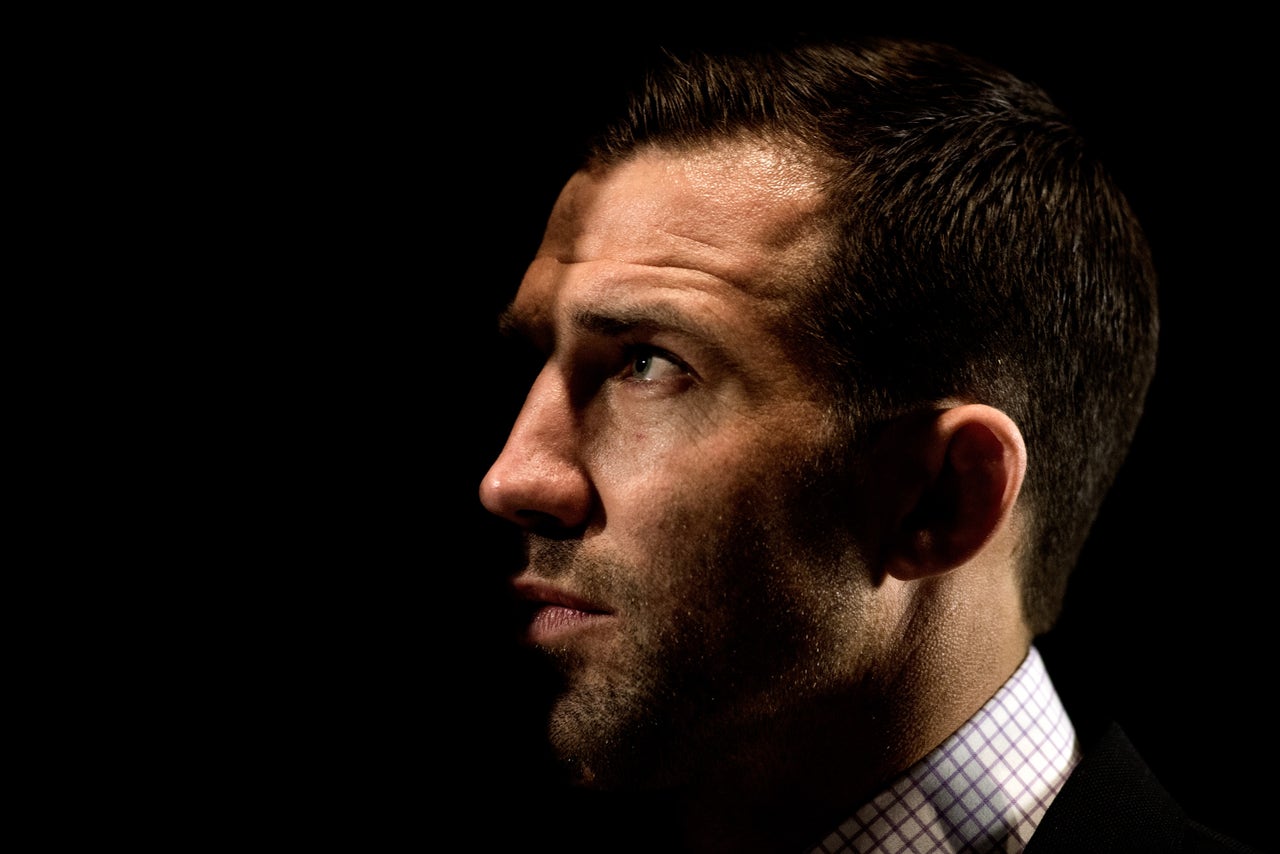
In public, Rockhold acts like an imperious superstar. Behind closed gym doors, he kept his arrogance but added real leadership of his team and unselfishness towards his teammates.
Whenever faced with his biggest challenges in the past, however, Weidman always fought his way out. Rockhold was on a roll and looked like a star, but not many picked him to be able to gut through a grind against Weidman.
The fighter with the movie-star looks was keenly aware of this underestimation and it bothered him. During one phone conversation for a story, Rockhold snapped a bit. "Maybe people overlook me because of the way I talk or the way I look. I don't know," he began.
"But I'm grittier than any of these (expletives)."
So, Rockhold headed into UFC 194 with a chip on his shoulder. He left it with the middleweight world title.
He'd won just like he predicted he would — after a brutal, close-fought battle in which he got stronger as Weidman faded. Once again, Rockhold had proven himself right.
Injured in victory, he allowed himself a week or two of relaxation, reflection and satisfaction.
"I always knew what I could do in there, and believed that I would win the world title," he said. "But when it actually happens, when your dreams all come true, it is the culmination of a life's work. The feeling you get, I don't have words for it. I don't know how to describe it."
But even then he looked toward getting back to work at AKA.
"Winning it is one thing, holding onto it is another," he said.
"I will always be motivated to improve until I feel I've achieved my potential. So far, I'm not even close to doing that. I wasn't anywhere near as good as I can be in that fight. I haven't come close to hitting my potential."

Rockhold with AKA teammate Khabib Nurmagomedov (L) and coach Javier Mendez (R) after winning the UFC middleweight title, in December.
With a lot more to prove, to himself perhaps most of all, Rockhold headed back into training camp this spring. I wrote him and asked if I could come visit his camp and get a glimpse of the work he was doing to make it all happen.
He obliged and I headed to San Jose.
American Kickboxing Academy is no stranger to media requests, evidently. When I walked through their doors last April, I was greeted warmly by a woman behind their desk and she handed me a clipboard with a sign-in sheet specifically for visiting journalists.
The sheet asks who you are, where you were from and who you're there to see. International outlets and some of AKA's biggest names filled the page.
I told her that I was there to see Rockhold. "He's always got an entourage with him," she joked.
I was told Luke wasn't in yet, so I sat in their lounge area, between their first-level workout spaces on my right and their apparel store to my left.
AKA is huge, with two large floors. However, as a former racquetball court, each large training area is walled-off from an adjacent one.
There's a room with a cage wall. Next to it is a large room with heavy bag racks. Next to that one is a larger main one with matted walls and more bags, and large photos of some of AKA's greats. On and on that goes, on both levels.
The entrance walls for every room on the first floor is ground-to-ceiling glass so you can see inside the rooms, even from afar. On the second floor, you can look down and into those rooms.
Before Rockhold walks in, his coach and AKA co-founder Javier Mendez walks in. An older gentleman with a black AKA baseball cap is already inside, talking to the woman behind the desk.
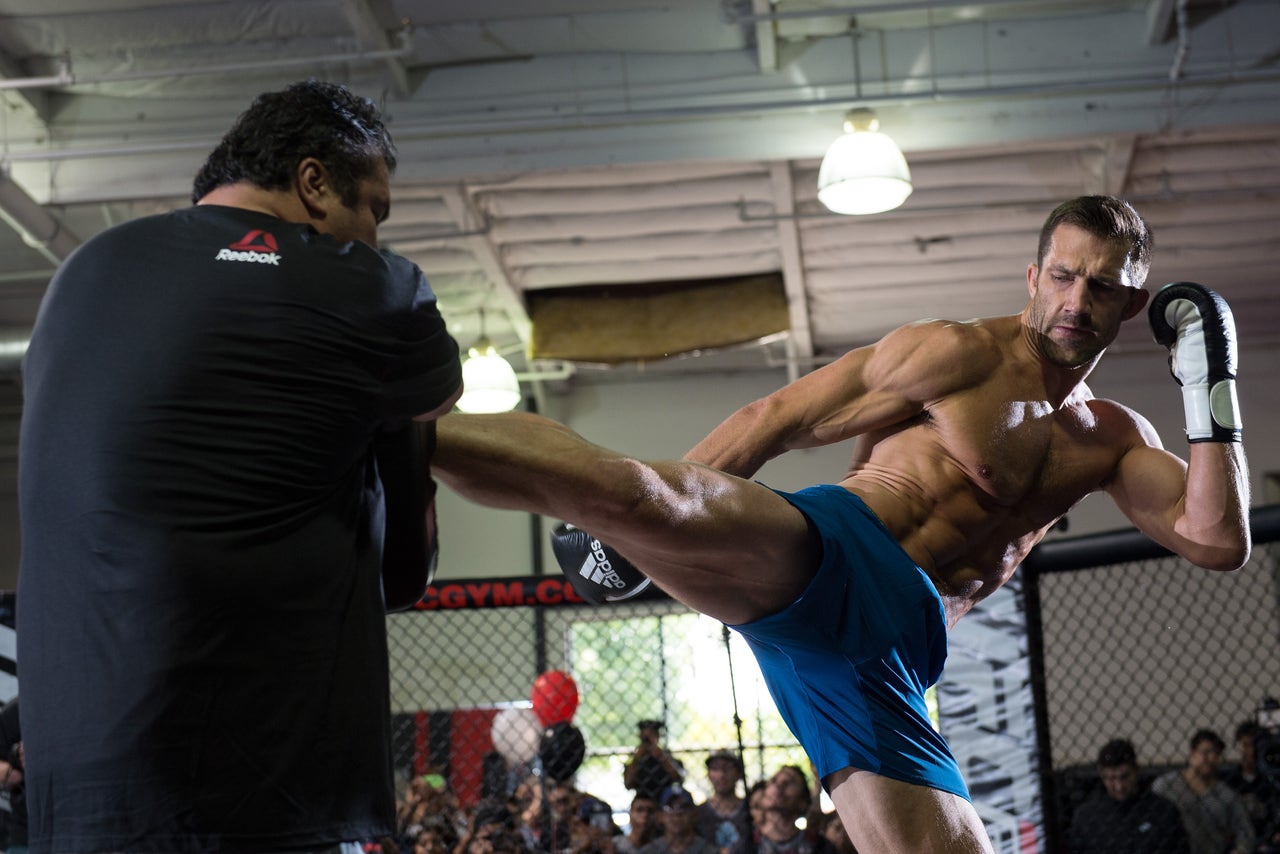
Because of a serious knee injury he says he sustained, Rockhold hasn't been able to grapple and kick in preparation for UFC 199 as he ordinarily might have.
The older man saw Mendez coming toward the gym and used the opportunity to startle him as he walked in. The coach was surprised and they all laughed
"I didn't jump, did I?" Mendez asked, chuckling.
"You were a little scared," the woman behind the desk replied.
The trio continued to chat about team matters and upcoming fights before Mendez moved on to the inside of the gym. After a few minutes, Rockhold walked through the doors, carrying a duffel bag.
AKA's pro team practice was set to start in a few minutes.
We shook hands and I followed him into the locker room. A fly on the wall can observe a lot, but being in the mix allows some depth to experience, so I asked Rockhold if I could gear up and train with him and the team.
He was bit surprised but said, "Sure, as long as Javier is cool with it." We walked into the largest first-floor training room, the one with the large portraits of AKA greats.
Mendez sat on the matted floor, with his back against a matted wall. I introduced myself and asked him if I could work in.
He shrugged and nodded his head. "Yeah, you can train." Then, he set a joking trap for me, based on an apparent inside joke.
"You can go with Luke. He's real good with new people," he said, with a straight face before Cain Velasquez scoffed, while wrapping his hands.
"Yeah, right!" the former two-time heavyweight champion said.
"What? I'm nice," Rockhold said.
No one around him bought it, apparently.
*****
The room filled with AKA men and women, wrapping their hands and putting on head gear and shin pads.
Rockhold also wore a black knee brace to go along with his white t-shirt. Later, he'd reveal that he'd torn an MCL.
Given just how much injuries went on to affect who he'd ultimately face at UFC 199, it was worth noting that Rockhold said he went through his entire camp pretty seriously injured.
Longtime top-five lightweight Josh Thomson was there, so was wrestling prodigy Aaron Pico, in addition to Velasquez and Rockhold.
Light heavyweight champion Daniel Cormier was in New York for a press conference to promote his rematch with Jon Jones, so Rockhold was the only current champ in the room.
He was in the thick of his preparation for his first title defense and I was eager to see how practice is customized to meet his needs. Instead, Mendez asked Luke what he had planned for the practice.
Rockhold relayed the plan, Mendez nodded, gave some notes and then watched as the fighter began practice. I figured perhaps Rockhold was just going to take the lead during warm-ups.
Shadow boxing served as the thorough warm-up. Rockhold called time on five rounds of movement and strikes for the entire team.
Mendez watched but soon left the room. Rockhold kept the lead.
We moved on to sparring rounds. Luke told everyone to partner up and then five-minute round after five-minute round ensued.
Luke mostly stayed with his one partner, a young welterweight pro from Portugal. It's worth noting that Rockhold sparred pretty much the same way he fights.
He fought long, baited his partner in with low hands, effectively taunted him with posture and sometimes words, before stinging with strikes. "You keep doing that and I'm going to get you with the left kick," he warned and coached his partner.
Called out publicly, Rockhold's teammate tried to play it off and laughed off the idea. Moments later, he was on the floor.
He'd kept doing what Rockhold warned him against, and so Luke hit him with the left kick. Hard.
The kick was more precise and controlled than crippling, and his opponent's wind was just momentarily knocked out of him. After a bit, he was back up and sparring again.
Nearby, Velasquez sparred a bit, but then focused on teaching and drilling with a young heavyweight teammate. The two best fighters in the room weren't being catered to, I realized.

Fighters walk into the cage or ring, alone, though they depend on teammates in many ways, prior.
Instead, Rockhold and Velasquez were catering to those around them. Afterwards, while eating lunch with AKA husband and wife team members Isaiah Gonzalez and Melissa Wang, I was told that was pretty typical.
"Those guys, Cain, DC, Luke, they push everyone," Isaiah said.
"They take this serious, and if they see someone's effort not being where it should be, they'll call them out on it. Like, 'Let's go, pick it up!'"
*****
That's exactly what I saw during practice. Rockhold moved the team on from sparring to bag work, coaching and shouting out instructions while he himself trained.
Afterwards, it was time for grappling with MMA gloves on and light strikes thrown at one another. Rockhold watched with a coach's eye and shouted instructions and admonishment from nearby.
He didn't partake in the grappling rounds. Evidently, Rockhold abstaining from grappling was a near-constant during the rest of his training camp.
He later said he did virtually no grappling, and very little kicking, during his camp due to the knee injury he described. More than training through an injury and planning to fight through it, however, Rockhold also advertised it.
About six weeks before UFC 199, Rockhold posted that he'd torn his MCL, along with a video of him training. Two days before the event, during the UFC 199 pre-press conference, Rockhold repeated his injury revelation.
Not many people noticed his original Instagram post about it, but the world sure took notice after the press conference, commenting on social media and even moving the betting lines vs. Bisping. In fighting, fighters usually go to great lengths to keep injuries secret.

Rockhold exhales after defeating Chris Weidman (R) in their middleweight championship bout at UFC 194.
Making one of his public was an interesting choice, to say the least. Perhaps being the confidence player that he is, Rockhold needed to do something so audacious to tell himself that he would win despite his injury.
Great competitors often corner themselves psychologically, forcing greatness out of themselves in order to fight out. They create additional storylines, grudges and challenges in their minds for extra motivation.
I can't say what was going through Rockhold's mind. As someone who has had repeated knee ligament injuries, however, I can tell you that it takes something to train and fight through one.
You have to convince yourself of something, that it is worth it, that victory is still possible, that you're good enough to overcome it. Rockhold certainly believed he was great enough to overcome it, all camp long.
He sparred more rounds than any other person in the room before sitting out grappling. After two hours had passed, Rockhold stopped the clock.
Mendez was back in the room and gathered the group around him. The necessary work and necessary words had already been largely done and said, however, and Mendez didn't feel the need to put his fingerprints on things, for the sake of it.
After all, his influence was already felt, whether or not he was in the room the whole time. He trained Velasquez, Thomson, Rockhold and all of the other main AKA pillars.
They learned to fight under him, and they learned to lead. Now, even as they did their own training, they were able to lead those around them.
Mendez asked if anyone had anything to add, then concluded practice.
After showering, and before leaving AKA, Rockhold told me that he'd be back in a few hours for conditioning work. "We're going to do bikes," he told me.

Rockhold and his coach Javier Mendez (L) have worked together for years.
"It's what makes us who we are."
Indeed, AKA fighter conditioning is legendary, and it was always rumored that some stationary bike-based training was the key to that cardiovascular and muscle-endurance success. I didn't know if I'd have it in me to take part (I wouldn't), but I certainly wanted to see that secret training.
As it turned out, the secret to the training was simply doing it, at a high pace. Rockhold met with two young fighters in a smaller room on the second floor of AKA, just hours after team practice.
There were Airdyne stationary bikes, a rope ladder on the ground, a trampoline, a rope-pull machine, heavy bags and matted pillars, walls and floors all used for stations in a brutal circuit workout. Before the conditioning session began, Mendez was once again there, to chat, debrief and oversee things.
Through his banter with Rockhold, it was clear that the fighter didn't get his confidence from being praised and coddled by his coach. The Luke Rockhold who busts chops during interviews and press conferences with opponents, making outlandish statements and predictions, is pretty much the same one you get in the training room, in some ways.
While Rockhold set up the room and warmed up, he and Mendez talked, and the topics included the weight class above his -- "Light heavyweights are slow. I'd love to fight at 205 but that's DC's division. If Jon Jones couldn't take me down, he'd be in trouble." -- and world-class professional kickboxers that he'd trained with, recently.
Rockhold insisted that he did well against them, even a huge heavyweight, in straight kickboxing sparring. Mendez wasn't buying it.
"Were you going hard?" he asked with a chuckle.
"I didn't see it. I didn't see it happen."
Mendez the coach isn't there to stroke his star fighters' egos. Building themselves up was something they could do on their own, through hard work and seeing their success.

Rockhold hits a ground bag during a conditioning session while his teammate works a hanging bag.
Still, Mendez could only shrug as Rockhold continued to make claims of how different sparring rounds had gone and what he'd do to future possible opponents. "I can't tell Luke he can't do something, anymore," he said, with a slight smile.
"Every time I tell Luke he can't do something, he goes out there and does it."
Good coaches know what different fighters respond to. Clearly, Mendez has learned that Rockhold feeds off of being doubted, challenged and counted out.
The chips on Rockhold's shoulders are as well-earned as his accomplishments. The former has probably helped feed the latter.
*****
Soon, Mendez cleared out and Rockhold once again took the lead. They sprinted on bikes for some time, then switched to different stations.
There were clinch stations, heavy bag stations, periods of fighting off the wall, and footwork drills. There was a touch and sprawl drill, shadow boxing, a ground bag and several other stations.
The only rest each man got was while shuffling from one station to the next. The pace each fighter pushed was impressive, and they seemed exhausted after each round, yet somehow pushed on even harder in the next one.
Still, Rockhold wasn't satisfied. He shouted out when he felt one of his teammates slowing down in some outwardly imperceptible way.
"Let's go, push it!"
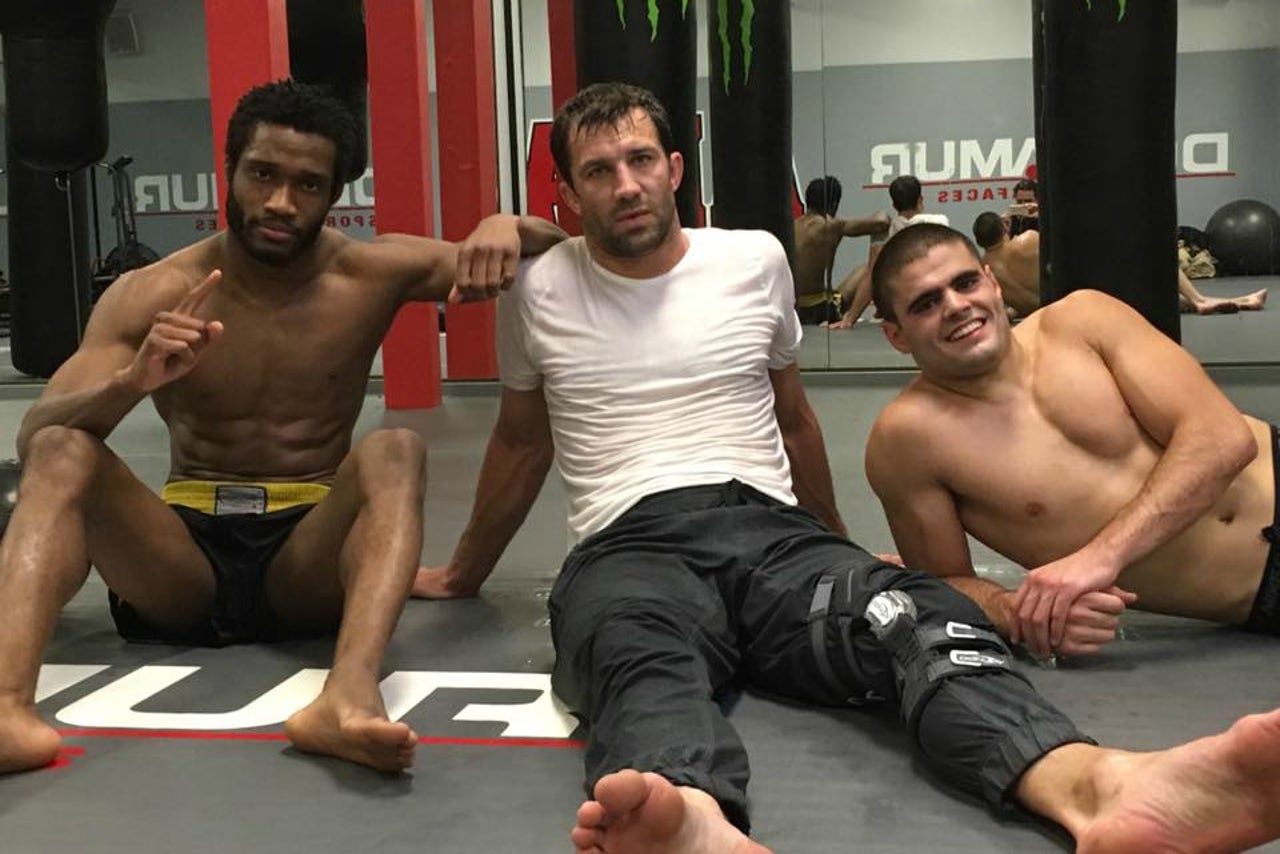
Rockhold isn't just a star at AKA, he's also a leader and coach.
Just like he had, earlier in the day during team practice and sparring, Rockhold led by example but kept a finger on the progress and effort put forth by his teammates. Rockhold was just as much a coach that day as he was a fighter preparing to defend a world title.
Then, after over 30 minutes of non-stop work, they circled-up and sat on the ground. "That's the hardest half-hour of your life," Rockhold exhaled.
"Cardio is king. This is how you make sure you don't wear out in the fight."
Then, there was 10 more minutes of ab work to do. They rotated from exercise to exercise, dripping with sweat.
Faces grimaced through the work, but not Rockhold's. He sang along to the rap music he had synced up on the room's speakers.
And, he prodded his teammates on. Even ab conditioning time wasn't exempt from Rockhold's coaching.
"This is where you make your gains," he told them, and one teammate in particular — the same one he'd dropped with a shot earlier in sparring.
"It gets easier the next time."
As Mendez made an effort to not act impressed with Rockhold, Luke himself didn't let on that he was the least bit satisfied in any way with his teammates at that point, while coaching them during conditioning. When he felt one slowing his pace to grab a nanosecond of rest Rockhold let it rip.
"If you want to stretch, you do it after," he said.

Rockhold often acts aloof in public, but his success is based on a close and heart-felt relationship with his AKA teammates.
"To be stronger, you finish everything you start. You can't take a break."
Finally, they were done. Soon, I'd be on my way to Stockton.
*****
As I drove from San Jose to Nick and Nate Diaz country the next day, I couldn't help but remember Rockhold's matter of fact taunts of Chris Weidman.
"You've dedicated your life to a family," Luke had said, explaining why Weidman would never be able to beat him.
"You can't push as hard. You can't do what I do."
No one can really do what Luke Rockhold does, it is true. And, so far, no one can push as hard as he does.
Whether or not Weidman or Bisping will ever beat him isn't yet known. But in just a short amount of time I'd realized Rockhold was at least partially wrong with his assessment.
Sure, Luke isn't married with kids pulling him to different play dates and doctor's appointments. Yes, he gets to focus his life on MMA, and maybe more so than opponents/dads like Weidman and Bisping.
Watching Rockhold take the lead during practices at the gym he's been at his entire career, I saw him also take responsibility for his teammates' development. Out in the world, at media events, Rockhold may walk around with the dark shades, and imperious saunter of a star, but at home, in the gym, he leads with hard work and lots of time devoted to others.
It is hard to underscore enough how difficult it can be for a top athlete to balance teaching with their own training. Imagine an MLB All-Star pitcher taking time each week to share tips and techniques with the Triple-A squad.
It doesn't happen. The phenomenon seems to be relegated — among major sports — to combat sports like boxing, MMA, and wrestling.
Even in the combat sports world, it's rare. Star MMA fighters with gyms named after them usually leave the real coaching and teaching to others, simply popping in to be seen or making use of the facilities for the most part.
I had wanted to see how a gym like AKA would revolve around a champion like Rockhold, but it doesn't seem to do that at all. If bred stars like him and Velasquez are the center of attention at AKA, it is well-hidden, and they at least make sure a big part of their role is giving attention back to their teammates.
Maybe Rockhold is right that he devotes more of himself to MMA than his opponents. But he's wrong in suggesting that he is completely without serious responsibilities to others.
Luke Rockhold has a family, and it is the American Kickboxing Academy. It isn't a normal family, and it doesn't require the 24/7 concern children or spouses, but it's a family that gets plenty of attention from the middleweight champ nonetheless.