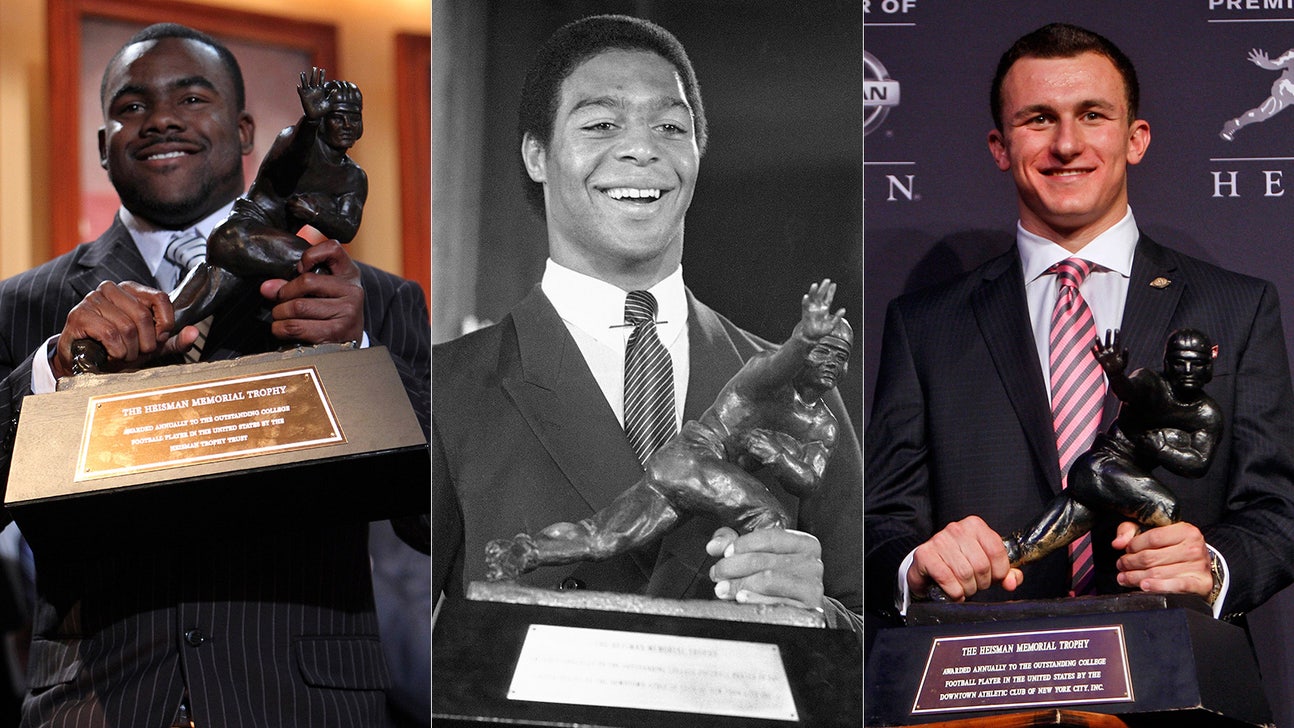


That we're once again concerning ourselves with the margin of victory and not the outcome as Oregon's Marcus Mariota nears a spot in the Heisman Trophy fraternity shows how subdued the hype is surrounding this year's ceremony.
Say what you want about the state of the Heisman, but it always has and always will stir up images of immortals and remain an American icon, linking the likes of Doc Blanchard, Doak Walker, Roger Staubach, Archie Griffin, Bo Jackson and Tim Tebow.
Over the past 79 years, we've seen this award deliver serious drama and results that are still being debated. From the closest margin of victory ever to historic and confounding wins, these are the 10 greatest races in Heisman history:
Stanford's Toby Gerhart led the nation in rushing that season, but Mark Ingram was the best player on the best team in powering Alabama to a 13-0 regular season. Ingram would receive just five more first-place votes (227) than Gerhart, while Texas' Colt McCoy was No. 1 on 203 ballots, and won by a mere 28 points, which stands as the closest finish in history. Of note, this was, at the time, the lowest finish for any winner to be invited to the ceremony as Florida's Tim Tebow came in fifth; it also started an incredible run for the Cardinal as Andrew Luck then came in second in 2010 (and '11), making Stanford the first program to have back-to-back runner-ups.
Given the cultural icon Bo Jackson would become, his 1985 race with Chuck Long seems in hindsight to have gone the right way, but at the time the debate was so heated that it landed on the cover of 'Sports Illustrated,' though it was actually a vehicle to change voters' mindsets, as the main article threw its weight behind Plymouth State's record-setting running back Joe Dudek. But the trophy went to Jackson, who won by the second closest margin ever at 45 points. For what it's worth, SI's piece succeeded in helping Dudek to ninth with 12 first-place votes and 56 points, a figure that had the potential to have swayed the vote in Long's favor or made this a bigger win for Jackson.
After a run of out-of-nowhere winners, Mariota will become the latest preseason favorite to claim the award since 2004 when USC's Matt Leinart pulled it off. The vote wasn't especially close, with Leinart winning by 328 points, but it was more about the class of players he beat out. Oklahoma's Adrian Peterson challenged to end the freshman hex by running for 1,843 yards at the time of voting. You also had the defending winner, Sooners QB Jason White (third) and the following year's recipient, Trojans RB Reggie Bush (fifth).
In 1961, Freedom Riders rode interstate buses into the South to challenge segregation, a push that is credited with sparking the Civil Rights Movement. Meanwhile that same year, Ernie Davis provided a breakthrough of his own in becoming the first black winner. At the time it was the closest vote ever, as 53 points separated him and Ohio State's Bob Ferguson (who was also black), but the greatness of this race was not in the margin, but what the proceedings represented. Davis' story would ultimately become the basis for the 2008 movie 'The Express.'
Herschel Walker should have won in 1980 when the then-freshman ran for 1,616 yards en route to Georgia winning the national title. But he finished second to George Rogers that year and despite even better numbers as a sophomore (1,891 yards), was second yet again. Walker's numbers were still great in '82 as he had 1,752 yards on 335 carries, but it ultimately feels like a lifetime achievement award. Going into the ceremony, the Associated Press preview quoted Fran Tarkenton calling Walker the "greatest college back who ever lived," while Arizona State coach Darryl Rogers said of Stanford's John Elway, he's "the greatest quarterback in the history of college football." Mix in Eric Dickerson, Dan Marino and future winner Mike Rozier and it was an impressive field. Walker came in 695 points ahead of Elway.
That quote came via the late, great Larry Munson and it was in regards to Walker, but Johnny Manziel turned heads too as he broke through for first-year players in '12. It boiled down to a strange decision for voters, a rookie against a defensive player in Notre Dame's Manti Te'o (no strict defender has ever won either) and to be technical about it, no true freshman has ever won as Manziel was a redshirt. But the Texas A&M quarterback still did what Herschel and Peterson -- both finalists as freshman --couldn't. He was simply that good, throwing for 3,419 yards and 24 TDs and running for another 1,181 yards and 19 more scores as the Johnny Football legend was born. It's worth nothing, Manziel's victory knocks out Tim Tebow's winning season of 2007 in which he became the Heisman's first underclassman recipient.
As previously stated, no strictly defensive player has ever won the Heisman. Charles Woodson gets credit as being the first defender though as he was primarily a cornerback, but he also returned punts and was included in a handful of plays on offense. That being said it was still groundbreaking and seemed unthinkable before that season with Peyton Manning returning for one last year at Tennessee. But Manning was a victim of heightened expectations, an inability to beat Florida, and as some alleged, a little nudge via ESPN. Regardless, the Manning vs. Woodson debate hasn't died down all these years later, especially with both of them putting the finishing touches on Hall of Fame pro careers.
Since Dec. 2, 1975, everyone has been chasing Archie Griffin, as he became the one and only two-time Heisman winner. His numbers during his second trophy run weren't as strong as they were in '74 -- Griffin ran for 1,450 yards and just four TDs, which was 245 yards and eight TDs fewer than the year before. But he still managed to finish 1,070 points ahead of Cal's Chuck Muncie, (who had 10 more yards and five more scores than Griffin), and 1,092 better than USC's Ricky Bell, who flirted with the college game's 2,000-yard season at 1,957. But the Buckeyes great had the unprecedented on his side as he pushed his NCAA record streak of 100-yard games to 31 (which was snapped in his last game before votes were due). Given the scrutiny Heisman winners are under when they return to school it seems unfathomable to repeat with worse stats, but with each year and each failed repeat bid (take a bow, Jameis Winston), Griffin's legend grows.
Billy Sims was the first Heisman winner post-Griffin to try and win trophy No. 2 and he would come the closest, finishing second to Charles White in 1979. But if anyone in the modern era was going to be able to claim a second Heisman it was going to be Florida's Tim Tebow, especially since being the first sophomore to win he had two more chances to equal Griffin. The '07 winner didn't come through, but his junior season at least showed the majority of voters were willing to make him the second two-time winner as he had more first-place votes (309) than that year's recipient, Sam Bradford (300). The Oklahoma QB won by 122 points over Texas' Colt McCoy, with Tebow 151 behind. All three returned in '09, making it the first time in history the top-three vote-getters all came back to school.
College football never had a 2,000-yard rusher until USC's Marcus Allen racked up 2,342 to go along with 23 touchdowns and led the Trojans with 34 receptions. That place in history should have been the table-setter for a landslide win, and while Allen did claim the trophy and won five of the six regions in racking up 441 of the 738 first-place votes, he won by just 598 points as Herschel Walker put together a more dominant season than his freshman one in running for 1,891 yards and 18 scores. Add in BYU's Jim McMahon -- who was fifth the year before and wound up third, Pitt's Dan Marino (fourth) and Ohio State's Art Schlichter (fifth), and it's one of the deepest core of contenders of all time, headlined by one of the greatest individual seasons.
Follow Cory McCartney on Twitter @coryjmccartney