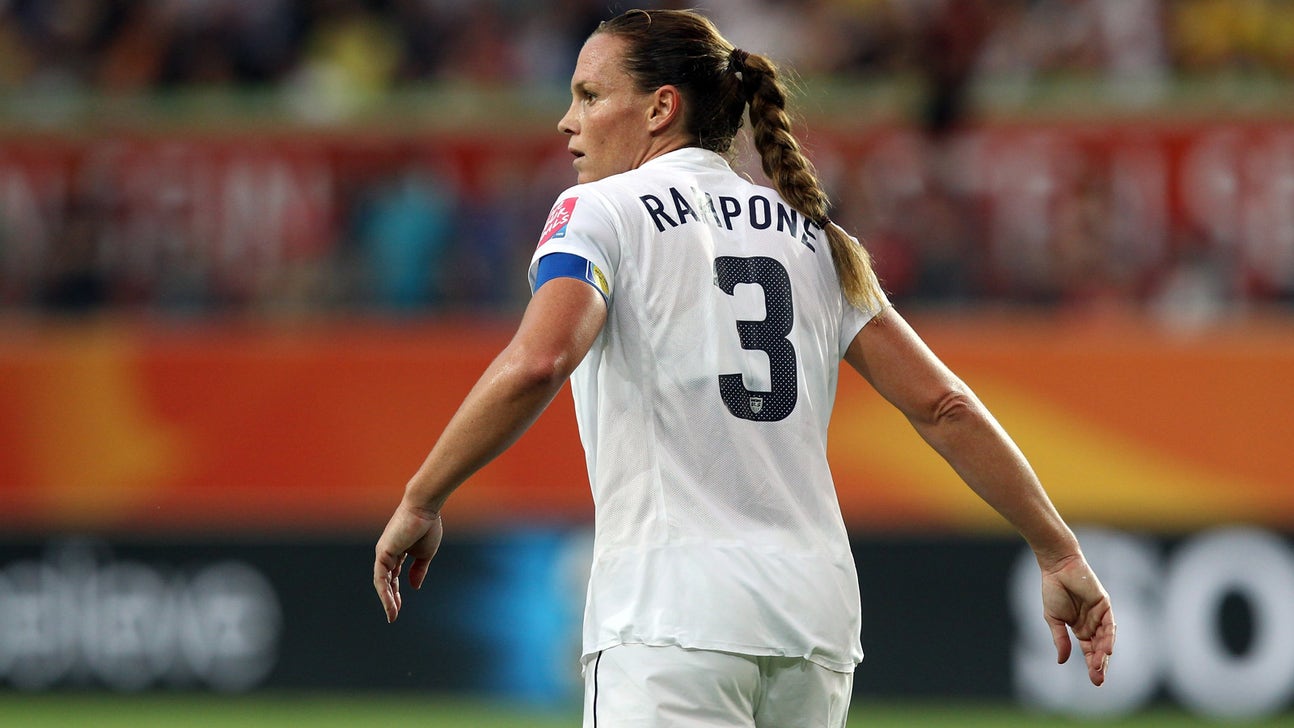


Every time Christie Rampone shakes a hand, signs a ball, t-shirt, scarf or jersey and gets up to pose with one little girl, flashing a toothpaste commercial-grade smile, another shuffles up to her. And then another and another. It never seems to end.
The line snakes around the field. More than a hundred yards of little girls and their families wait for a meet and greet after a Sky Blue FC game at Rutgers University. For a professional women's soccer player, this is a part of the job, ensuring a future that is never a given. Rampone has been doing this for over fifteen years now. The girls continue to come - but they stay the same age while Rampone slowly gets older.
An end is in sight for Rampone. After a fifth Women's World Cup next summer, during which she will turn 40 and most probably record her 300th appearance for the United States, the central defender will finally call time on her career. Barring a change of heart, the final active member of the last American world champions - she played 17 minutes at the 1999 Women's World Cup - will finally retire from the international game next summer, with the second-most international appearances of anybody ever.
"The World Cup is my goal - and then [from] international soccer I'll probably retire," Rampone says after a practice session a few days later, as a clump of girls a few feet away wait for a signature and a picture. It won't mean the end of her career, necessarily. She might stay on with Sky Blue: "Everything has to add up. I have other things in my life just besides soccer that will have to come together."
Rampone's longevity beggars belief, bookending a run that started as a four-sport star in high school. Rampone was All-State in three and considered the most accomplished high school athlete in New Jersey's history. She picked Monmouth University out of many, taking a basketball scholarship, and walked onto the soccer and lacrosse teams - even though she didn't play the latter in high school. During her senior basketball season, she got her first call-up to the national soccer team. She wasn't sure what that meant. Soccer was her second sport, if that.
"It was a chance I knew I couldn't give up, even though I didn't really know what the chance was at the time because I didn't grow up in the soccer world," Rampone recalls. "It was unknown. I didn't know what a call-up was."
Rampone had enjoyed a college soccer career as a forward -- she scored 79 goals and recorded 54 assists in 80 games -- but she was moved to fullback mid-way through her first camp because that's where there were jobs up for grabs. She made her debut in February of 1997 and has been there since. Despite her 5-foot-6 frame, she moved to central defense and became captain in 2008, ahead of her second of three Olympic gold medal campaigns. The next year, she was named the third head coach in a tumultuous Sky Blue season. She led them to the Women's Professional Soccer title, while three months pregnant with her second child.
There are four factors that typically end a career. A body breaks down; a player loses a step; she loses interest; or she loses her job. None of these grim reapers ever caught up to Rampone. And there is hardly any explaining it.
Long-time national team right back Ali Krieger gives it a shot: "She's Superwoman? I don't really know."
Kelley O'Hara, the left back, takes a stab, too: "She's kind of like a freak of nature, in a good way."
Rampone's Sky Blue head coach Jim Gabarra has his own working theory. "She's got magic beans or something," he says with a shrug.
But time is catching up with Rampone. She cuts a thick bundle of tape off her ankles after every game this season as she is playing through sesomioditis in her left foot - a floating bone is fractured - and arthritis in both feet. She returned to the field this season just 10 days after suffering a concussion. And she has Lyme disease, which she'd had for years but wasn't diagnosed with until 2010, when she was 13 years into her professional career.
Regardless, she plays on. She's always played on. "My adrenaline is my medicine," she says. But that doesn't clarify how she's been able to keep going so much longer than others. Mia Hamm quit at 32. At 34, Abby Wambach is counting down to her own retirement. Yet it feels revelatory for Rampone, at 40, to announce that her own end is in sight. It felt like it might never happen, like a wily old head of state finally croaking.
Even Rampone herself can't give a definite answer. "I don't know, just..." she begins before trailing off. "I don't know. I think I've always loved the fact that the game is challenging to me."
But simply cherishing the challenge isn't a thesis that stands up to scrutiny either. All elite athletes like to challenge themselves, that's how they got to be elite. When they retire, it isn't their competitiveness that has eroded but their abilities.
As best as anyone can tell, Rampone never stopped going because nature or circumstance never told her to. And it didn't occur to her to quit of her own volition. "Why not?" she says at length. "If I'm able and capable, why not? I'm waiting for the aches or pains that are going to tell me, but why can't I control when I'm done? Not many people get to do that."
Rampone's career may be something of an aberration but it isn't coincidental. She still conditions herself compulsively, does extra work beyond team conditioning, and retains her explosiveness with quick bursts of effort that combine weight lifting and cardio work. That way she saves time to spend with her family.
"Your body is not a machine, but I think hers is a machine," says the chatty Crystal Dunn, a 22-year-old newcomer to the American back line. "She's one of the fastest players still on the team. She kills it in the gym. Sometimes it's scary and I'm like, 'I'm not going over there with her.'"
Slowly, the rest of the women's game has worked out what Rampone knew years ago. "The game is faster and quicker," she says. "Females are understanding how to get fitter and how to battle more. They're hitting the weight room, they're hitting the field. The game advances."
When Rampone does go out, on her own terms, it will be because cumulatively, the rest of her obligations have grown too unwieldy to coexist with her playing career. "It's the way life is heading," she says. "My kids are getting older, they're 8 and 4. International soccer is a lot more travel, a lot more commitment than it used to be. This year is going to be a tough year being away a lot. But the end goal is winning another World Cup.
"I've put what I can into the game, now I want to put the rest into the kids," adds Rampone. "It's who I've been since I've been a young child, onto the next and onto the next - enjoying the craziness and the pressure. And will I love it when it quiets down in retirement? Yes, I am looking forward to that."
But for now, Rampone will simply do what she has always done: play on.





 Your Privacy Choices | Closed Captioning


