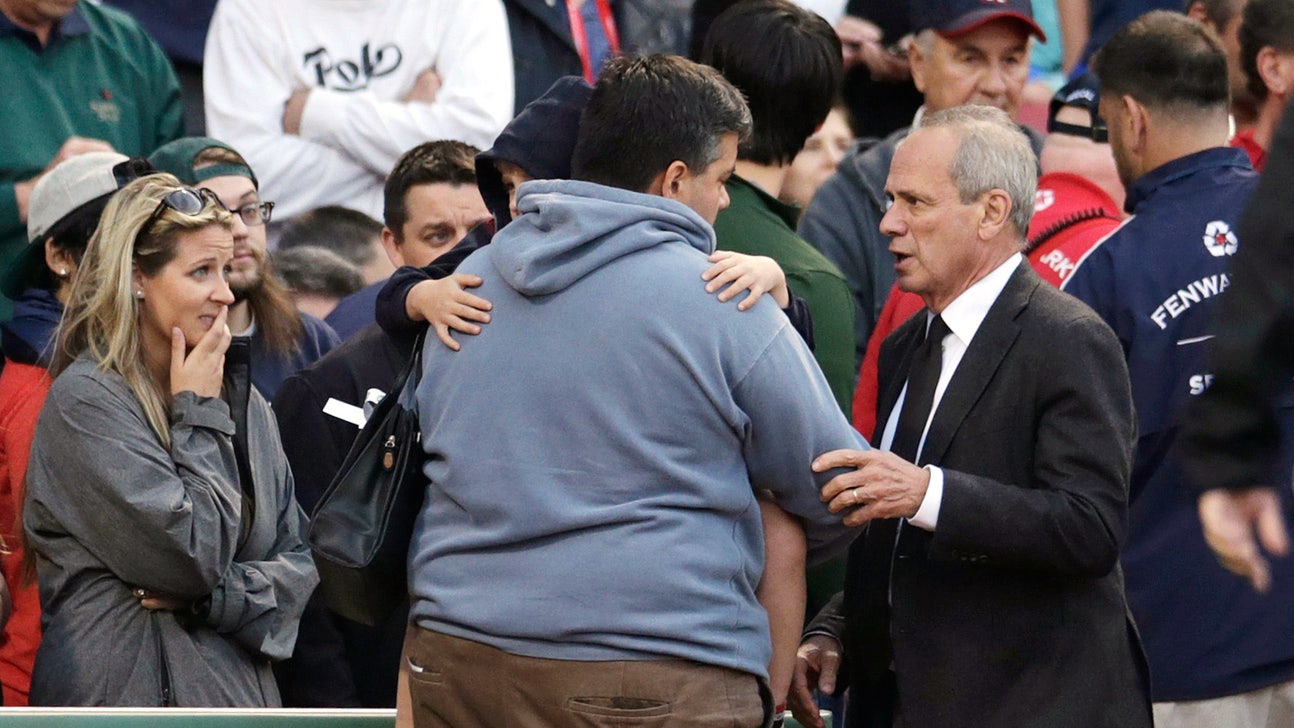
Fenway Park accident: Where should we draw the line on making baseball safer for fans?


What happened Friday night in Fenway Park is horrible, and -- if you're of a particular mindset, or can afford some of the best seats in the house -- perhaps even frightening. I want to be really clear about this: It was horrifying, and not merely because a ballpark should be a place full of cheering and cotton candy and yes, maybe the occasional gameplay-related tears. It should not be a place for real, physical pain. Not if we can reasonably help it (and we can, usually).
Hell, I've always been a purist about this. I've been militating for years against violence on the field, and I don't even think they should play baseball when it's raining or the temperature's under 45 or 50 degrees.
With that in mind, I was intrigued by Jeff Passan's reaction Friday night:
Hoping that the lede on this story I wrote seven years ago does not come true with that horrific accident in Boston: http://t.co/Imw9tRJvao
— Jeff Passan (@JeffPassan) June 6, 2015
If you click through, you'll find a column that Passan wrote back in the spring of 2008. Here is Passan's aforementioned lede:
Someone's going to die at a baseball stadium soon.
Helluva grabber, wasn't it? Jeff's a helluva writer. His next book's probably going to be the most important baseball book of the year (next year, I hope).
But I'm not sure if seven-plus years later counts as soon, exactly. I suppose that depends completely on your definition. To an eight-year-old, seven years seems like a hell of a long time. To a geologist, seven years is nothing at all.
Passan's follow-up tweet:
I haven't made a great habit of making excuses for Major League Baseball over the years. Just to name one example, I've ripped the league for its pointless, cover-your-ass security theater that's now made attending a game even more inconvenient than before.
I'm not going to make an excuse here. But seven years ago, Passan's primary complaint was about the maple bats. And as he says, steps have been made. No, not an outright ban (as he advocated). But the rules have changed, and bats are shattered 50 percent less often now than in 2009. If you believe MLB, anyway.
So, there's that. For which the owners and the players deserve some credit.
Netting, of course, is completely up to the owners. I have seen netting mentioned over the years -- not in Passan's column, but elsewhere -- and I've written about it. Oh, and in case you're wondering, I've been there. In 2000, when I was at Fenway for every Red Sox game, I usually had great seats (for which I paid full price, at least). When I sat in an exposed location, I never forgot just how close to the action I was, and how quickly something terrible might happen, and how important it was that I pay attention. Of course I didn't have a cell phone then, which helped.
I didn't know what the odds were. I did know the odds were in my favor, and I happily accepted the risk that came with those seats.
And frankly, I think the great majority of fans feel the same way, which I suspect is the No. 1 reason why there's not netting all the way beyond the dugouts. If you're spending a hundred bucks on a seat behind the dugout, you don't want a net between you and the field. Or I don't, anyway.
I do know that I wouldn't sit in those seats with my baby daughter. Because yes, it's frightening. But I prefer to have that choice; not to sit there with an infant, but to sit there with myself, and anyone else who's old enough to know what might happen.
There's always been danger from batted balls, and for the last decade or two there's also been more danger from shattered bats, thanks to a combination of thinner handles, more brittle woods (especially maple), and tougher, harder pitching. Of course, all the new ballparks with less foul territory have only increased the hazards.
It's a potent stew of risks, no doubt.
No deaths have occurred in those close seats, the ones that Passan says should be protected by netting, not just in the seven years since Passan wrote, but in the past 37; in fact, nobody's died after being struck by a flying object at a major-league game since 1970. Many, though, have been injured. Some severely. Friday night's victim at Fenway was said to have life-threatening injuries, but is now officially in "serious but stable condition."
In the seven-plus years since Passan predicted a death "soon," approximately FIVE HUNDRED MILLION fans have attended major-league games. Now, most of those HALF A BILLION fans weren't sitting in the expensive seats within hailing distance of shattered bats and screaming foul balls. But there's risk everywhere.
Four years ago in Arlington, a fan fell 20 feet from the outfield stands and later died. Immediately afterward, management said there wasn't a design issue: "The ballpark was built above specs, and we feel good about that," Nolan Ryan said.
Not good enough, apparently. Shortly after the incident, alterations were made to the railing out there. There are undoubtedly still many ways for someone to get hurt at a Rangers game. But at least that particular way isn't quite as likely. So the Rangers can plausibly claim that they've done something. But the only way to keep fans completely safe is to throw a net around every seat in the stadium and below every railing or ramp. Oh, and for good measure the teams could stop selling alcohol, too.
On Twitter, someone asked me, "Are you really against nets down the line?"
Ah, there's that good ol' binary thinking again. You'd think after all this time, I'd have trained my readers better by now. Oh well ...
Hey, I kid my readers because I love them.
No, I'm not against nets down the line. On a personal level, yes, I would rather there weren't nets between me and the game, the next time I'm lucky enough to have those seats. But that's just me. If there are nets, I'll cope. Or get different seats.
What I'm against is making long-term decisions because of short-term emotions. You'll remember that a few years ago, a first-base coach lost his life when he was struck by a batted ball. Shortly thereafter, every base coach in professional baseball was forced to wear a helmet ... even though a helmet probably wouldn't have saved that first-base coach, and in fact there hadn't been any real history of base coaches, through thousands and thousands and thousands of professional games, getting killed or even injured by batted balls.
What happened to Mike Coolbaugh was a freak occurrence. But Baseball responded because people were clamoring for Baseball to do something. So something was done. Even though it might not save a single life, might not even prevent a single concussion.
Risk is inherent in life. I do realize that some risks are worth taking and some aren't -- some risks are worth allowing, and some aren't -- and that reasonable people will disagree about where those lines are drawn. We've decided that the inherent risks of driving 70 miles an hour on the freeway, instead of 55, aren't really worth worrying about. On the other hand, now it's practically illegal to send a couple of eight-year-old kids to the park without adult supervision. On the other hand, it's perfectly legal in many places to carry a semi-automatic in public, regardless of how many eight-year-old kids might be hanging around.
Like I said, we all draw different lines.
But I do wish we could have honest, data-driven discussions about those lines, instead of drawing them according to deeply held passions by whomever shouts the loudest, or whatever might have happened just yesterday, however unfortunate and horrible.
We're irrational animals most of the time, though. So we usually don't.





 Your Privacy Choices | Closed Captioning


