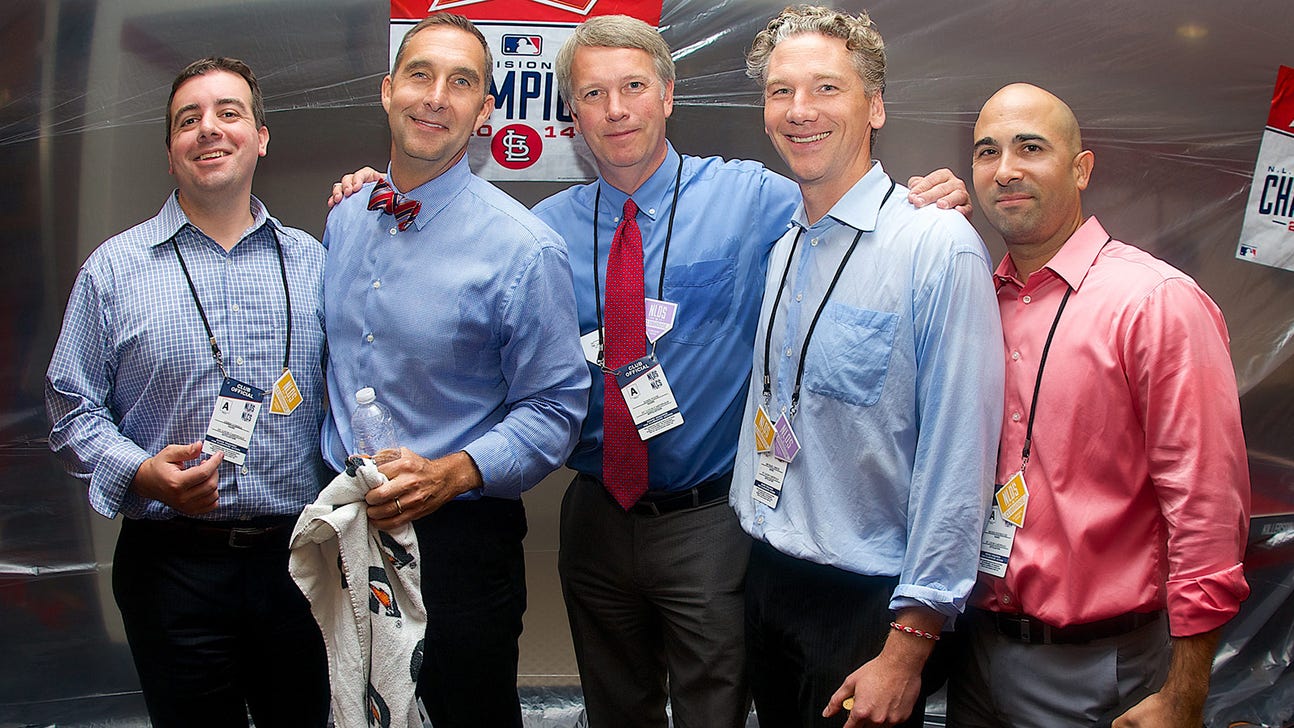
After 30 years with club, Vuch's greatest legacy is support of Cardinal Way


ST. LOUIS -- It's on a summer evening at Busch -- or perhaps in the cool winds of October in St. Louis -- that Cardinals director of baseball administration John Vuch experiences his favorite part of his job: watching a baseball game.
In that moment, he admits, he is helpless -- the club's success lies in the hands of the players and staff scattered across the field and crowding the dugout. But it remains the heart of the organization, and what still moves him after more than 30 years working with the club.
"That's what we're all here for," Vuch says. "Nobody's buying tickets to watch me work in the office or moving things around on the board or anything like that. They're here to watch the players play. We realize that all of our job is geared around what happens out on the field."
Vuch has been a confirmed baseball enthusiast since his dad pulled him out of school in first grade to see the 1968 World Series and, in his own way, has become as much a part of Cardinals history as those players and managers on the field. Vuch's fingerprints -- though he steadfastly denies any personal credit -- are all over the farm system that produced current Cardinals such as first baseman Matt Adams and closer Trevor Rosenthal. And during his climb from lowly runner to one of the top positions in the organization, Vuch has helped preserve a legendary style of baseball that's become known around the sport simply as the Cardinal Way.
1985 was supposed to be his last chance to work in baseball.
Vuch's parents were harping on him to get a real job. He'd just graduated from UMSL, where he'd transferred after a year at the University of Missouri to be closer to the Cardinals organization. Vuch had first worked for the club in 1979, when, as a 16-year-old, he had a chance to become a runner for the organization, which involved performing odds-and-ends duties mostly on game days. When he'd told his high school baseball coach about the opportunity, however, the coach delivered an ultimatum about his playing career.
"You're going to miss games, you can't be on the team," the coach insisted.
So Vuch didn't even bother trying out; he joined the tennis team instead and took the job with the Cardinals. He took tickets to the ticket window -- there were no computerized systems back then -- and ran off the statistics for the press box. Other times, if someone needed to get in touch with a player, they'd call a switchboard, and Vuch would run the message down to the clubhouse.
But by 1985, with a college degree under his belt, Vuch admitted he needed something more long-term and decided if he couldn't get a full-time job with the club by the end of the season, he'd call it quits. But late that summer, a spot opened up in the Cardinals' sales department, and Vuch took it. It wasn't a bad time to join sales -- by the mid to late '80s, the club was reaping the benefits of several successful seasons under manager Whitey Herzog, and tickets basically sold themselves.
"It was a lot less selling and a lot more filling orders back then," Vuch admits. "We had gone from drawing under 2 million fans before Whitey got there in the early '80s, and all the sudden, we're selling 2.5, 3 million tickets."
Still, Vuch hoped to end up on the baseball side of the organization. The director of sales at the time was Joe Cunningham, a former player who had gleaned from conversation how well Vuch knew the technical side of the game. Cunningham was good friends with the farm director, Lee Thomas, and mentioned Vuch's interest.
"I've got a guy in my sales department that would like to get to the baseball side, if possible," Cunningham told Thomas.
It turned out Thomas had someone in his department who was looking to get into sales. The two directors operated a department trade, and Vuch soon found himself typing up contracts and transaction papers. He also employed a technique that became vital later in his career: Listening. At the time, there were several marquee baseball minds -- guys such as George Kissell and Dave Ricketts -- affiliated in some way on the baseball side of the franchise. For the next two or three years, Vuch jokes, he never said more than two words at work -- he was too busy soaking up knowledge. He also heard talk of the Cardinal Way, a philosophy of how the organization has played the game throughout years. He likely had no idea at the time that, over 20 years later, he'd help cement that knowledge for future generations of Cardinals players.
In the meantime, his career progressed. Only six people were in baseball operations when Vuch joined, which gave him plenty of opportunity to gain new skills. Within a few years, he was helping with arbitration cases and negotiating contracts. As his experience grew, so did the department. By 2015, Vuch had passed through so many titles that he can't recall them off the top of his head.
Watch the Cardinals Live pregame and postgame shows before and after every St. Louis Cardinals game on FOX Sports Midwest.
"I'd have to really kind of look through year by year to see what my title was," he admits.
A big shift, meanwhile, came in the late 2000s. From the outside, the Cardinals appeared to restructure their organizational philosophy, placing more emphasis on developing players in their farm system as opposed to acquiring veterans. The old system had worked well for a time -- they'd secured such stars as Jim Edmonds and Mark McGwire that way. The question was how long the Cardinals could sustain that trend in a medium-size market, as players' salaries escalated and the pool of available veteran talent shrunk. With other teams becoming reticent to unload their high-profile players, it became necessary for the Cardinals to develop their own.
Vuch found himself on the cusp of the change. In 2007, he was named director of minor league operations for the Cardinals' system, and in September 2010 he became the farm director, a position he held for two years. In the latter role, he had the final say on all player moves in the minors and also served as a sounding board for call-ups to the majors. While Vuch trusted his own judgment, he'd decided that, for the organization to be truly successful in developing players, he needed to employ the same technique that he'd used when first joining baseball operations -- listening.
"Listening to your managers and coaches -- they're the ones seeing the guys every day. I would go in and see a club for five days or a week, and you might catch a guy having the best week of his career or the worst week of his career," Vuch says. "I think the managers and coaches liked being empowered as well because they felt like they had a voice."
His approach led to several healthy conversations within the organization, and ultimately helped develop the careers of several players now in Cardinals jerseys. In fact, one of the first things Vuch did was fast-track Adams' minor league career after consulting the personnel on the ground.
"Adams had been playing at low A, and the question was who was the better first baseman at Double A," Vuch recalls. "It's unusual to usually have a guy skip right from low A up to Double A, but in talking with our guys, we ended up doing that, and he ended up being player of the year at Double A. Those kind of moves, I think, are something that was really a product of incorporating everybody into the decision-making process."
A similar process played out with outfielder Oscar Taveras and second baseman Kolten Wong. Overall, Vuch's tenure turned out to be a raging success. Not only did the parent club eventually reap the player development rewards, but three Cardinals teams won championships in the minors. When, after the 2012 season, Vuch left his position as farm director to move to his current role as director of baseball administration, even outsiders recognized how far the farm system had come. On April 1, 2010, the season before Vuch took over as farm director, the Cardinals had fallen to 29th in Baseball America's organization talent rankings.
On April 1, 2013, they ranked first.
In the end, however, Vuch's greatest legacy might end up having nothing to do with any one player's name, but his help preserving a way of baseball that's come to define the Cardinals' success through generations of players and managers.
In 2010, when Vuch was named farm director, the first thing he did was have a conversation with then-Cardinals manager Tony La Russa. Vuch realized there'd been a disconnect between how players were being taught to play in the minors and what the big-league club expected of them.
"What can we do to make players, when they get to St. Louis, be more acceptable to you, or fit in better?" Vuch had asked.
The result became a handbook known as the Cardinal Way, which had a predecessor in a thick, typewritten set of pages that had been assembled by Kissell in 1969. Between the 2010 and 2011 seasons, the Cardinals assembled a full handbook approved by the major league staff. That handbook was then disseminated across the club's farm system. It allowed for uniform instruction at all levels of the organization so that, as players moved up the ladder, they had fewer adjustments to make on fundamentals.
"If a player moves from one level to the next, the only thing he has to worry about is the better level of play," Vuch explains.
The handbook doesn't contain any state secrets, Vuch admits, but does get updated from year to year. Still, it serves as a monument to the Cardinals' giants of the past -- and perhaps, in a game where personnel comes and goes, the most lasting connection to everything that has made, and will continue to make, the organization successful through the years.
Because even a baseball game on a summer night will end.
You can follow Elisabeth Meinecke on Twitter at @lismeinecke or email her at ecmeinecke@gmail.com.





 Your Privacy Choices | Closed Captioning


