

Richard Commey, the undefeated, granite-fisted lightweight contender from Ghana, will face Robert Easter Jr. for the IBF 135-pound title this Friday at the Santander Arena in Reading, Pennsylvania (9:00 p.m. ET/PT, Spike TV). For Commey, a win would elevate him into the pantheon of great Ghanaian fighters.
Although boxing limits all combatants to the use of their fists to inflict pain and damage, the sport is so intriguing partly due to the variations in fighting styles that have developed and evolved in diverse locales all over the world. For lightweight contender Richard Commey, embodying the qualities of Ghana’s pugilistic philosophy and advancing his country’s storied fighting lineage are both the source of his strength as a boxer and the root of his motivation to win a world title.
Commey (24-0, 22 KOs) may not be a household name in the United States, having only fought once on American soil in career that has seen him globe-trot in search of opponents and opportunities. But now, as Commey closes in on a title shot after diligently working his way into a mandatory position, North American fans will be given the opportunity to appreciate the powerful Ghanaian.
Richard Commey’s fight against Robert Easter Jr. is the type of co-feature that has “steal the show” potential written all over it. Easter (17-0, 14 KOs) is a rangy, gifted talent who was last seen stopping Argenis Mendez in an explosive performance. Commey’s power may at times overshadow underrated boxing skills, but in speaking with him, it’s his stoic and confident demeanor that truly stands out.
“Come on the 9th of September,” Commey said during a recent conference call. “I’m coming to put my life on the line. And I’m going to be the world champion — IBF lightweight world champion.”
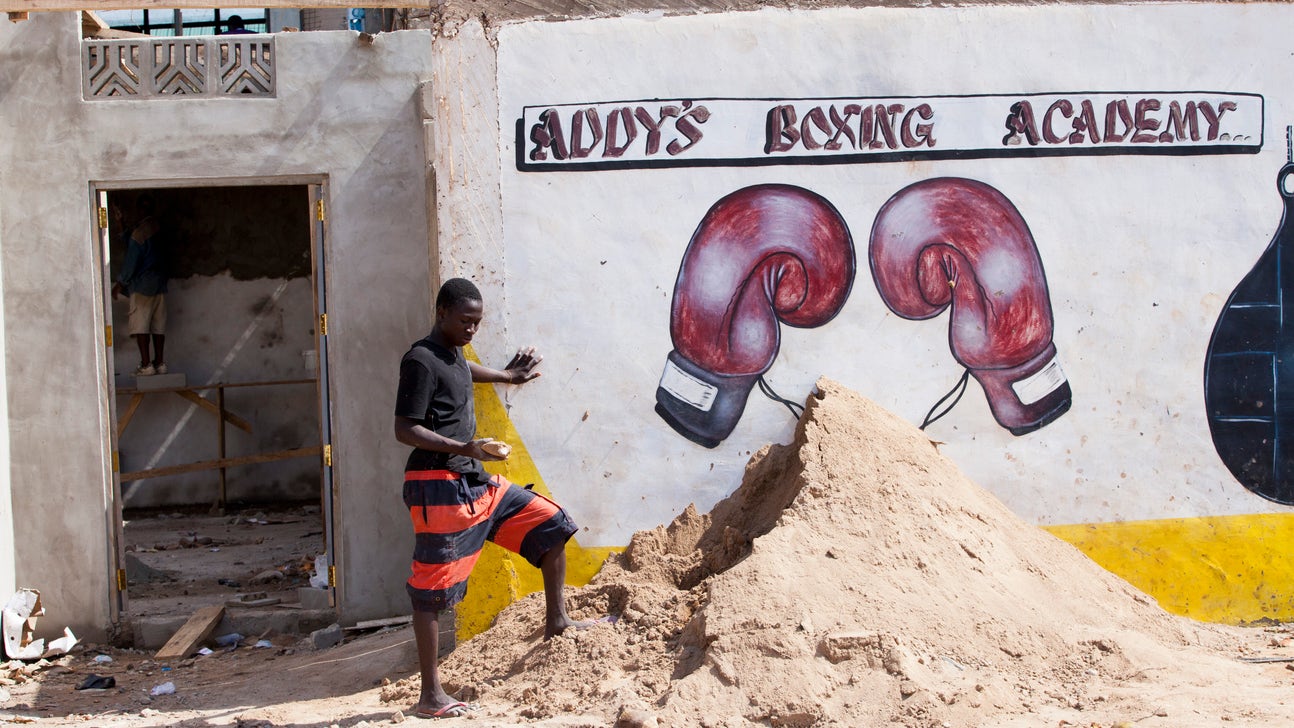
Richard Commey’s directness can be jarring, but one doesn’t doubt his resolve to put his “life on the line.” The willingness to sacrifice that Commey expresses was fostered via a unique upbringing in Ghana’s boxing hotbed of Bukom, a neighborhood in Accra that has produced multiple world champions.
More from The Living Daylights
“They love to fight – they enjoy fighting,” Commey said when speaking of the qualities of Bukom boxers. “So, you know, they have the heart. They grow up having to fight. It’s what you want to do when you come from that place.”
In a piece for Vice’s Fightland Blog, Ed Berry chronicles an evening training session at one of Bukom’s 40 boxing gyms, describing the courtyard setting littered with spartan, makeshift equipment. The training is gruelling; the heat is punishing. And, as Berry notes, “Disagreements among the primarily Ga people of Bukom have historically been settled in pugilistic fashion.”
“It’s [Boxing’s] a big part of our culture, and we just want to fight because fighting is a way of showing respect,” Commey said.
Make no mistake, the ingrained, seemingly primordial reverence of boxing in Bukom (and Ghana in general) has bred a lineage that any emerging Ghanaian fighter must strive to live up to. Consider the impressive list of iconic figures and world champions who have emerged from Bukom to capture professional or Olympic glory: Roy “The Black Flash” Ankrah, David Kotei (aka DK Poison), the incomparable Azumah “The Professor” Nelson, Ike “Bazooka” Quartey and Joshua Clottey.
Ghana, though, has not had a world champion since Joseph Agbeko held the IBF bantamweight title until 2009. This imbues Richard Commey’s fight against Robert Easter Jr. with an added layer of pressure, as Commey is viewed as his country’s best current hope to claim world honors.
To get to this point, Commey had to make the transition from kickboxing to boxing after receiving encouragement from friends, and he only began a brief two-year amateur career in 2009. Somewhat disillusioned with the lack of funding and structure in Ghana’s amateur ranks, Commey turned pro in 2011 due to a sense of stagnation. “It always takes a long time before you have one fight,” Commey said of the amateur system. “You don’t have a lot of shows.”
But since 2011, Richard Commey has made up for lost time. His rise and emergence as one of the world’s most explosive and feared lightweights has fostered hope that he can end Ghana’s world title drought — something he is keenly aware of but refuses to let overwhelm him.
“It means a lot,” Commey said when speaking about continuing the lineage of great Ghanaian fighters. “These people, I look up to them. We’re all from the same community. But we’re all human beings, you know, and I’m training hard, I’m learning a lot from this, and I’m working as hard as I can.”
To prepare for the Easter fight, Commey has enlisted the help of the man considered to be not only the best Ghanaian boxer of all time, but the greatest to ever come out of Africa: two-weight and three-time world champion and Hall of Famer Azumah Nelson.
Nelson first rose to prominence in a classic battle with WBC featherweight champion Salvador Sanchez, a fight that the then-13-bout novice took on short notice. Despite getting stopped in the fifteenth and final round, Nelson’s stock rose dramatically. The loss, in which Nelson showed the character and spirit that would help define his remarkable career, led to dozens of iconic moments and victories, and he remains an example for fighters like Richard Commey to follow.
“He’s a legend,” Commey said. “I mean, he’s the greatest in Africa. To have him there to advise you means a lot. You have respect for him before, but him coming down to advise you, and to see you and to encourage you is good for me.
“He goes into the ring and then he leaves everything in the ring, you know? He doesn’t hold back in anything. And when he’s fighting, he gives all that he can, and that’s exactly what I’ve learned from him, and that’s exactly what I’m going to do come the fight – go into the ring and leave everything in the ring.”
As if the pressure of winning a world title wasn’t enough, Richard Commey is also battling the perceptions of discerning and naturally skeptical boxing fans, much like Nelson was when he challenged Sanchez as a complete unknown in 1982.
Commey understands that making a name for himself Stateside could propel his career to yet unseen heights, but his experience fighting in a multitude of foreign countries mitigates some of the pressure that comes with the need to deliver an explosive performance in front of a major American audience. Commey still recalls his crucial U.S. debut last year, which ultimately resulted in a TKO of Bahodir Mamadjonov. The fight, Commey acknowledges, wasn’t a masterclass, and he battled nerves as he struggled at times to employ his tactics.
“It was very important. It was my first time in the States and I was very nervous,” Commey said. “It was really important to win that fight. In that fight I pushed and showed who I am. That’s why it was so important for my career.”
Richard Commey is aware of the way Ghanaians admire him and the impact he has, and can have, in his community. But for Commey to have the kind of lasting legacy that will garner him a permanent place amongst his country’s best boxers and afford him the chance to give back to his countrymen and women in an even more profound way, he has to win a world title. Anything less would simply fall short of the benchmark past Ghanaian greats have set.
Commey sees the potential to influence both aspiring boxers and non-athletes alike. He talked about how few people are afforded the opportunities he’s been given (and certainly earned), and so he carries with him a sense of capitalizing on each chance he gets. Commey’s respect for Easter is profound, but it’s no different from the way he views any other opponent.
As he boxes in the shadow of Ghana’s history, on foreign soil and against a supremely difficult opponent, Richard Commey manages to combine an unshakable confidence in his abilities with a broader awareness of what he’s hoping to accomplish.
“I’ve wanted to win a world title for a long time now – to be great, to put my name in the history of Ghanaian boxing, and world boxing as well – and then lift the flag of my country up.”
(For some excellent insights into Ghana’s boxing culture, check out “The Boys of Bukom” on Vice Sports. All quotes from Richard Commey were obtained firsthand and via media conference call.)
This article originally appeared on 





 Your Privacy Choices | Closed Captioning


